




Trucking Conditions Index Heads Higher
The Trucking Conditions Index from the freight transportation forecasting firm FTR registered 9.07 for September, according to a just released report.
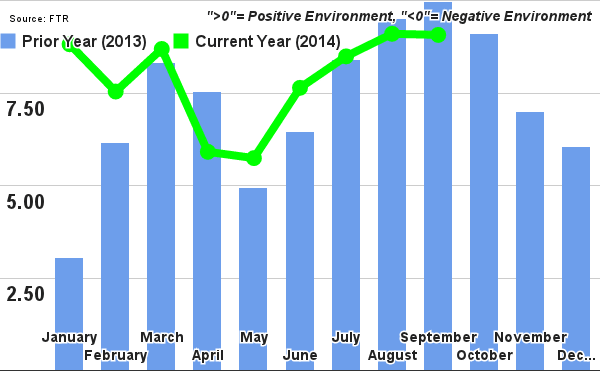
FTR’s Trucking Conditions Index. Graphic: FTR
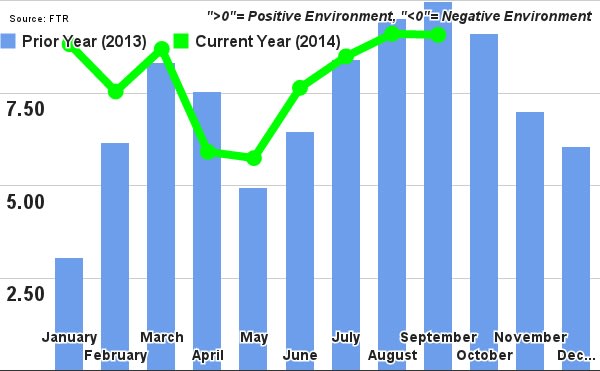
FTR’s Trucking Conditions Index. Graphic: FTR
A measure of business conditions in trucking industry has moved up again reflecting strong underlying market trends.
The Trucking Conditions Index, from the freight transportation forecasting firm FTR, registered 9.07 for September, according to a just released report.
The TCI has moved up in the last couple of months due to increased rate gains and will remain in very positive but stable territory for the foreseeable future, according to FTR.
It expects little change in the TCI unless and until there is a change in the economy or increased regulatory drag on capacity. FTR saod capacity utilization currently stands very close to its all-time record and is at the breakpoint between manageable tightness and crisis.
"Spot market activity and rates have been easing, but this is to be expected at this time of year. Rates are still well above year ago levels and will stay that way until we lap winter conditions in January and February,” said Jonathan Starks, FTR's director of transportation analysis. “The contract market is lagging on rate growth, but we still see a concerted upward shift over the last year.”
He noted the combination of hours-of-service changes in 2013 with weather events in early 2014 was enough to move market conditions in truckers favor.
“Contract negotiations will take place during the winter slow season [and] we will see how much market clout the fleets are able to use,” Starks said. “The real results will come later in the year. Successful shippers will be able to secure capacity and limit cost inflation by working with their carrier base rather than focusing on negotiating strength."
More Fleet Management

Nominations Open for HDT Emerging Leaders
Heavy Duty Trucking is looking for accomplished trucking fleet professionals under 40 who are making an impact and helping lead the industry forward.
Read More →
Why Private Fleets Are Taking More Freight
Private fleets are putting their own trucks on demanding customers and high-cost lanes as companies seek greater control over service, costs, and capacity.
Read More →
Color Match Smarter: Tools That Restore & Perform
For fleet managers and collision repair professionals keeping heavy-duty trucks on the road, getting the color right the first time isn't just about appearance — it's about efficiency, turnaround time, and bottom-line results. Discover how today's digital color tools are transforming the repair process from guesswork to precision.
Read More →


FMCSA Pauses Biennial-Update Enforcement Amid Motus Transition
Carriers whose updates were due on or after June 1 have more time, while FMCSA works to stabilize its new registration system and warns of phishing sites impersonating its new carrier registration system, Motus.
Read More →
2026 Blueprint for Countering Smarter Supply Chain Theft
Cargo theft is no longer just the cost of doing business. It's a multi-billion-dollar criminal enterprise exploiting vulnerabilities across your fleet, drivers, and supply chain.
Read More →
How Telematics Improves Visibility, Control, and Performance in Refrigerated Fleets
Explore how telematics help refrigerated fleets improve visibility, uptime, efficiency, compliance, and cargo protection across connected cold chain operations.
Read More →
What the U.S.-Canada Trade War Means for Trucking
Escalating U.S.-Canada tariffs could disrupt cross-border freight, reduce truck volumes, raise costs, and create new uncertainty for carriers on both sides of the border.
Read More →
What Are Trucking’s Top Concerns for 2026?
The American Transportation Research Institute wants to know what's worrying trucking fleet managers, drivers, and other stakeholders in its annual Industry Issues survey.
Read More →
American Trucking Associations Looks for a New Leader
ATA President and CEO Chris Spear abruptly left his job at the association on August 21, at a pivotal time for the trucking industry.
Read More →
Public Wi-Fi Cybersecurity Risks: How Truck Drivers and Fleets Can Protect Their Data
Public Wi-Fi can expose truck drivers and fleets to credential theft, malware, and other cyber threats. Here’s how to reduce the risk on the road.
Read More →