





Related – Economic Recovery: Alphabet Soup or Tennis Ball Bounce? [Commentary]
Truck Freight Outlook Murky: FTR
Improvements in industrial production and housing may help drive a truck freight recovery, but spikes in COVID-19 cases in many parts of the country and questions about what Congress may or may not do leave a lot of uncertainty in the forecast, according to analysts at FTR.
July 9, 2020
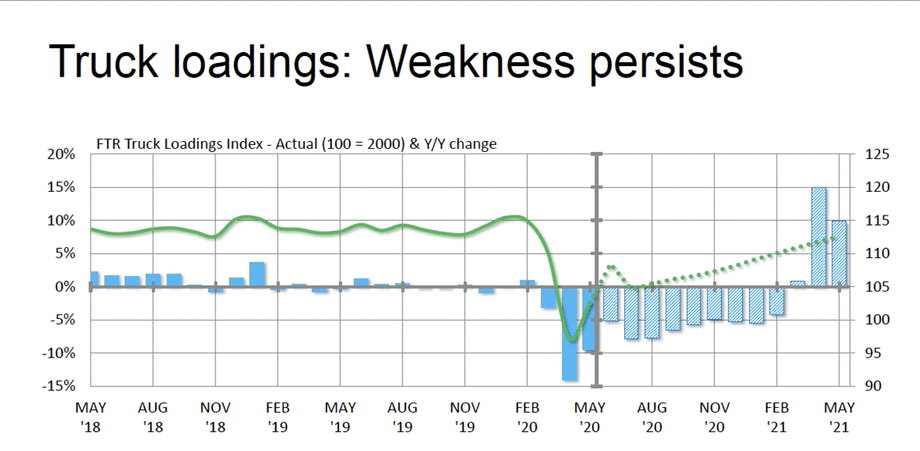
The forecast for truck loadiings is more optimistic than it was a month ago.
Source: FTR
7 min to read
Improvements in industrial production and housing may help drive a truck freight recovery, but spikes in COVID-19 cases in many parts of the country and questions about what Congress may or may not do leave a lot of uncertainty in the forecast, according to analysts at FTR.
In a July 9 webinar, the transportation forecasting firm explored the current state of freight and its forecasts.
Looking at truck freight, FTR sees incremental firming of the market over the rest of 2020 and into 2021. The current forecast for loadings is for this year to be about 5.7% less than last year, although that forecast has improved from where it was a month ago, thanks to recent improvements in industrial production and housing starts.
For 2021, FTR forecasts truck loadings to improve by about 6%. “That’s very strong growth, but the base of course is low,” said Avery Vise, FTR vice president of trucking. “We don’t expect volumes to recover to pre-crisis levels until the second half of 2021.”
Spot freight numbers are currently pretty strong, he said. Two weeks ago, according to Truckstop.com data, the total and dry van numbers were their highest in nearly two years. (Last week’s numbers were down due to the July 4 holiday.) However, Vise cautioned that it was too soon to know if a few weeks of robust growth will lead to a larger freight recovery.
Vise also looked at truck utilization statistics, which have a direct bearing on rates. Looking at the share of seated trucks actually engaged in hauling freight, Vise said, “right now we basically feel we’ve bottomed out but aren’t particularly strong yet. At this stage we anticipate a steady improvement over the course of the next year, but there are still a lot of unknowns.”
A lot of those unknowns are driven by the COVID-19 pandemic.
Pandemic
FTR Chairman and CEO Eric Starks said while fatality rates have dropped considerably, which is good news, “I don’t think I it’s the number that drives the economy.”
“What’s driving the economy more is what’s happening with the number of new cases,” he said, which has been surging to more than 60,000 cases a day, double the previous peak. In total, more than 3 million people have been diagnosed with COVID-19 since the crisis began, and more than 132,000 have died.
Although some people argue that the number of cases is rising because the number of tests is rising, Starks also pointed to the fact that the percentage of positive tests is also rising, not just the raw number.
“If it was just more testing, we would anticipate that positive tests as a percentage would stay the same. We’ve almost tripled the positive test rate and it’s starting to move closer to that 10% range.”
And this is not good news for the economy.
“We’re seeing Florida, Texas, California shut down” in the face of spiking COVID cases. “Texas and California have been pretty aggressive lately. Those have real consequences. When we look at just those three states, that is a big portion of GDP,” with the energy and chemical market in Texas and the food-producing regions of California and Florida.
“I do think these regional disruptions are going to be very problematic and this makes it hard for the economy to really get moving,” Starks said.
On Capitol Hill
Normally, said FTR analysts, they don’t take a great deal of Congressional action into their forecasts because of the slow nature of the process. But there were two areas they wanted to highlight: Infrastructure funding and pandemic stimulus.
Todd Tranausky, FTR’s vice president of intermodal and rail, said it’s highly unlikely we will see a highway funding measure pass until 2021. While both the House and the Senate have infrastructure bills, the two are vastly different – too different, he said, to hammer out a compromise in a conference committee, especially in an election year.
Vise focused on the jobs situation.
Last week, the Bureau of Labor Statistics reported a return of 4.8 million jobs in June from what we had lost when the economy was largely shut down earlier this year for COVID quarantine, improving the unemployment rate to 11.1%.
“But if we look at where we are relative to February, that’s the key comparison, pre COVID, the seasonally adjusted data is still about 10% below February levels throughout the economy, and no major sector of the economy has fully recovered.”
Looking at new unemployment claims, Vise said, “we continue to see extraordinary numbers, 1.3 million reported this morning for the week ending July 4, and it has not changed all that much in the last several weeks… even 16 weeks into this, we’re fairly close to double the record number of claims before the crisis.”
And continued claims haven’t moved down much, either. “Data through June 27 showed just over 18 million continuing to get unemployment payments. Before the crisis, the most we had ever seen was 6.6 million (seasonally adjusted).”
What does unemployment have to do with Congress? The extra $600 a week in unemployment benefits currently being funded by the federal government runs out at the end of this month. That money is also going to some independent contractors and sole proprieters (including some truck owner-operators) who normally would not be eligible for unemployment. Unless Congress extends additional benefits, “This flow of cash is going to end soon,” Vise sad, which means many unemployed will have less money to pump into the economy.
Trucking employment and PPP loans

Trucking employment is still significantly below where it was pre-COVID.
Source: FTR
Looking just at trucking jobs, on a seasonally adjusted basis, Vise said, in June we added back 8,100 payroll jobs. “That is a fraction of the jobs we lost in trucking in April and March.”
Since February, he said, the industry has lost 86,600 jobs, or 5.7%.
The segments that took the biggest hits, he said, were less-than-truckload and household goods. The only exception was the local delivery market, which has been in growth mode thanks to e-commerce.
Payroll Protection Plan loans have helped preserve some jobs. Recently released data on PPP recipients showed that nearly 12,000 companies that fall under truck transportation got loans of $150,000 or more, and nearly 43% of those were local general freight.
However, Vise said, Congress recently relaxed the rules on the PPP loans.
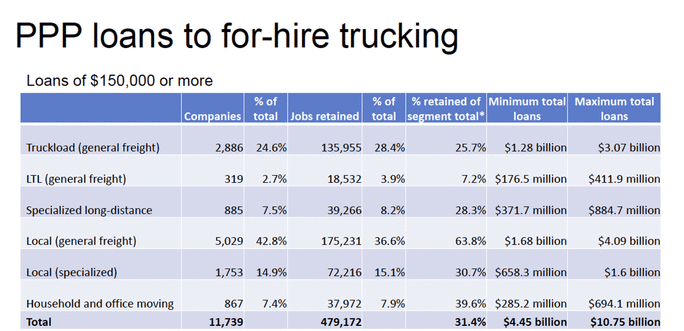
Recent changes to the rules for PPP loans mean some of the jobs they support may not come back until later in the year.
Source: FTR
“The original rules would have pressured companies to bring back or keep employment immediately at the levels prior to the crisis. When thy revised them they gave companies until the end of the year and other changes that reduced that pressure.”
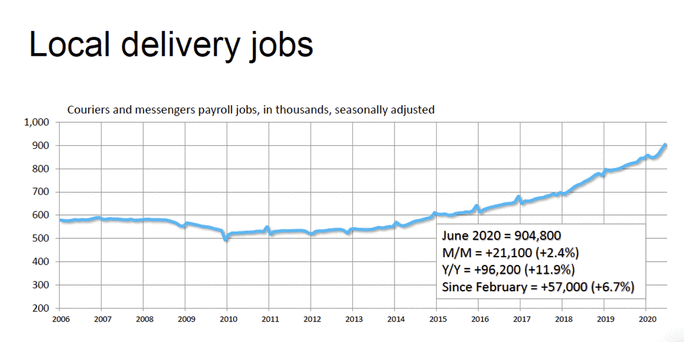
The one bright spot in the jobs report? Local delivery.
Source: FTR
Industrial, Housing Bright Spots
Record-low mortgage rates may help drive a resurgence in the home-building market, Vise said, which could be good news for freight ranging from lumber to home furnishings.
On July 9, 30-year fixed-rate mortgage rates hit a new low of 3.03%. Low rates, Vise said, have led to “a lot of refinancing, which has its own benefits for the economy because it ups disposable income, but it’s also led to a lot of purchase applications, and we could soon be regaining a lot of what we lost in the pandemic.”
While we have seen industrial demand begin to come back, Jonathan Starks, FTR chief intelligence officer, said there’s a disconnect between trucking and carload recovery numbers that could be troubling for the industrial sector.
As Eric Starks explained, “My hypothesis is we have seen strong consumer demand as things have started to open up and started moving that inventory through the system, and truck [freight] has clearly benefited. The industrial sector was sitting on inventory and I’m happy we’re seeing more inventory reallocation.”
However, he said, “When we look at rail data, it clearly shows we are not seeing the industrial sector picking up. I’ve been paying a lot of attention to chemical and metals, and we have just not seen increases there, and those two go into a substantial amount of manufacturing.
“If this is a short term consumer recovery, this can’t last. I don’t see the trucking numbers staying at those high levels as those inventories come down and the initial exuberance of the consumer [following the lockdowns] starts to dissipate.”
More Fleet Management

Sponsored•September 16, 2026
Color Match Smarter: Tools That Restore & Perform
For fleet managers and collision repair professionals keeping heavy-duty trucks on the road, getting the color right the first time isn't just about appearance — it's about efficiency, turnaround time, and bottom-line results. Discover how today's digital color tools are transforming the repair process from guesswork to precision.
Read More →
FMCSA Pauses Biennial-Update Enforcement Amid Motus Transition
Carriers whose updates were due on or after June 1 have more time, while FMCSA works to stabilize its new registration system and warns of phishing sites impersonating its new carrier registration system, Motus.
Read More →
Sponsored•September 14, 2026
2026 Blueprint for Countering Smarter Supply Chain Theft
Cargo theft is no longer just the cost of doing business. It's a multi-billion-dollar criminal enterprise exploiting vulnerabilities across your fleet, drivers, and supply chain.
Read More →


Sponsored•September 1, 2026
How Telematics Improves Visibility, Control, and Performance in Refrigerated Fleets
Explore how telematics help refrigerated fleets improve visibility, uptime, efficiency, compliance, and cargo protection across connected cold chain operations.
Read More →
What the U.S.-Canada Trade War Means for Trucking
Escalating U.S.-Canada tariffs could disrupt cross-border freight, reduce truck volumes, raise costs, and create new uncertainty for carriers on both sides of the border.
Read More →
What Are Trucking’s Top Concerns for 2026?
The American Transportation Research Institute wants to know what's worrying trucking fleet managers, drivers, and other stakeholders in its annual Industry Issues survey.
Read More →
American Trucking Associations Looks for a New Leader
ATA President and CEO Chris Spear abruptly left his job at the association on August 21, at a pivotal time for the trucking industry.
Read More →
Public Wi-Fi Cybersecurity Risks: How Truck Drivers and Fleets Can Protect Their Data
Public Wi-Fi can expose truck drivers and fleets to credential theft, malware, and other cyber threats. Here’s how to reduce the risk on the road.
Read More →
For Nicky Cupp, Fleet Innovation Starts With Frustration
HDT Truck Fleet Innovator Nicky Cupp turns everyday pain points at Fraley & Schilling into opportunities for better technology and smarter processes.
Read More →
Adam Buttgenbach’s Approach to Electric Trucks: Start With Where They Fit
HDT Truck Fleet Innovator Adam Buttgenbach helped PepsiCo build one of North America’s largest EV fleets by focusing on where electric trucks make operational sense.
Read More →