




Transtex Introduces Next-Generation eAPU with DClimate Lithium Pro
Lithium-ion battery technology means longer run times, less weight for DClimate's next-generation electric auxiliary power unit.

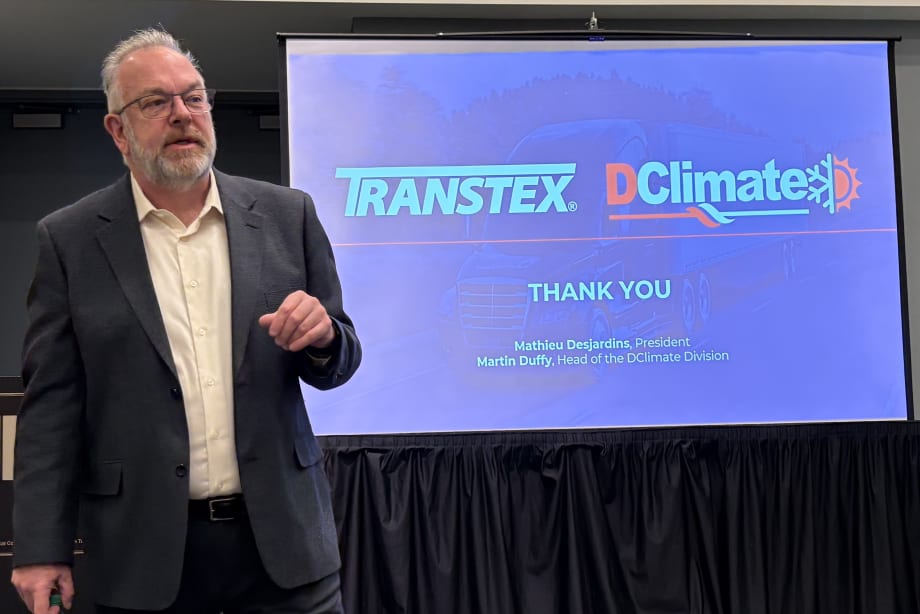
Martin Duffy, head of Transtex’s DClimate Division, talks to reporters about the new lithium-powered eAPU.
Photo: Deborah Lockridge
Transtex launched the next generation of its DClimate electric auxiliary power unit with the DClimate Lithium Pro.
This lithium-ion powered eAPU is designed to deliver greater reliability, longer runtimes, and lower emissions for fleets, according to the company, which announced the new product on March 9 during the American Trucking Associations’ Technology & Maintenance Council Annual Meeting in Nashville.
"We're not just introducing a new electric APU. We're driving the future of auxiliary power," said Mathieu Desjardins, president of Transtex.
Transtex, which offers emission-reducing solutions such as aerodynamic add-ons, acquired DClimate in June 2024. The combined companies meant more research and development capabilities.
Improving on a Winning APU Design
Last fall, Transtex announced the DClimate eAPU at the American Trucking Associations’ Management Conference & Exhibition. It earned an HDT Top 20 Products Award.
At TMC on Sunday, Martin Duffy, head of Transtex’s DClimate Division, outlined two main areas where the new DClimate Lithium Pro has improved versus the current version.
1. Battery Technology
Duffy said while the current DClimate eAPU introduced last year is outperforming other APUs on the market, their engineers felt they could do better.
"The biggest weakness in the current model is the battery technology," he said. "Even though with our system, Enersys will provide a four-year warranty on those batteries, the fact that a warranty event is needed is a concern for us.
"Lithium ion allowed us to do a couple of things. It took the uncertainty around those auxiliary batteries out of play."
The new lithium-powered version now matches the life of the eAPU itself, he said -- 4,000 cycles or about 10 years.
2. Trade-In Values and APUs
Generally speaking, Duffy said, the additional residual value an APU adds to a truck has been steadily declining, and DClimate wanted to change that.
"With the current products out there, a lot of them don't work by the time the truck is traded in or need a significant investment to get them to that standpoint.
The way our system is designed, it's designed to align with the expected life cycle of the truck." The belief is this will improve the residual value.
New Lithium Battery Advantage for DClimate's Electric APU
At the core of the new, improved version of the eAPU is a LiFePO4 battery pack, paired with four starting batteries in a hybrid configuration. This design maximizes reliability and efficiency, according to the company.
"By leveraging lithium-ion technology, we’ve created a more efficient, reliable, and maintenance-friendly solution compared to traditional APU systems,” Duffy said.
"With the 48-volt eAPU, we've developed the most advanced solution available."
DClimate, he said, does not design its products for a typical 10-hour rest period.
"We like to look at 34-hour resets that drivers have to do once a week. So we want to create the dynamic so our system will not run in high ambient [temperatures] for 34 hours continuously."
At some point during that time, the truck will need to run in order to keep the batteries from draining down too far.
To fully recharge, he said, would take two and a half hours. "That's not what we do."
"If there is a recharge event required when the driver is resting or the truck is not moving, we start the truck, it runs for 60 minutes and shuts back down," he explained.
"In that 60 minutes, if you have a fully depleted lithium ion battery, you get back to about 40% safe charge. That is kind of the sweet spot where we found the balance between idle time versus how many times the truck would need to restart in that extended rest period."
He also noted that the hybrid battery configuration not only optimizes performance but also simplifies retrofitting — making it easier for fleets to install on trucks already in operation.
The DClimate Lithium Pro eAPU:
Is 150 pounds lighter than one using AGM batteries improving fuel efficiency and increasing payload capacity. Traditionally, Duffy explained, eAPUs use four auxiliary AGM batteries, which are replaced in the new DClimate product with a single lithium ion battery, which is 150 pounds, compared to a typical 300 pound weight for those four AGM batteries.
Delivers 15% more available energy per cycle, extends what DClimate said are industry-leading runtimes, and supports full hotel loads without idling.
Protects battery life through bidirectional charging. It transfers charge between Li-ion and starting batteries while supporting wet-cell and AGM batteries. The system protects battery life and virtually eliminates costly over-the-road jump starts, according to the company.
Was designed with a 10-year system life, enhanced residual value, and minimal maintenance.
The new eAPU will be commercially available in the third quarter.
Some customers have requested day cab applications, Duffy said, and the company is looking into whether that's a viable market.
"The acquisition of DClimate has strengthened Transtex’s role in fleet efficiency, allowing us to better address the challenges fleets face today," said Desjardins.
"With rising fuel costs, fluctuating regulations, and growing demand for driver comfort, fleets need solutions that are both cost-effective and future ready. The DClimate Lithium Pro delivers exactly that – offering lower operating costs and a more sustainable approach to driving the future of auxiliary power."
More Fuel Smarts

How Volvo Updated Its D13 for EPA 2027 [Watch]
Volvo’s updated D13 promises lower emissions without sacrificing performance or fuel economy. Take a closer look at what changed inside the engine in this HDT Spotlight video.
Read More →
Diesel Price Spike Shortens Payback for Natural Gas Trucks, Report Says
Energy Vision estimates fleets could recover the higher purchase price of an RNG-fueled Class 8 tractor in 1.3 to 2.8 years under current fuel-price scenarios.
Read More →
Calstart Becomes Catalyst Mobility, Reflecting Broader Focus
Calstart is now Catalyst Mobility, reflecting the nonprofit’s growing national role in clean transportation, including zero-emission trucks, infrastructure and incentive programs.
Read More →

Record Diesel Prices Squeeze Trucking Fleets
Average U.S. diesel prices have climbed to nearly $6 a gallon, surpassing the 2022 record as tight refinery capacity and Middle East disruptions keep fuel costs elevated.
Read More →
How Fuel Delivery Shapes Engine Performance
Fuel delivery depends on more than what happens at the injector. For fleet, maintenance and technical professionals, looking at the full path from pump to injector can provide useful context for understanding engine performance.
Read More →
East Coast Port Launches $45M Electric Truck Push
The Port Authority of New York and New Jersey announced millions in incentives for zero-emission drayage trucks, yard tractors, and new charging hubs near the port.
Read More →
California Bill Could Shed Light on Electric Truck Prices
Why do battery-electric Class 8 trucks remain so expensive? A California bill headed to Gov. Gavin Newsom would give fleets and state agencies more visibility into what manufacturers charge.
Read More →
Detroit Opens Orders for EPA 2027 Engines
Detroit isn’t starting from scratch to meet EPA 2027 diesel emissions standards. Its Gen 6 DD13 and DD15 engines keep much of today’s platform while updating the fuel and aftertreatment systems.
Read More →
Zero-Emission Truck Corridor Planned for West Coast
California, Oregon, Washington, British Columbia and Baja California are coordinating plans for truck charging and hydrogen fueling from Canada to Mexico.
Read More →
A Closer Look at Kenworth’s Electric T880E Vocational Truck [Video]
Learn more about Kenworth's T880E battery-electric vocational truck at the Paccar Technical Center, including its range, applications, upfitting considerations, and PTO options, in this HDT Spotlight video.
Read More →