





Also of interest: How to Maximize Trailer Space
Trailer Orders Plummet in April Amidst Supply-Chain Concerns
The pent-up demand for trailers is estimated at over 100,000 units, with an average backlog-to-build ratio of just over eight months for the total industry.
May 13, 2022
“There is no reason for trailer OEMs to overbook, with increasing uncertainties regarding the supply chain,” said Don Ake, FTR vice president of commercial vehicles.
Source: FTR
2 min to read
Trailer orders in April were down substantially from March, although up slightly over a year ago, as lockdowns in China and the war in Ukraine prompted caution in the market.
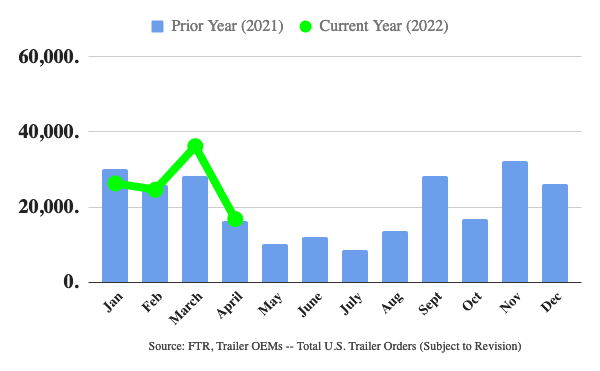
FTR reports preliminary trailer orders fell in April to 16,800 units, 53% below March order activity and up 4% year over year. Trailer orders for the past 12 months have totaled 252,000 units. ACT Research numbers put April numbers at 16,100 units, down almost 60% from the previous month and up slightly from the same month last year.
This followed a month when March trailer orders surged to their highest since December of 2020, representing most of the trailer-maker build slots for dry vans for the rest of the year.
While seasonal patterns typically see a drop in trailer orders in April, preliminary reports indicate that volumes fell more than might have been expected, according to Frank Maly, director of commercial vehicle research at ACT Research.
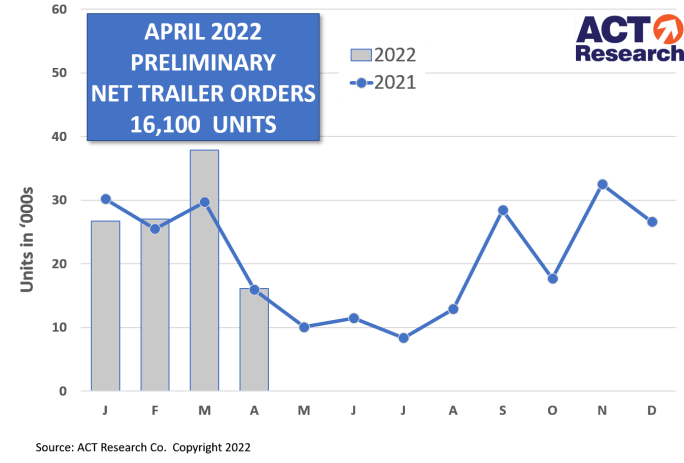
March trailer orders were significantly higher than a year ago, making the April drop from the previous month look even worse.
Source: ACT Research
“While some may think recent economic challenges could be a contributing factor to the sequential decline, it’s more likely that a reluctance to push the orderboard horizon into next year is responsible, as OEMs continue to closely control order acceptance,” Maly said.
“There is no reason for trailer OEMs to overbook, with increasing uncertainties regarding the supply chain,” said Don Ake, FTR vice president of commercial vehicles.
The situation in Shanghai, which has been locked down due to a COVID-19 outbreak, he explained is going to delay some components that are needed to make trailers, while the war in Europe is creating shortages of aluminum.
“These and other doubts have delayed OEMs from issuing quotes for 2023 requirements,” Ake said. “So, the low order volumes reflect OEMs filling in the months of the 2022 production schedule they feel more confident about.”
ACT’s Maly said their discussions indicate that active negotiations between OEMs and fleets continue, as fleets prepare to make commitments for 2023 production, when that opportunity becomes available.
The pent-up demand for trailers is estimated at over 100,000 units, according to FTR. ACT said the lower order levels for April will still result in an average backlog-to-build ratio of just over eight months for the total industry.
Pandemic-triggered supply chain difficulties the world has been experiencing are now expected to extend into 2023. “OEMs will then have to build at high rates for an extended time to catch up to demand,” Ake said. “The short-term prospects are subdued, but the long-term outlook remains bright.”
More Equipment

Tesla Wants a Self-Driving Semi. Are Cameras Enough?
Could Tesla’s camera-only autonomous driving technology work on an 80,000-pound Semi? In this commentary, HDT's Deborah Lockridge takes a look at Tesla, Cybercab, and how autonomous trucks see the road.
Read More →
Kodiak: Driverless Long-Haul Truck Launch on Track for 2026
Kodiak AI says its driverless long-haul safety case is 93% complete and it remains on track to begin commercial operations by year-end 2026.
Read More →
What DOT’s Automated Vehicle Strategy Means for Trucking
The U.S. Department of Transportation issued a new automated-vehicle strategy that outlines plans for driverless-truck regulations, cross-state freight corridors, and federal safety standards.
Read More →
East Coast Port Launches $45M Electric Truck Push
The Port Authority of New York and New Jersey announced millions in incentives for zero-emission drayage trucks, yard tractors, and new charging hubs near the port.
Read More →
PlusAI Going Public to Fund Autonomous Truck Launch
A SPAC deal could provide PlusAI with up to $300 million as it works toward a 2027 commercial launch of factory-built autonomous trucks.
Read More →
NHTSA Moves to Rewrite Truck Fuel-Economy Rules
The National Highway Traffic Safety Administration says it lacks authority to regulate medium- and heavy-duty truck engines separately from complete vehicles, but the existing standards have not yet been eliminated.
Read More →
Detroit Opens Orders for EPA 2027 Engines
Detroit isn’t starting from scratch to meet EPA 2027 diesel emissions standards. Its Gen 6 DD13 and DD15 engines keep much of today’s platform while updating the fuel and aftertreatment systems.
Read More →
Carrier Transicold Adds All-Electric TRU for Stationary Cold Storage
Carrier Transicold’s new Vector 8200 all-electric transport refrigeration unit gives fleets a diesel-free option for temporary refrigerated and frozen trailer storage.
Read More →
A Closer Look at Kenworth’s Electric T880E Vocational Truck [Video]
Learn more about Kenworth's T880E battery-electric vocational truck at the Paccar Technical Center, including its range, applications, upfitting considerations, and PTO options, in this HDT Spotlight video.
Read More →
Kenworth T880E Brings EV Power to Vocational Trucks
A closer look at the Kenworth T880E’s range, charging, powertrain and upfit options — and where fleets are showing the most interest.
Read More →