





From the HDT archives (2001), a report from TMC on disc brakes and electronic braking control: Keeping the Dirty Side Down
TMC Reports on Rising Repair Costs, Electromechanical Braking
The American Trucking Associations’ Technology & Maintenance Council is working with partners to track repair costs and study electromechanical braking. A progress report kicked off TMC's Annual Meeting in Atlanta Feb. 23.
February 23, 2020
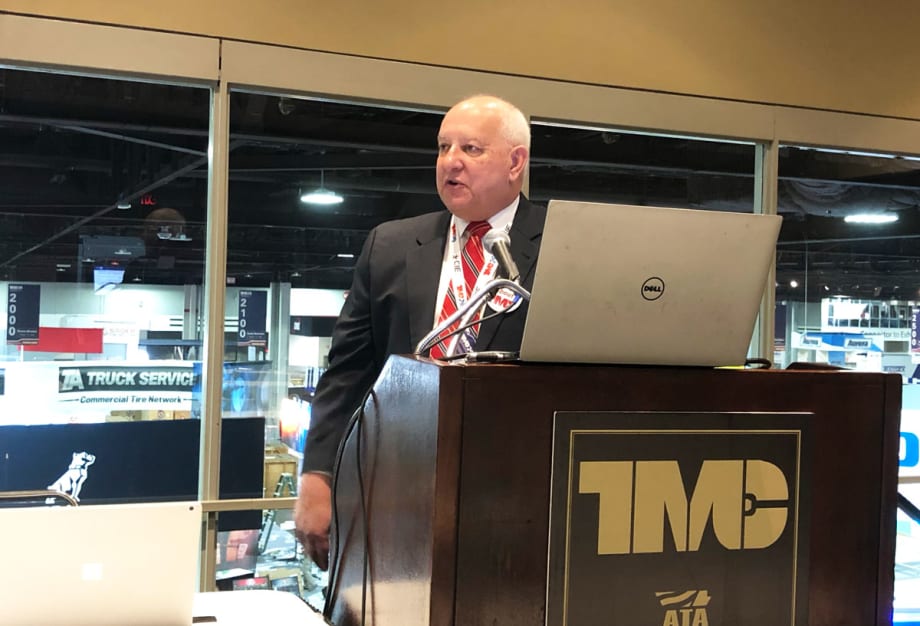
Jack Legler, technical director, TMC, outlines the current state of electromechanical braking system technology at the 2020 TMC Annual Meeting in Atlanta, Georgia.
Photo: Jack Roberts
4 min to read
Unscheduled repair costs for fleets continued to rise for the fourth quarter in a row, according to the latest results of a study of unscheduled repair costs done by the American Trucking Associations’ Technology & Maintenance Council and FleetNet America. The group reported on the latest results from the benchmarking study, as well as fuel-saving calculator and electromechanical braking work it’s been doing with Pit group, as it kicked off its annual 2020 meeting in Atlanta Feb. 23.
The benchmarking study, which began in 2017, documented yet another rise in unscheduled repair costs for fleets, said Jim Buell, executive vice president, sales and marketing for FleetNet America. The latest data, compiled for the third quarter of 2019, showed that unscheduled repair costs for fleets rose for the fourth straight quarter in a row and — for the first time — the average cost of those repairs exceeded $400 an event. Buell said the study found that $407 an event, the average cost of a mechanical repair, is now 24% higher than mechanical repairs in the same quarter in 2018.
The report, which looks at repair costs in truckload, less-than-truckload, and tank industry fleets, also showed that roadside repairs vary greatly across all of these market sectors, Buell added.
The average miles between breakdowns has improved, however, for LTL fleets by 15%. Tanker fleets in the study are running 27% fewer miles between breakdowns.
The data also shows a strong indication that the industry has room to reduce maintenance costs by closing the gap between the average and best-in-class fleet performers in each sector. For instance, the best-performing tanker fleet participating in the study does 18% better than the average fleet. The best-performing LTL fleet does 14% better than average, while the best dry van fleet does a whopping 188% better than the average fleet participating in the study.
“Cost per repair looks like a permanent headwind our industry is facing, and it would be advantageous for fleets to seek to address this,” said Robert Braswell, executive director, TMC. “The TMC/FleetNet America Vertical Benchmarking Program is a TMC member benefit designed to help fleets deal with increasing costs by having fewer roadside repairs.”
New Truck Braking System on the Horizon?
TMC, in partnership with the Pit Group, a transportation technology research organization, also released reports outlining the effectiveness of TMC’s Aerodynamic Fuel Savings Calculator, and an investigation of new electromechanical braking systems for tractor trailers.
Jack Legler, TMC technical director, noted during the press briefing that after reviewing data from 87 tests dating back to 2007, as well as telemetry from other sources, the Pit Group “found the calculator helpful for fleet managers and owner-operators to evaluate the options for the adoption of aerodynamic technologies.”
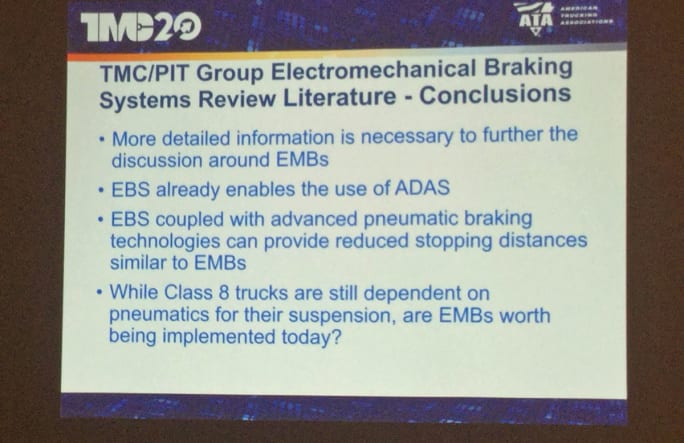
Pit Group and TMC have concluded so far that EMBs exist and are being worked on now. But more information is needed before a full evaluation of effectiveness on Class 8 trucks can be quantified.
Photo: Jack Roberts
In the second joint project between TMC and the Pit Group, launched a year ago, Legler noted that to date, 43 developers of electromechanical braking systems (EMBs) have been evaluated to determine the work they are doing on this potential new stopping system for heavy trucks.
EMBs, Legler explained, are airless brake systems that use wheel end-mounted servo motors to apply friction brakes.
In addition, the group is looking at 16 global OEMs known to be working on this technology as well. In both cases, the study is seeking to determine the current “state of design” for this technology, based available technology and any progress made on building prototype systems. Other considerations include technical challenges, limitations and any obstacles that have either been encountered or anticipated.
Looking at the data obtained so far, Legler said the jury was still out on whether EMBs would prove to be a viable technology for heavy trucks. He said that more detailed information was needed before those determinations could be made, and whether or not the technology would eventually prove to be more reliable and safer than current pneumatic brake systems.
TMC’s Future Truck Committee will consider the results of this research at TMC’s Annual Meeting this week and recommend whether TMC should proceed to a second phase of the project, which would be to track test prototype EMB equipped tractor-trailers in configurations typical in the North American market.
More Equipment

How Volvo Updated Its D13 for EPA 2027 [Watch]
Volvo’s updated D13 promises lower emissions without sacrificing performance or fuel economy. Take a closer look at what changed inside the engine in this HDT Spotlight video.
Read More →
Michelin Tire Improves Efficiency and Durability for Regional Fleets
The Michelin X Multi Energy D2 is a regional haul drive tire engineered to help fleets improve fuel efficiency, durability and traction in demanding stop-and-go operations.
Read More →
ZF Expands Commercial Vehicle Push in North America
ZF is expanding its North American commercial-vehicle presence with new transmission applications, electrification, trailer technology and autonomous-driving systems.
Read More →
Tesla Wants a Self-Driving Semi. Are Cameras Enough?
Could Tesla’s camera-only autonomous driving technology work on an 80,000-pound Semi? In this commentary, HDT's Deborah Lockridge takes a look at Tesla, Cybercab, and how autonomous trucks see the road.
Read More →
Kodiak: Driverless Long-Haul Truck Launch on Track for 2026
Kodiak AI says its driverless long-haul safety case is 93% complete and it remains on track to begin commercial operations by year-end 2026.
Read More →
What DOT’s Automated Vehicle Strategy Means for Trucking
The U.S. Department of Transportation issued a new automated-vehicle strategy that outlines plans for driverless-truck regulations, cross-state freight corridors, and federal safety standards.
Read More →
East Coast Port Launches $45M Electric Truck Push
The Port Authority of New York and New Jersey announced millions in incentives for zero-emission drayage trucks, yard tractors, and new charging hubs near the port.
Read More →
PlusAI Going Public to Fund Autonomous Truck Launch
A SPAC deal could provide PlusAI with up to $300 million as it works toward a 2027 commercial launch of factory-built autonomous trucks.
Read More →
NHTSA Moves to Rewrite Truck Fuel-Economy Rules
The National Highway Traffic Safety Administration says it lacks authority to regulate medium- and heavy-duty truck engines separately from complete vehicles, but the existing standards have not yet been eliminated.
Read More →
Detroit Opens Orders for EPA 2027 Engines
Detroit isn’t starting from scratch to meet EPA 2027 diesel emissions standards. Its Gen 6 DD13 and DD15 engines keep much of today’s platform while updating the fuel and aftertreatment systems.
Read More →