




Swift Adopts FlowBelow Kits for Existing and New Tractors
Aerokits improve fuel economy on Swift’s tractors by a “solid 1.5%,” the procurement VP said. The payback comes in 24 to 26 months.
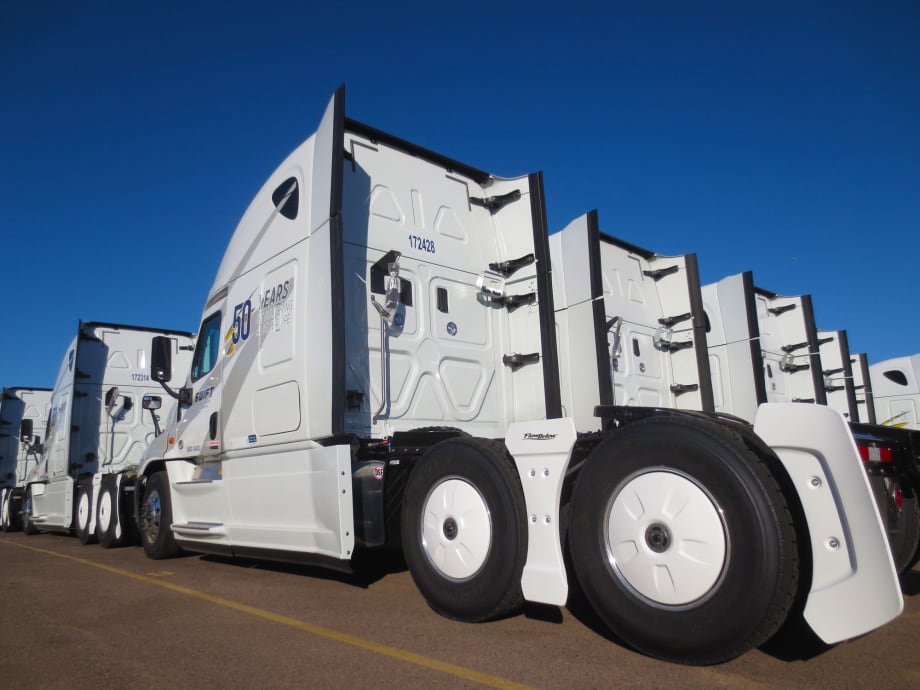
Swift will retrofit 40% of its 65,000 existing tractors with FlowBelow AeroKits and install them on new purchases. Photo: FlowBelow Aero Inc.
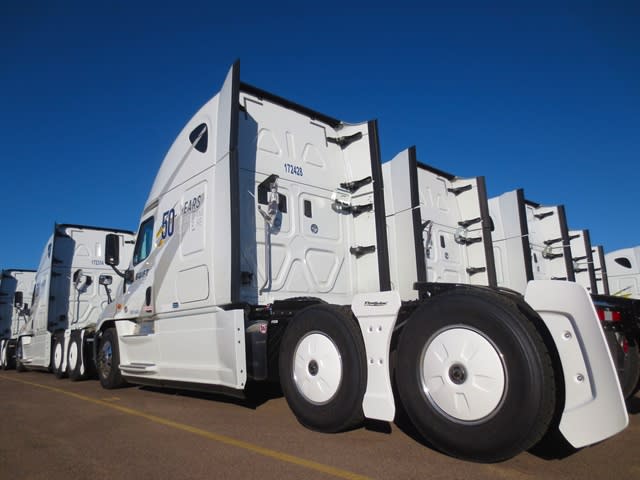
Swift will retrofit 40% of its 65,000 existing tractors with FlowBelow AeroKits and install them on new purchases. Photo: FlowBelow Aero Inc.
FlowBelow Aero Inc. says that Swift Transportation Co. will immediately begin deploying thousands of Tractor AeroKit systems in its fleet. They’ll go on existing equipment and new purchases.
“Here at Swift we are laser-focused on implementing new technologies that are economical and proven to improve safety, fuel efficiency, and driver comfort,” said Bert Kinsel, vice president of heavy equipment procurement. “Over the years we have refined the specs of our trucks and trailers to optimize the air flowing around the vehicle and reduce drag as much as possible.
“Many aerodynamic products for trailers exist today, and we certainly utilize those that work well for us," he continued. "But because we operate over three trailers for every one truck in the fleet, meaning that our trailers are utilized approximately one-third as much as the tractors, the return on an investment for a trailer-mounted technology can take a lot longer than a comparable technology installed on one of our trucks. FlowBelow’s system only needs to be installed on the tractor. The best thing about it is that it makes an impact on every mile we drive.”
FlowBelow kits improve fuel economy on Swift’s tractors by a “solid 1.5%,” Kinsel said. The payback comes in 24 to 26 months, which is why retrofits will be done on tractors that have at least 30 months of service remaining in the fleet. They’ll be bought on new tractors as well. Swift currently runs Freightliner, International, Kenworth, and Volvo tractors.
Swift first began testing Tractor AeroKits in 2014 and subjected them to an extensive evaluation process. After completing initial SAE fuel efficiency tests against a control vehicle, the fleet deployed 100 AeroKits for nine months to further test the product’s durability, ease of use, and real-world fleet average fuel efficiency performance. The AeroKits proved worthwhile, and the initial large-scale deployment through 2017 is expected to account for approximately 40% of Swift’s company trucks.
A Tractor AeroKit reduces aerodynamic turbulence and drag around the rotating wheels of the truck, FlowBelow says. The system includes four quick-release wheel covers for access to hubs and lugs; the covers have a patented push-and-turn quick-release latching system. Four fairings are placed between and behind the drive wheels of the truck.
At speeds above 40 mph, the system claims to be highly effective at reducing drag and horsepower required to move the rig. Citing multiple third party test results, FlowBelow claims fuel savings of up to 2.23%.
An AeroKit complements trailer aerodynamic devices, allowing a fleet to capture all available fuel savings from aero improvers across the entire vehicle, FlowBelow says. The product was introduced in 2013, and is now available as a factory-installed option on Freightliner and Kenworth trucks. Retrofit installations take as little as one hour, and account for over half of FlowBelow’s business.
More Fuel Smarts

How Volvo Updated Its D13 for EPA 2027 [Watch]
Volvo’s updated D13 promises lower emissions without sacrificing performance or fuel economy. Take a closer look at what changed inside the engine in this HDT Spotlight video.
Read More →
Diesel Price Spike Shortens Payback for Natural Gas Trucks, Report Says
Energy Vision estimates fleets could recover the higher purchase price of an RNG-fueled Class 8 tractor in 1.3 to 2.8 years under current fuel-price scenarios.
Read More →
Calstart Becomes Catalyst Mobility, Reflecting Broader Focus
Calstart is now Catalyst Mobility, reflecting the nonprofit’s growing national role in clean transportation, including zero-emission trucks, infrastructure and incentive programs.
Read More →

Record Diesel Prices Squeeze Trucking Fleets
Average U.S. diesel prices have climbed to nearly $6 a gallon, surpassing the 2022 record as tight refinery capacity and Middle East disruptions keep fuel costs elevated.
Read More →
How Fuel Delivery Shapes Engine Performance
Fuel delivery depends on more than what happens at the injector. For fleet, maintenance and technical professionals, looking at the full path from pump to injector can provide useful context for understanding engine performance.
Read More →
East Coast Port Launches $45M Electric Truck Push
The Port Authority of New York and New Jersey announced millions in incentives for zero-emission drayage trucks, yard tractors, and new charging hubs near the port.
Read More →
California Bill Could Shed Light on Electric Truck Prices
Why do battery-electric Class 8 trucks remain so expensive? A California bill headed to Gov. Gavin Newsom would give fleets and state agencies more visibility into what manufacturers charge.
Read More →
Detroit Opens Orders for EPA 2027 Engines
Detroit isn’t starting from scratch to meet EPA 2027 diesel emissions standards. Its Gen 6 DD13 and DD15 engines keep much of today’s platform while updating the fuel and aftertreatment systems.
Read More →
Zero-Emission Truck Corridor Planned for West Coast
California, Oregon, Washington, British Columbia and Baja California are coordinating plans for truck charging and hydrogen fueling from Canada to Mexico.
Read More →
A Closer Look at Kenworth’s Electric T880E Vocational Truck [Video]
Learn more about Kenworth's T880E battery-electric vocational truck at the Paccar Technical Center, including its range, applications, upfitting considerations, and PTO options, in this HDT Spotlight video.
Read More →