




Supreme Court Stays OSHA Vaccine-or-Test Mandate
The Supreme Court on Jan. 13 halted enforcement of a controversial emergency rule that would have required business with more than 100 employees to require workers to have COVID-19 vaccines or else undergo weekly testing.

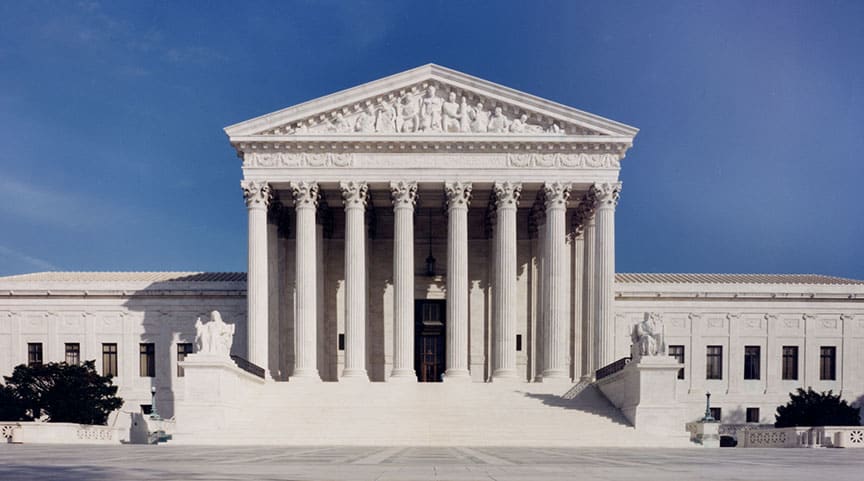
The Supreme Court stayed a controversial OSHA vaccine mandate.
Photo: U.S. Supreme Court
The U.S. Supreme Court on Jan. 13 halted enforcement of a controversial emergency rule from the Biden administration that would have required business with more than 100 employees to require workers to have COVID-19 vaccines or else undergo weekly testing.
The unsigned opinion came just days after the court heard an emergency appeal last Friday. The rule, an “emergency temporary standard,” would have affected more than 84 million workers. The trucking industry was among those that had challenged the mandate, and it was quickly put on hold by an appeals court.
The Occupational Safety and Health Administration published the ETS in early November, arguing that the mandate was needed to ensure workplaces were safe for employees in the face of the COVID-19 pandemic. The administration said a 1970 law permits the agency to set an emergency rule when a “grave danger” exists that could expose workers to “substances or agents determined to be toxic or physically harmful or from new hazards.”
The majority of justices disagreed, saying the agency had overstepped its authority.
“Although Congress has indisputably given OSHA the power to regulate occupational dangers, it has not given that agency the power to regulate public health more broadly,” the court wrote. "Requiring the vaccination of 84 million Americans, selected simply because they work for employers with more than 100 employees, certainly falls in the latter category.”
The court’s three liberal justices issued a dissent.
"It's an extraordinary use of emergency power occurring in an extraordinary circumstance, a circumstance that this country has never faced before," Associate Justice Elena Kagan said.
American Trucking Associations President and CEO Chris Spear issued a statement calling it “a tremendous victory.”
“Trucking has been on the front lines throughout the pandemic – delivering PPE, medical supplies, food, clothing, fuel, and even the vaccines themselves,” Spear said. “Thanks to this ruling, our industry will continue to deliver critical goods, as our nation recovers from the pandemic and we move our economy forward.”
The news comes on the heels of OSHA publishing a frequently asked question about the mandate confirming that most solo truck drivers woulde have been exempt from the rule.
More Safety & Compliance

FMCSA Pauses Biennial-Update Enforcement Amid Motus Transition
Carriers whose updates were due on or after June 1 have more time, while FMCSA works to stabilize its new registration system and warns of phishing sites impersonating its new carrier registration system, Motus.
Read More →
ZF Expands Commercial Vehicle Push in North America
ZF is expanding its North American commercial-vehicle presence with new transmission applications, electrification, trailer technology and autonomous-driving systems.
Read More →
Truck Drivers Need More Than Another Alert
Fleets have more visibility into truck health, safety events, and driver activity than ever. The next challenge is turning all that information into useful guidance for the person who has to decide what to do next.
Read More →
Tesla Wants a Self-Driving Semi. Are Cameras Enough?
Could Tesla’s camera-only autonomous driving technology work on an 80,000-pound Semi? In this commentary, HDT's Deborah Lockridge takes a look at Tesla, Cybercab, and how autonomous trucks see the road.
Read More →
What DOT’s Automated Vehicle Strategy Means for Trucking
The U.S. Department of Transportation issued a new automated-vehicle strategy that outlines plans for driverless-truck regulations, cross-state freight corridors, and federal safety standards.
Read More →
NYC Expands Speed, Pedestrian Safety Tech Across Fleet
New York City is expanding intelligent speed assistance and pedestrian-alert systems across its municipal fleet, moving the technologies from pilot programs into vehicle procurement and retrofit requirements.
Read More →
FMCSA Removes 110 Truck Driver Training Schools from Certified ELDT List
Federal regulators also are targeting more than 160 additional training providers and launching a nationwide audit of third-party CDL skills testers as part of a broader crackdown on trucking fraud.
Read More →
Beyond DOT Compliance: What Makes a Trucking Fleet Truly Safe?
A trucking fleet can follow every rule and still make unsafe decisions. The real test comes when safety conflicts with freight, productivity, or cost.
Read More →
Hours of Service Pilot Programs: FMCSA Readies for 2027 Rollout
Two pilot programs could eventually reshape hours-of-service rules, giving truck drivers options to pause their 14-hour clock or use longer split sleeper rest periods.
Read More →
New Guide Offers Pet Safety Tips for Truck Drivers
Hundreds of thousands of pets travel in truck cabs. A new safety guide from Volvo Trucks and the Center for Pet Safety offers practical advice for truck drivers who bring dogs and cats along for the ride.
Read More →