




Study Suggests Cocaine Use More Prevalent than Marijuana Among Truck Drivers
Is marijuana really the drug most commonly used by truck drivers? National Drug and Alcohol Clearinghouse statistics say it is by far, but hair-testing advocates cite an analysis finding otherwise.

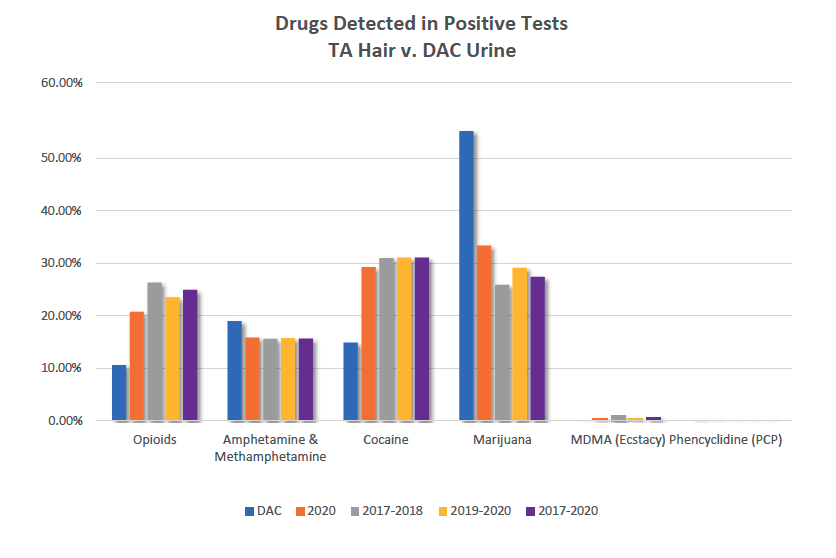
The Trucking Alliance said comparing data from the Clearinghouse and from its member fleets who do hair-testing shows how urine-testing often doesn't catch drugs such as cocaine.
Graph: The Trucking Alliance
Is marijuana really the drug most commonly used by truck drivers? National Drug and Alcohol Clearinghouse statistics say it is by far, but hair-testing advocates cite new research finding that truck drivers abuse cocaine more than cannabis.
“Our research found that DOT is seriously under-reporting the actual use of harder drugs by truck drivers, such as cocaine and illegal opioids,” said Doug Voss, professors of Logistics and Supply Chain Management at the University of Central Arkansas, in a news release. He was citing an analysis prepared for the Alliance for Driver Safety & Security, also known as The Trucking Alliance, late last year.
“Our analysis clearly concludes that hair testing identifies these harder drugs at higher percentages than the single urine testing method relied on by the federal government.”
The study compared 1.43 million truck driver pre-employment urine drug test results reported by the Clearinghouse with 593,832 urine and hair test results submitted by carriers in the Trucking Alliance. The Clearinghouse is administered by the Federal Motor Carrier Safety Administration, but the agency accepts urine test results only.
In 2020, the FMCSA disqualified 54,955 commercial truck drivers for failing a urine test for illegal drug use. Marijuana was cited by FMCSA as the primary drug of choice. However, the UCA study found that FMCSA would likely have disqualified twice that many truck drivers, another 58,910, had they submitted to a hair drug test. Cocaine would have been the primary drug.
UCA researchers concluded that Trucking Alliance drivers are less likely to use illegal drugs than the national truck driver population. They passed their urine drug tests 269% more frequently than drivers in the Clearinghouse.
Marijuana was the most commonly identified substance in positive urine tests from both the Clearinghouse and the Trucking Alliance carriers data.
However, among Trucking Alliance drivers who were disqualified for failing their hair test, cocaine was identified 16% more frequently and opioids were identified 14% more frequently than in the federally required urine tests.
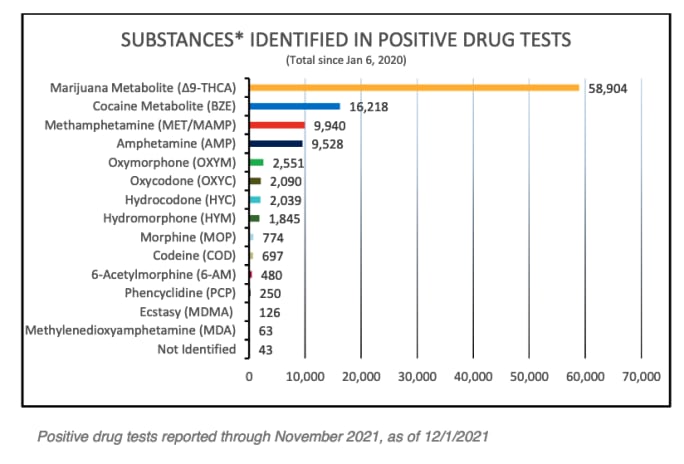
Urine-testing results reported to the federal clearinghouse are dominated by marijuana positives.
Graph: U.S. Drug and Alcohol Clearinghouse
Researchers found statistical evidence that while urine testing is effective at detecting marijuana, hair testing detects not only marijuana, but also a higher percentage of harder drugs, such as cocaine, heroin, and opioids, than a urine test. Hair testing, they said, detects drugs 8.26 time (826%) more frequently than urine testing.
The research analyzed test data from U.S. Express, Cargo Transporters, Dupre, J.B. Hunt, KLLM, Knight/Swift, Maverick USA, and Schneider, all members of the Alliance. Each carrier provided hair and urine drug test data for 2019 and 2020.
“Federal law prohibits truck drivers from using illegal drugs, yet thousands are escaping detection,” said Lane Kidd, managing director of the Trucking Alliance, in the news release. “Drug-impaired truck drivers are a critical public safety issue, but employing these drivers can be a considerable liability risk.”
In the most recent Drug and Alcohol Clearinghouse report, showing data through November 2021, 56% of the positive urine-testing reports were for marijuana metabolite, and only 15% for the second-most-common drug, cocaine. (More than one substance can appear in a positive drug test.)
HDT has reached out to FMCSA for comment.
Why Doesn’t the Clearinghouse Include Hair Testing?
Because of problems with drivers being able to cheat urine testing, or simply wait until drugs have passed out of their systems, some motor carriers use more stringent hair drug tests, which can detect drug use over a longer period of time. Advocates of hair-testing say it does a better job of catching "lifestyle" users of illegal drugs. In 2020, a study issued by the Alliance comparing urine- and hair-testing results found that almost 300,000 truck drivers would fail a hair test for drug use.
In 2015, Congress directed the Secretary of Transportation to “use hair testing as an acceptable alternative to urine testing” for pre-employment and random testing of commercial truck drivers. But the federal government has yet to issue guidelines.
DOT has said it must wait for guidelines from the Department of Health and Human Services, or more specifically the Substance Abuse and Mental Health Services Administration. The proposed hair-testing rule, issued by SAMHSA in 2020, was widely panned, in part because it required the less-stringent urine testing as a “back-up” test to corroborate the results.
The final deadline for comments on the proposal was well over a year ago.
HDT reached out to HHS for an update. In a statement, a spokesman said, "Under the Congressional rule, the Department of Health and Human Services is fulfilling its obligation by writing the proposed Mandatory Guidelines for Federal Workplace Drug Testing Using Hair. As is customary for this process, HHS sought public comment and is revising the proposed rule based on the feedback the department received. HHS will next send the final rule to the Office of Management and Budget for final review and publication."
HHS did not provide a timeline for that next step. The September 2020 proposal received 213 comments. While not a particularly high number of comments, the comments were generally critical of the proposal's details, so it's likely the proposal needed significant revision.
In its comments on the proposal, truck-safety-advocacy organization Road Safe America outlined why "continuing to require the use of urine-analysis as an alternate specimen to hair testing is flawed for several reasons:"
It undercuts the language in the FAST Act that motor carriers should be able to use hair testing “as an acceptable alternative to urine testing.” By requiring dependency on another alternative, hair testing itself cannot be considered an alternative form of test as the law states.
It undermines the benefits of hair testing in comparison to urine testing. Given the proposed guidelines would allow for a driver to contest a positive hair test with a urine analysis, there is a chance that certain drivers will test positive on the hair test and negative on the urine test. Not only does this create potential liability for the motor carrier, but they could end up putting an unsafe driver on the road as a result.
It requires motor carriers to spend money on unnecessary urine-analysis tests that have a lower detection rate than hair analysis. These are funds that could be appropriated to improving safety measures rather than on redundancy.
UPDATED 10:45 EST Jan. 12, 2022, to add response from the Department of Health and Human Services.
More Safety & Compliance

FMCSA Pauses Biennial-Update Enforcement Amid Motus Transition
Carriers whose updates were due on or after June 1 have more time, while FMCSA works to stabilize its new registration system and warns of phishing sites impersonating its new carrier registration system, Motus.
Read More →
ZF Expands Commercial Vehicle Push in North America
ZF is expanding its North American commercial-vehicle presence with new transmission applications, electrification, trailer technology and autonomous-driving systems.
Read More →
Truck Drivers Need More Than Another Alert
Fleets have more visibility into truck health, safety events, and driver activity than ever. The next challenge is turning all that information into useful guidance for the person who has to decide what to do next.
Read More →
Tesla Wants a Self-Driving Semi. Are Cameras Enough?
Could Tesla’s camera-only autonomous driving technology work on an 80,000-pound Semi? In this commentary, HDT's Deborah Lockridge takes a look at Tesla, Cybercab, and how autonomous trucks see the road.
Read More →
What DOT’s Automated Vehicle Strategy Means for Trucking
The U.S. Department of Transportation issued a new automated-vehicle strategy that outlines plans for driverless-truck regulations, cross-state freight corridors, and federal safety standards.
Read More →
NYC Expands Speed, Pedestrian Safety Tech Across Fleet
New York City is expanding intelligent speed assistance and pedestrian-alert systems across its municipal fleet, moving the technologies from pilot programs into vehicle procurement and retrofit requirements.
Read More →
FMCSA Removes 110 Truck Driver Training Schools from Certified ELDT List
Federal regulators also are targeting more than 160 additional training providers and launching a nationwide audit of third-party CDL skills testers as part of a broader crackdown on trucking fraud.
Read More →
Beyond DOT Compliance: What Makes a Trucking Fleet Truly Safe?
A trucking fleet can follow every rule and still make unsafe decisions. The real test comes when safety conflicts with freight, productivity, or cost.
Read More →
Hours of Service Pilot Programs: FMCSA Readies for 2027 Rollout
Two pilot programs could eventually reshape hours-of-service rules, giving truck drivers options to pause their 14-hour clock or use longer split sleeper rest periods.
Read More →
New Guide Offers Pet Safety Tips for Truck Drivers
Hundreds of thousands of pets travel in truck cabs. A new safety guide from Volvo Trucks and the Center for Pet Safety offers practical advice for truck drivers who bring dogs and cats along for the ride.
Read More →