



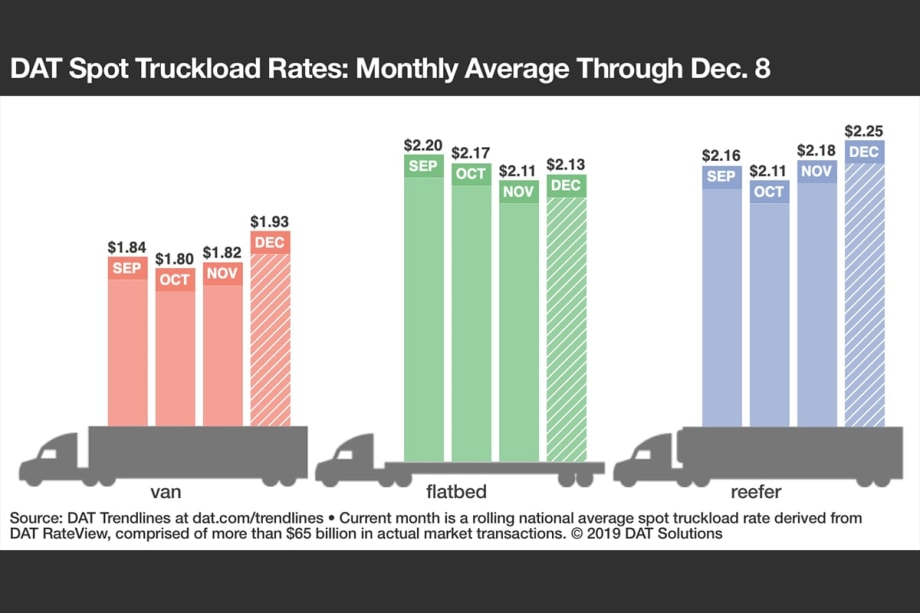
Monthly National Average Spot Rates (through Dec. 8)
Van: $1.94 per mile, 12 cents higher than the November average
Refrigerated: $2.26 per mile, 8 cents higher than November
Flatbed: $2.14 per mile, 3 cents higher than November
 MENU
MENU SEARCH
The national average spot van rate hit its highest level since last January and load-to-truck ratios for all three equipment types surged during the week ending Dec. 8, according to DAT Solutions.
Source: DAT Solutions
The national average spot van rate hit its highest level since last January and load-to-truck ratios for all three equipment types surged during the week ending Dec. 8, according to DAT Solutions.
Demand for truckload van and refrigerated capacity is expected to remain strong through the end of 2019 and into early January due to holiday-related retail goods and groceries moving through the supply chain.
Pricing moved higher on 77 of DAT’s top 100 van lanes by volume, while eight lanes declined and 15 were neutral. The national average van load-to-truck ratio hit 4.0 last week, which translates to four loads available for every truck posted to DAT’s load board network –almost double the average since the start of November.
Load volumes were up nearly 30% out of the Laredo, Texas, freight market and about 20% in the Phoenix market compared to the previous week. Some of the largest van lane-rate increases last week were out West:
Seattle to Los Angeles: $1.59 per mile, up 26 cents. The return trip added 12 cents to $2.47 a mile.
Salt Lake City to Stockton, Calif.: $1.57 a mile, up 22 cents. The return trip also added 22 cents to $2.60 per mile.
Denver to Los Angeles: $1.21 per mile, up 20 cents. The return trip dipped just 3 cents to $2.70 a mile.
The national average spot reefer rate has been on the increase since October. Rates were higher on 42 of the top 72 reefer lanes by volume last week while only seven lanes dropped.
Lanes from Tucson, Ariz., Philadelphia, and Elizabeth, N.J. also saw increases in their average rates:
Tucson to Los Angeles: $2.12 per mile, up 26 cents. The return trip slipped 15 cents to $2.97.
Philadelphia to Chicago: $1.72 a mile, up 21 cents. The return trip was $3.04 per mile, down 3 cents compared to the previous week.

For fleet managers and collision repair professionals keeping heavy-duty trucks on the road, getting the color right the first time isn't just about appearance — it's about efficiency, turnaround time, and bottom-line results. Discover how today's digital color tools are transforming the repair process from guesswork to precision.
Read More →
Carriers whose updates were due on or after June 1 have more time, while FMCSA works to stabilize its new registration system and warns of phishing sites impersonating its new carrier registration system, Motus.
Read More →
Cargo theft is no longer just the cost of doing business. It's a multi-billion-dollar criminal enterprise exploiting vulnerabilities across your fleet, drivers, and supply chain.
Read More →
Explore how telematics help refrigerated fleets improve visibility, uptime, efficiency, compliance, and cargo protection across connected cold chain operations.
Read More →
Escalating U.S.-Canada tariffs could disrupt cross-border freight, reduce truck volumes, raise costs, and create new uncertainty for carriers on both sides of the border.
Read More →
The American Transportation Research Institute wants to know what's worrying trucking fleet managers, drivers, and other stakeholders in its annual Industry Issues survey.
Read More →
ATA President and CEO Chris Spear abruptly left his job at the association on August 21, at a pivotal time for the trucking industry.
Read More →
Public Wi-Fi can expose truck drivers and fleets to credential theft, malware, and other cyber threats. Here’s how to reduce the risk on the road.
Read More →
HDT Truck Fleet Innovator Nicky Cupp turns everyday pain points at Fraley & Schilling into opportunities for better technology and smarter processes.
Read More →
HDT Truck Fleet Innovator Adam Buttgenbach helped PepsiCo build one of North America’s largest EV fleets by focusing on where electric trucks make operational sense.
Read More →
