





Related: Is the Capacity Crunch Slowing?
Spot Rates Fall But Van, Reefer Ratios Increase
Spot truckload rates continued a seasonal decline during the week ending August 4, as the overall number of loads posted on DAT load boards fell 0.7% and capacity dipped 1.3%.
August 8, 2018
2 min to read
Spot truckload rates continued a seasonal decline during the week ending August 4, as the overall number of loads posted on DAT load boards fell 0.7% and capacity dipped 1.3%, according to a weekly report from the load-matching provider.
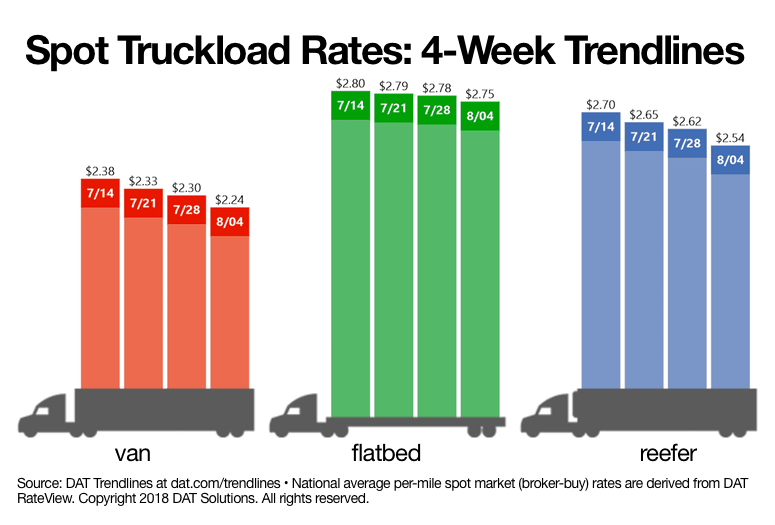
The national average van rate slipped 6 cents to $2.24/mile, the flatbed rate fell 3 cents to $2.75/mile, and the refrigerated rate was 8 cents lower at $2.54/mile compared to the previous week.
The number of available van and reefer loads on the DAT network both increased, however, reflecting strength in the spot market for late July and early August. The $2.24/mile van rate equaled the monthly average for January, which was a record at that time.
Van and reefer load-to-truck ratios also made slight gains while the flatbed ratio settled lower into a typical mid-summer pattern, albeit at an elevated level compared to previous years.
The number of available van loads increased 3% compared to the previous week while truck posts declined 1%. The national van load-to-truck ratio increased slightly to 7.1, and average outbound rates held steady in several key markets, with Los Angeles, Atlanta, and Allentown, Pennsylvania, down only 1 to 2 cents. On a lane-by-lane basis, rates involving Buffalo showed big gains. For instance, Chicago to Buffalo surged 33 cents to an average of $3.33/mile.
The number of reefer load posts increased 3% last week while truck posts dropped 4%. The load-to-truck ratio rose to 9.4, which is above the July average of 8.8. Reefer load counts were up sharply in California, Texas, and in the Midwest, while a disappointing lemon harvest in Mexico appears to be affecting shipments coming across the border at Nogales, Arizona.
The number of flatbed load posts was down 7% while truck posts increased 1% compared to the previous week, which caused the load-to-truck ratio to drop to 36.4. That's still a strong number, DAT notes, adding that the flatbed ratio was 14.4 in July 2016 and 37 in July 2017.
More Fleet Management

Sponsored•September 16, 2026
Color Match Smarter: Tools That Restore & Perform
For fleet managers and collision repair professionals keeping heavy-duty trucks on the road, getting the color right the first time isn't just about appearance — it's about efficiency, turnaround time, and bottom-line results. Discover how today's digital color tools are transforming the repair process from guesswork to precision.
Read More →
FMCSA Pauses Biennial-Update Enforcement Amid Motus Transition
Carriers whose updates were due on or after June 1 have more time, while FMCSA works to stabilize its new registration system and warns of phishing sites impersonating its new carrier registration system, Motus.
Read More →
Sponsored•September 14, 2026
2026 Blueprint for Countering Smarter Supply Chain Theft
Cargo theft is no longer just the cost of doing business. It's a multi-billion-dollar criminal enterprise exploiting vulnerabilities across your fleet, drivers, and supply chain.
Read More →


Sponsored•September 1, 2026
How Telematics Improves Visibility, Control, and Performance in Refrigerated Fleets
Explore how telematics help refrigerated fleets improve visibility, uptime, efficiency, compliance, and cargo protection across connected cold chain operations.
Read More →
What the U.S.-Canada Trade War Means for Trucking
Escalating U.S.-Canada tariffs could disrupt cross-border freight, reduce truck volumes, raise costs, and create new uncertainty for carriers on both sides of the border.
Read More →
What Are Trucking’s Top Concerns for 2026?
The American Transportation Research Institute wants to know what's worrying trucking fleet managers, drivers, and other stakeholders in its annual Industry Issues survey.
Read More →
American Trucking Associations Looks for a New Leader
ATA President and CEO Chris Spear abruptly left his job at the association on August 21, at a pivotal time for the trucking industry.
Read More →
Public Wi-Fi Cybersecurity Risks: How Truck Drivers and Fleets Can Protect Their Data
Public Wi-Fi can expose truck drivers and fleets to credential theft, malware, and other cyber threats. Here’s how to reduce the risk on the road.
Read More →
For Nicky Cupp, Fleet Innovation Starts With Frustration
HDT Truck Fleet Innovator Nicky Cupp turns everyday pain points at Fraley & Schilling into opportunities for better technology and smarter processes.
Read More →
Adam Buttgenbach’s Approach to Electric Trucks: Start With Where They Fit
HDT Truck Fleet Innovator Adam Buttgenbach helped PepsiCo build one of North America’s largest EV fleets by focusing on where electric trucks make operational sense.
Read More →