





Related: ACT Research: For-Hire Trucking Index Keeps Rebounding in June
Spot Market May be Softening
Looking at the spot market for the third week of July, it's hard to tell where we may be going, with rates and volumes hard to compare to typical seasonal trends due to COVID-19.
July 28, 2020
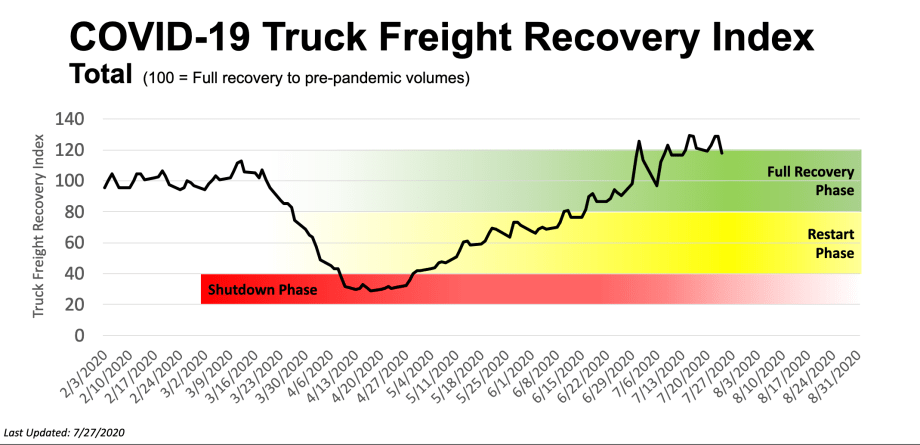
FTR says the truck freight recovery may be stalling.
Graph: FTR/Truckstop.com
3 min to read

DAT says freight rates aren't following normal trends.
Graph: DAT Solutions
Comparing the spot market to normal trends probably isn't a good comparison, based on analysis from DAT Solutions and FTR, with the upheaval to supply chains due to the COVID-19 pandemic.
DAT Solutions analysts, looking at the week of July 20-26, said spot rates are not following normal trends. Load posts on the DAT One load board network were still elevated for this time of year, with freight networks disrupted by the ongoing coronavirus pandemic. That has pushed truckloads that would normally move as contract shipments over to the spot market, with spot rates climbing during a time of year when the market would normally see declines in prices.
Average van rates of $2.03, flatbed rates of $2.19 and refrigerated rates of $2.29 are higher than rates have been in the previous three months. Spot load posts were down 3% from the previous week, after being up 22.5% for the month of June compared to a year earlier. Spot truck posts were up 1.9%.
Last week, analyst Dean Croke wrote in the DAT blog that several key factors cloud the current freight outlook: The possible end of the extended unemployment insurance program, COVID-19 outbreaks in many states, uncertainty in consumer demand, and rising retail warehouse inventories.
Meanwhile, total spot load postings in the Truckstop.com system were down 1.2% during the week ended July 24 from the prior week, but volume remained very strong compared to seasonal expectations, according to an FTR analysis. Dry van, refrigerated, and flatbed all saw slight declines week over week. Total loads, which were slightly above 2018 levels, were 41% above the same week last year and 50% higher than the five-year average.
FTR Transportation Intelligence and Truckstop.com on July 27 reported the “truck freight has been volatile, but the surge appears to have stalled at a strong level.”
The FTR/Truckstop.com COVID-19 Truck Freight Recovery Index showed that total freight recently approached – but didn't exceed – its mid-July peak, FTR said, but the latest data shows a downtick. Volumes are volatile, but the trend line is basically flat.
“Although volume has flattened … it does so at a time when we typically would see volumes easing. However, given the sharp contraction in April, seasonal expectations might not as useful as a benchmark as it is in ‘normal’ markets,” FTR said.
“A stabilization in the spot market is not unexpected. First, the economy has had a couple of months to catch up to pent-up demand in the consumer and industrial sectors, so growth rates naturally should taper off. Meanwhile, carriers likely are bringing back more drivers, which should allow the route guide environment to handle more freight. And the surge in COVID-19 cases in June and July could be tempering demand somewhat in some states.”
More Fleet Management

Sponsored•September 16, 2026
Color Match Smarter: Tools That Restore & Perform
For fleet managers and collision repair professionals keeping heavy-duty trucks on the road, getting the color right the first time isn't just about appearance — it's about efficiency, turnaround time, and bottom-line results. Discover how today's digital color tools are transforming the repair process from guesswork to precision.
Read More →
FMCSA Pauses Biennial-Update Enforcement Amid Motus Transition
Carriers whose updates were due on or after June 1 have more time, while FMCSA works to stabilize its new registration system and warns of phishing sites impersonating its new carrier registration system, Motus.
Read More →
Sponsored•September 14, 2026
2026 Blueprint for Countering Smarter Supply Chain Theft
Cargo theft is no longer just the cost of doing business. It's a multi-billion-dollar criminal enterprise exploiting vulnerabilities across your fleet, drivers, and supply chain.
Read More →


Sponsored•September 1, 2026
How Telematics Improves Visibility, Control, and Performance in Refrigerated Fleets
Explore how telematics help refrigerated fleets improve visibility, uptime, efficiency, compliance, and cargo protection across connected cold chain operations.
Read More →
What the U.S.-Canada Trade War Means for Trucking
Escalating U.S.-Canada tariffs could disrupt cross-border freight, reduce truck volumes, raise costs, and create new uncertainty for carriers on both sides of the border.
Read More →
What Are Trucking’s Top Concerns for 2026?
The American Transportation Research Institute wants to know what's worrying trucking fleet managers, drivers, and other stakeholders in its annual Industry Issues survey.
Read More →
American Trucking Associations Looks for a New Leader
ATA President and CEO Chris Spear abruptly left his job at the association on August 21, at a pivotal time for the trucking industry.
Read More →
Public Wi-Fi Cybersecurity Risks: How Truck Drivers and Fleets Can Protect Their Data
Public Wi-Fi can expose truck drivers and fleets to credential theft, malware, and other cyber threats. Here’s how to reduce the risk on the road.
Read More →
For Nicky Cupp, Fleet Innovation Starts With Frustration
HDT Truck Fleet Innovator Nicky Cupp turns everyday pain points at Fraley & Schilling into opportunities for better technology and smarter processes.
Read More →
Adam Buttgenbach’s Approach to Electric Trucks: Start With Where They Fit
HDT Truck Fleet Innovator Adam Buttgenbach helped PepsiCo build one of North America’s largest EV fleets by focusing on where electric trucks make operational sense.
Read More →