




Second Fatal Wheel-off Raises Questions About Truck Safety in Ontario
A woman driving a Honda Civic was killed by a flying truck wheel near Hamilton, Ont. on Thursday. It was the province's second fatal wheel-off incident in as many weeks
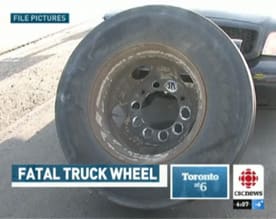
The wheel suspected to be involved in Thursday's fatal wheel-off incident, showing elongated stud holes, indicating loose wheel nuts. Photo from CBC.
A woman driving a Honda Civic was killed by a flying truck wheel near Hamilton, Ont. on Thursday. It was the province's second fatal wheel-off incident in as many weeks.
The Ontario Provincial Police say Miroslawa Chmielewski, 53, was travelling east bound on the Queen Elizabeth Way in southern Ontario when a wheel from a westbound truck bounced over the concrete jersey barrier in the median and struck her car. She was the only occupant of the car and was killed instantly.
Earlier in December, Jason Eligh, a 24-year-old father of two, from Mallorytown, Ont. was killed on Hwy. 401 just west of Brockville. Ont. after a set of duals left a westbound truck and struck his eastbound vehicle.
Safety advocates are calling for an investigation into truck safety in the province, but speaking on CFRB radio the day of the incident, David Bradley, president of the Ontario Trucking Association, defended the industry's record in dealing with wheel separation events, and urged all truckers to be more vigilant in their wheel-end maintenance practices.
"Our hearts go out the family of Ms. Chmielewski," he said. "Tragedies like this are largely preventable and while the industry has done much to reduce the number of wheel-off incidents in the province since the mid-nineteen-nineties, we can't sit idly by while these events still occur. We as an industry have a responsibility to ensure our equipment is in top operating condition. Obviously there's still room for improvement."
In 1995, two back-to-back wheel-off fatalities prompted Ontario's then transport minister, Al Palladini, to convene a Blue Ribbon Task Force investigating the cause of the wheel-offs. As a result of that work, the OTA developed a mandatory training program for wheel installers in the province.
As well, the province instituted an "absolute liability" policy for any wheel-off incident where the driver and/or the carrier would automatically be held liable if a wheel became separated from a truck. Fines for wheel-off incidents could be as high as $50,000.
"This is a tragedy which should not be inflicted upon any family so we're asking all truckers, indeed the operators of all commercial vehicles, to review their wheel installation and maintenance practices and policies to try to prevent further occurrences," Bradley says.
Information provided by the Ontario Ministry of Transportation shows a sharp reduction in wheel separation incidents from 215 in 1997 to 47 last year and 48 so far this year. Seven fatalities have occurred during that period with two occurring in 2011.
The truck that lost the wheel that struck the Honda did not stop following the incident, but police tracked the vehicle down on Saturday. No names have been released pending further investigation, said OPP Sgt. Dave Woodford.
The Ontario Trucking Association has published a "Wheel-Off" advisory on its website urging all carriers operating in the province to be extra vigilant with wheel maintenance.
More Safety & Compliance

Marijuana and Trucking’s Drug-Testing Dilemma
Marijuana is getting stronger, laws are changing, and drug tests still can’t reliably establish impairment. What does that mean for truck drivers and the fleets that employ them?
Read More →
PrePass, Kodiak Connect Driverless Trucks to Roadside Enforcement
The system will allow enforcement agencies to verify Enhanced Inspection information and decide whether Kodiak’s autonomous trucks can bypass roadside screening sites.
Read More →
From One Generation to the Next: How Mentorship Builds Safer Truck Drivers
After three decades in trucking, Harold Perry shares what he's learned about driver safety, mentorship, and helping the next generation build confidence behind the wheel.
Read More →
FMCSA Pauses Biennial-Update Enforcement Amid Motus Transition
Carriers whose updates were due on or after June 1 have more time, while FMCSA works to stabilize its new registration system and warns of phishing sites impersonating its new carrier registration system, Motus.
Read More →
ZF Expands Commercial Vehicle Push in North America
ZF is expanding its North American commercial-vehicle presence with new transmission applications, electrification, trailer technology and autonomous-driving systems.
Read More →
Truck Drivers Need More Than Another Alert
Fleets have more visibility into truck health, safety events, and driver activity than ever. The next challenge is turning all that information into useful guidance for the person who has to decide what to do next.
Read More →
Tesla Wants a Self-Driving Semi. Are Cameras Enough?
Could Tesla’s camera-only autonomous driving technology work on an 80,000-pound Semi? In this commentary, HDT's Deborah Lockridge takes a look at Tesla, Cybercab, and how autonomous trucks see the road.
Read More →
What DOT’s Automated Vehicle Strategy Means for Trucking
The U.S. Department of Transportation issued a new automated-vehicle strategy that outlines plans for driverless-truck regulations, cross-state freight corridors, and federal safety standards.
Read More →
NYC Expands Speed, Pedestrian Safety Tech Across Fleet
New York City is expanding intelligent speed assistance and pedestrian-alert systems across its municipal fleet, moving the technologies from pilot programs into vehicle procurement and retrofit requirements.
Read More →
FMCSA Removes 110 Truck Driver Training Schools from Certified ELDT List
Federal regulators also are targeting more than 160 additional training providers and launching a nationwide audit of third-party CDL skills testers as part of a broader crackdown on trucking fraud.
Read More →