




Scania Tests Solar-Powered Hybrid Truck
A unique Scania hybrid truck with a solar panel-covered trailer is being tested on public roads in Sweden.

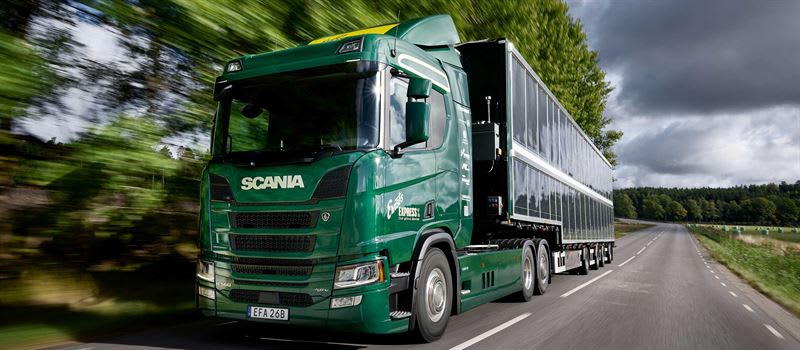
A Scania truck with a hybrid powertrain is being used in a research project in Sweden to study how trailer-mounted solar panels can decrease carbon emissions and extend battery range.
Photo: Scania
A unique hybrid truck with a solar panel covered trailer is being tested on public roads in Sweden. The concept truck is a result of a two-year research collaboration involving Swedish truck OEM Scania, Uppsala University, Eksjö Maskin & Truck, Midsummer, Ernsts Express, and Dalakraft. The solar energy decreases operational costs and local emissions significantly because of the truck's self-produced energy, the researchers said.
"Scania's purpose is to drive the shift towards a sustainable transport system,” said Stas Krupenia, head of the research office at Scania. “Never before have solar panels been used to generate energy to a truck's powertrain like we do in this collaboration. This natural energy source can significantly decrease emissions in the transport sector. It is great to be at the forefront in the development of the next generation's trucks."
A Solar Truck 5,000-Kilometers of Extra Range
The truck is being used in a research project to examine the generated solar energy, and how much carbon emissions decrease via use of the solar panels. The researchers developed new, efficient, and lightweight solar panels for trucks. They also are studying how trucks can interact with the power grid, and may bring forward new models for what will happen if several trucks like this one are connected to the power grid.
"This is an exciting project where academia and industry together try to decrease the climate impact from truck transports. The results from this unique truck will be very interesting," said Erik Johansson, project manager and professor of physical chemistry at Uppsala University.
The truck's 18-meter trailer is almost completely covered in solar panels, equivalent to a house equipped with similarly powerful panels. The solar energy gives the hybrid truck a prolonged driving range of up to 5,000 more kilometers (3,106 miles) annually in Sweden, compared to a conventional battery-electric truck of that size. In countries like Spain, with more sun hours, the vehicle can double the amount of solar energy and thus the driving range as well compared to Swedish circumstances.
The project also includes research on new, lightweight tandem solar cells, that are based on a combination of Midsummer's solar cells and new perovskite solar cells. These enable a higher efficiency transformation of sunlight to electricity. Such a solution could double the solar energy generation, compared to the current energy generated by the panels, researches said.
"Our research towards efficient and light solar cells will be truly important, especially when it comes to applying them in future trucks," Johansson added.
Researchers said the thin, film panel designs being tested are excellent for commercial vehicles.
"Our solar panels are excellent for applications that make commercial vehicles sustainable,” said Erik Olsson, head of corporate development, Midsummer. “We see great potential to decrease the emissions from heavy vehicles with electrification. Electricity generated by solar panels will save fuel and carbon emissions. We want to be a partner to count on, and that is enabled by this ground-breaking project."
One part of the project was to evaluate the charging's impact on the electricity grid and whether it would be possible to sell the surplus power captured by the solar panels. However, researchers said the possibility of two-way charging is not entirely straightforward and the legislation is unclear.
"We thought we would be able to buy the trucks' surplus, unfortunately that is not possible at the moment,” said Sverker Ericsson, electrical trade engineer at Dalakraft. “But the solar cells becoming part of the truck's energy supply is fantastic. As an electricity trading company, we see that all renewable energy sources are needed to cope with the energy transition."
A 560-Horsepower Hybrid Powertrain
The solar powered truck has been developed in a research project partly funded by the government agency of innovation, Vinnova, to develop trucks with low climate impact thanks to solar energy. The truck is a 560 horsepower plug-in hybrid. On the 18-meter trailer, an area of 100 square meters is covered by thin, lightweight and flexible solar panels with a maximum efficiency of 13,2 kWp (kilowatt peak). They are estimated to deliver 8,000 kilowatt hours (kWh) annually when operated in Sweden. The batteries have a total capacity of 300 kWh, with 100 kWh on the truck and 200 kWh on the trailer.
The truck will now be tested by operating on public roads by the haulage company Ernsts Express AB.
"The whole industry is facing big challenges in general, and with fuel in particular. Electrification from renewable electricity is the future. It makes this project even greater for the green haulage company to be a part of," Lars Evertsson, CEO Ernsts Express said of the upcoming tests.
More Fuel Smarts

How Volvo Updated Its D13 for EPA 2027 [Watch]
Volvo’s updated D13 promises lower emissions without sacrificing performance or fuel economy. Take a closer look at what changed inside the engine in this HDT Spotlight video.
Read More →
Diesel Price Spike Shortens Payback for Natural Gas Trucks, Report Says
Energy Vision estimates fleets could recover the higher purchase price of an RNG-fueled Class 8 tractor in 1.3 to 2.8 years under current fuel-price scenarios.
Read More →
Calstart Becomes Catalyst Mobility, Reflecting Broader Focus
Calstart is now Catalyst Mobility, reflecting the nonprofit’s growing national role in clean transportation, including zero-emission trucks, infrastructure and incentive programs.
Read More →

Record Diesel Prices Squeeze Trucking Fleets
Average U.S. diesel prices have climbed to nearly $6 a gallon, surpassing the 2022 record as tight refinery capacity and Middle East disruptions keep fuel costs elevated.
Read More →
How Fuel Delivery Shapes Engine Performance
Fuel delivery depends on more than what happens at the injector. For fleet, maintenance and technical professionals, looking at the full path from pump to injector can provide useful context for understanding engine performance.
Read More →
East Coast Port Launches $45M Electric Truck Push
The Port Authority of New York and New Jersey announced millions in incentives for zero-emission drayage trucks, yard tractors, and new charging hubs near the port.
Read More →
California Bill Could Shed Light on Electric Truck Prices
Why do battery-electric Class 8 trucks remain so expensive? A California bill headed to Gov. Gavin Newsom would give fleets and state agencies more visibility into what manufacturers charge.
Read More →
Detroit Opens Orders for EPA 2027 Engines
Detroit isn’t starting from scratch to meet EPA 2027 diesel emissions standards. Its Gen 6 DD13 and DD15 engines keep much of today’s platform while updating the fuel and aftertreatment systems.
Read More →
Zero-Emission Truck Corridor Planned for West Coast
California, Oregon, Washington, British Columbia and Baja California are coordinating plans for truck charging and hydrogen fueling from Canada to Mexico.
Read More →
A Closer Look at Kenworth’s Electric T880E Vocational Truck [Video]
Learn more about Kenworth's T880E battery-electric vocational truck at the Paccar Technical Center, including its range, applications, upfitting considerations, and PTO options, in this HDT Spotlight video.
Read More →