




Standardize driver education. Use crash data for vehicle design. Shift the focus from roadside inspections to in-company inspections.
Those are a few of the recommendations to come from a study of European safety practices by the Federal Highway Administration's Office of International Programs. A study panel made up of government and industry representatives focused its research on four countries: Sweden, Germany, the Netherlands, and France. Following are some of its findings and recommendations.
Human Resource Management. In Europe, basic driver training stresses overall business competence as well as driving skills. A standardized curriculum often uses advanced technologies such as simulators and password-protected Internet access.
Drivers are issued licenses by their home country and must comply with rules and regulations established by the confederacy of European countries (EC). Driving tests are standardized and cover administrative knowledge (traffic rules, safety regulations and vehicle mechanics) plus actual driving skills.
The most common commercial vehicle infraction is a violation of hours-of-service rules. The rules there are as complicated as they are in the U.S.
They allow 45 driving hours per week averaged over two weeks, with a maximum 9 hours per day -- except twice a week when 10 hours is permitted if followed by 11 consecutive hours of rest. Every 4.5 hours of work must include 45 minutes of break time in segments of at least 15 minutes. Drivers must be compensated for all compulsory rest time, and there is a mandated rest of 45 consecutive hours for every six days of work.
The mechanical rotary tachograph has been required since 1985, but will be phased out and replaced by electronic devices. The tachographs track driving time, other work time such as truck washing or paperwork, availability time such as waiting to be unloaded, rest time, and 15 minute break time pauses. Laws prohibit the data from being used for anything but compliance with driving and rest hours.
Drivers in Germany and the Netherlands are paid by distance traveled, but the practice is not allowed in Sweden and France. France also mandates a minimum 35-hours-per-week salary.
The study panel’s major recommendation regarding drivers was that the U.S. establish a comprehensive, standardized driver education curriculum. They also recommended a more scientific and systematic approach to managing driver performance with assessments based on data that measures driving performance and outcomes (crashes and violations.).
Vehicle Safety Systems: European truck manufactures are closely tied with U.S. manufacturers, but the traditional working relationships and organizational structures are very different. In Europe, crash investigation plays a key role in vehicle design.
European manufacturers typically have active crash investigations teams that study causes and try to come up with safety improvements. While the threat of lawsuits effectively prevents such activity in the U.S., the panel recommended a greater safety focus by third party organizations such as universities, insurance companies, trade associations, other manufacturers (component, electronic, etc.), federal and state agencies. It suggested that the large volume of crash information now collected primarily for litigation purposes could be used to help improve vehicle designs. Involvement by law enforcement organizations as well as state and local law enforcement officials was also encouraged.
Road structure and condition is also vital to safety, and the panel found some noteworthy road design ideas in Europe. In the Netherlands, for instance, truck-only lanes are being tested as part of an overall “transport in balance” approach. The Dutch are also designing some highways with a limited number of entrance and exit ramps to exclude local commuters and reduce the diversity of vehicles in traffic.
Safety Regulations and Enforcement: The overall approach of European enforcement is built on strong rules and deterrence versus strict enforcement. Because speed is considered to be a major safety problem, a 1995 EC rule requires speed limiters that prevent trucks larger than 3,500 kg (7,700 pounds) from exceeding 85 km/h (54 mph).
The Dutch emphasize prevention with a program that combines a warning system with focused in-company inspections. A violation of driving or hour-of-service rules generates a written notice to the trucking company. A serious violation produces immediate repressive action. Recurring violations trigger an extensive in-company investigation.
The panel clearly favored this prevention versus enforcement approach, recommending expanded U.S. focus on in-company inspections. They noted that several third-party safety management firms provide such services to motor carriers, but the inspections usually come when the carriers is on the verge of closure due to poor safety practices. These “best practices” could also be used for good carriers.
Many U.S. carriers maintain effective safety management programs, they noted. A combination of these programs and enhanced penalties could be the foundation for a self-certification initiative.
The full report, "Commercial Vehicle Safety Technology and Practice in Europe," is available at www.international.fhwa.dot.gov. Copies are also available by contacting international@fhwa.dot.gov.
Safety: What Can We Learn From the Europeans?
Standardize driver education. Use crash data for vehicle design. Shift the focus from roadside inspections to in-company inspections. Those are a few of the recommendations to come from a study of European safety practices by the
More Safety & Compliance

Deadline Extended for HDT Truck Fleet Innovators Nominations
Heavy Duty Trucking has extended the deadline for nominations for its Truck Fleet Innovators awards. The deadline has been extended to May 22.
Read More →
Supreme Court Ruling Puts Freight Broker Vetting Practices in Spotlight
The unanimous SCOTUS ruling in the closely watched Montgomery v. Caribe case allows state negligence claims against freight brokers that hire unsafe motor carriers, raising new liability and vetting concerns among brokers.
Read More →
The Truck Safety Tech K&B Transportation Says Is Making a Difference [Watch]
Can technology help prevent truck crashes? In this HDT Talks Trucking Short Takes episode, K&B Transportation explains how it’s using cameras, speed management tools, cellphone-blocking technology, and other systems to improve safety and reduce risk across its fleet.
Read More →
Listen: Inside Modern Fleet Safety: AI, Cameras & Speed Control at K&B Transportation
Fleet safety is evolving fast—and technology is at the center of it. Learn how a former commercial vehicle enforcement officer turned director of safety at K&B Transportation is embracing real-world safety technology.
Read More →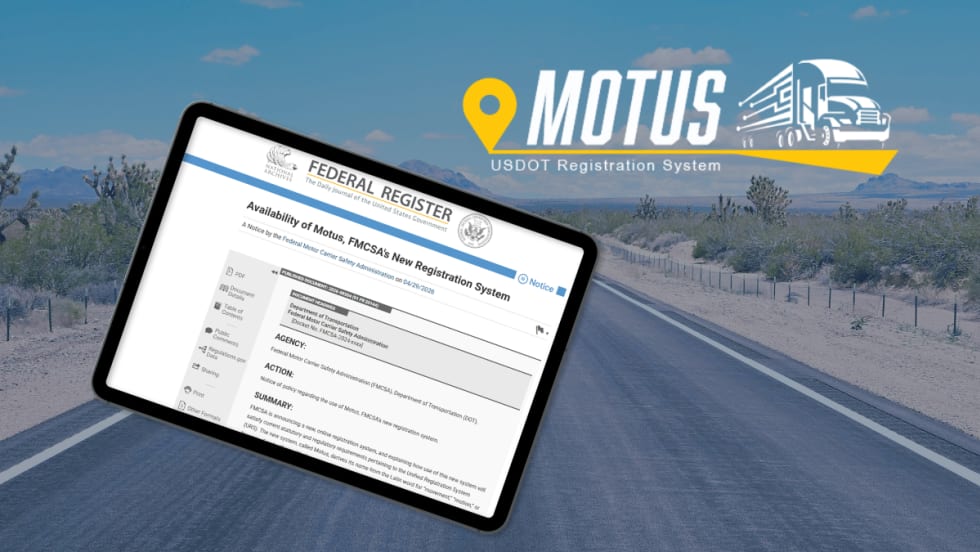
FMCSA’s Motus System Is Coming. What Fleets Need to Know Now
FMCSA's long-awaited registration system promises a single portal — and tighter fraud controls. And there are steps you need to take by May 14.
Read More →
Avoiding Winter Pileups: Don’t Become the Next Link in the Crash-Chain
Winter roadway “pileups” aren’t one crash — they’re a chain reaction. Here’s what triggers them, how truck drivers can spot the danger early, and what to do if you're suddenly trapped in the mess.
Read More →
Freightliner Expands Detroit Assurance with New Intersection and Turning Safety Tech
Detroit’s next-generation ABA6 safety system adds cross-traffic detection and enhanced side guard assist with left-turn protection, targeting high-risk urban scenarios.
Read More →
'Beyond Compliance,' Regulations, Driver Coaching on ATRI’s 2026 Research List
The American Transportation Research Institute will examine driver coaching, regulatory impacts — including the "Beyond Compliance" concept —and weather disruptions that shape trucking operations.
Read More →
FMCSA Revamps DataQs to Improve Fairness, Speed of Reviews
New requirements add firm deadlines and independent review steps, addressing long-standing complaints about inconsistent rulings and slow response times.
Read More →
FMCSA Extends Paper Medical Card Exemption … Again
Five states still aren't ready to accept commercial driver medical exam information directly from the medical examiner's registry.
Read More →