




Safety Improvements Show HOS Rule Does Not Need Revision, ATA Says
The continuing improvement in truck safety shows that the current hours of service rules do not need to be revised, American Trucking Associations President Bill Graves said in a letter to the White House Office of Management and Budget
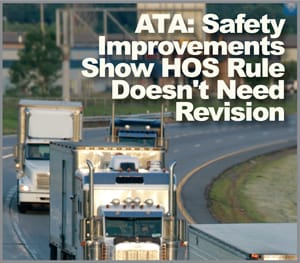
The continuing improvement in truck safety shows that the current hours of service rules do not need to be revised, American Trucking Associations President Bill Graves said in a letter to the White House Office of Management and Budget.
The most recent update of trucking's safety performance shows a 31% drop in the number of large trucks involved in fatal crashes between 2007 to 2009.
The update, posted last month by the Federal Motor Carrier Safety Administration, is overwhelmingly positive, Graves told OMB Administrator Cass Sunstein.
"(It) is a clear indication how well trucking is performing while operating under the current HOS rules, and further demonstrates FMCSA has no evidence of a safety problem with the current rules," Graves said in his November 15 letter.
OMB is reviewing the agency's revision of the rule as a last step before publication. It could complete the review at any time, but the likely date will be as late as February.
FMCSA is revising the rule in order to resolve a long-running legal fight with Public Citizen, the Teamsters union and other groups.
Twice since 2003 these groups won rulings in which the court ordered the agency to tighten work hours, and each time the agency came back with a defense of the rule. Then in 2009 the agency reversed course, agreeing to revisit the rule while Public Citizen suspended its suit. Public Citizen reserved the right to renew its suit if it does not like the new rule.
The details of the proposed changes will remain sealed until publication, but trucking interests are on high alert based on what FMCSA proposed in earlier stages of the rulemaking process.
Among other changes, the agency said it is leaning toward cutting driving time from 11 to 10 hours a day. It also proposed giving drivers a one-hour break during the day by limiting actual duty time within the 14-hour driving window to 13 hours. Another significant change would modify the 34-hour restart to include two periods between midnight and 6 a.m., to be used only once a week.
The trucking and shipping community believe these changes would not improve safety and would add significant costs to doing business. ATA is prepared to sue if the agency goes ahead as it has proposed.
Graves also questioned FMCSA's reliance on a two-part study by researchers at Washington State University for its proposed changes to the 34-hour restart rule.
The researchers, who conducted the study on a driving simulator, reached two conclusions: that the current restart rule is safe for daytime drivers but not safe for nighttime drivers, and that the agency needs to test these findings in the field, Graves said.
"The researchers strongly believe that field study research is needed to determine what real world driving performance, safety and cost implications of such a policy change would be," he said. "Neither FMCSA nor DOT know the potential safety and cost impacts of the proposed restart policy change."
Safety Improvement
Graves was referencing a new report from FMCSA, 2009 Large Truck and Bus Crash Facts, that shows the 31% drop in trucks involved in fatal crashes, as well as a 26% drop in the number of trucks in fatal crashes per 100 million vehicle miles.
The industry's improved safety performance might be an indicator that the current hours rule is not harmful, as Graves said, but there is no objective proof that the improvement arises from the rule, or from any one factor in particular.
Truck safety experts offer a range of explanations for why the industry's performance has gotten better.
The economic recession is a leading factor. In a recession, the amount of rural and leisure driving goes down more than urban and commuter driving, according to researcher Michael Sivak of the University of Michigan's Transportation Research Institute. Statistically, the rural and leisure group is less safe than the urban and commuter group.
Recession also removes marginal trucking operations from the picture, which probably leads to better industry safety performance, says safety expert Ron Knipling.
A third factor is speed.
"Most of us slowed down in 2008 and maybe in 2009 as well, when fuel prices spiked," said Dave Osiecki, senior vice president of policy and regulatory affairs at ATA. "Keep in mind that many, many fleets are more focused now than ever on fuel efficiency, and slower, more careful driving is a large contributor to better fuel economy."
Osiecki noted that the single largest drop in fatalities year-over-year was from 1973 to 1974, when the national maximum 55-mph speed limit was imposed for fuel reasons.
"Slower driving makes a huge difference," he said. "This is something almost completely lost on FMCSA and many other policymakers."
Osiecki also said that technological improvements in cars and trucks probably contributes, as does increased seat belt use. The FMCSA report said that 82% of the truck drivers involved in fatal crashes in 2009 were wearing their seat belts. The rate for car drivers was 63%.
But safety researchers agree that it is hard to statistically link safety gains with regulatory initiatives. Ralph Craft of the FMCSA's Analysis Division has said regulators believe the rules help but it's hard to pin that down. Still, he credits initiatives such as stronger enforcement and tougher entry requirements.
Osiecki added that he believes most professional drivers will say the more regular schedules and longer rest opportunities under the current hours rules contribute to their alertness and safety.
"No one knows for sure," he said. "But the bottom line is that it is very likely due to a large mix of favorable variables, including lower speeds, vehicle and safety technologies, fuel economy focus, greater belt use and better HOS rules."
More Safety & Compliance

Marijuana and Trucking’s Drug-Testing Dilemma
Marijuana is getting stronger, laws are changing, and drug tests still can’t reliably establish impairment. What does that mean for truck drivers and the fleets that employ them?
Read More →
PrePass, Kodiak Connect Driverless Trucks to Roadside Enforcement
The system will allow enforcement agencies to verify Enhanced Inspection information and decide whether Kodiak’s autonomous trucks can bypass roadside screening sites.
Read More →
From One Generation to the Next: How Mentorship Builds Safer Truck Drivers
After three decades in trucking, Harold Perry shares what he's learned about driver safety, mentorship, and helping the next generation build confidence behind the wheel.
Read More →
FMCSA Pauses Biennial-Update Enforcement Amid Motus Transition
Carriers whose updates were due on or after June 1 have more time, while FMCSA works to stabilize its new registration system and warns of phishing sites impersonating its new carrier registration system, Motus.
Read More →
ZF Expands Commercial Vehicle Push in North America
ZF is expanding its North American commercial-vehicle presence with new transmission applications, electrification, trailer technology and autonomous-driving systems.
Read More →
Truck Drivers Need More Than Another Alert
Fleets have more visibility into truck health, safety events, and driver activity than ever. The next challenge is turning all that information into useful guidance for the person who has to decide what to do next.
Read More →
Tesla Wants a Self-Driving Semi. Are Cameras Enough?
Could Tesla’s camera-only autonomous driving technology work on an 80,000-pound Semi? In this commentary, HDT's Deborah Lockridge takes a look at Tesla, Cybercab, and how autonomous trucks see the road.
Read More →
What DOT’s Automated Vehicle Strategy Means for Trucking
The U.S. Department of Transportation issued a new automated-vehicle strategy that outlines plans for driverless-truck regulations, cross-state freight corridors, and federal safety standards.
Read More →
NYC Expands Speed, Pedestrian Safety Tech Across Fleet
New York City is expanding intelligent speed assistance and pedestrian-alert systems across its municipal fleet, moving the technologies from pilot programs into vehicle procurement and retrofit requirements.
Read More →
FMCSA Removes 110 Truck Driver Training Schools from Certified ELDT List
Federal regulators also are targeting more than 160 additional training providers and launching a nationwide audit of third-party CDL skills testers as part of a broader crackdown on trucking fraud.
Read More →