





Read More: Volvo VNR Electric Customers Can Get Chargers Direct From Dealers
Ryder Deploys Volvo VNR Electric Trucks
Seven Volvo VNR Electric trucks were delivered to Ryder System to support local supply chain routes servicing Mack truck assembly operations.
December 9, 2022
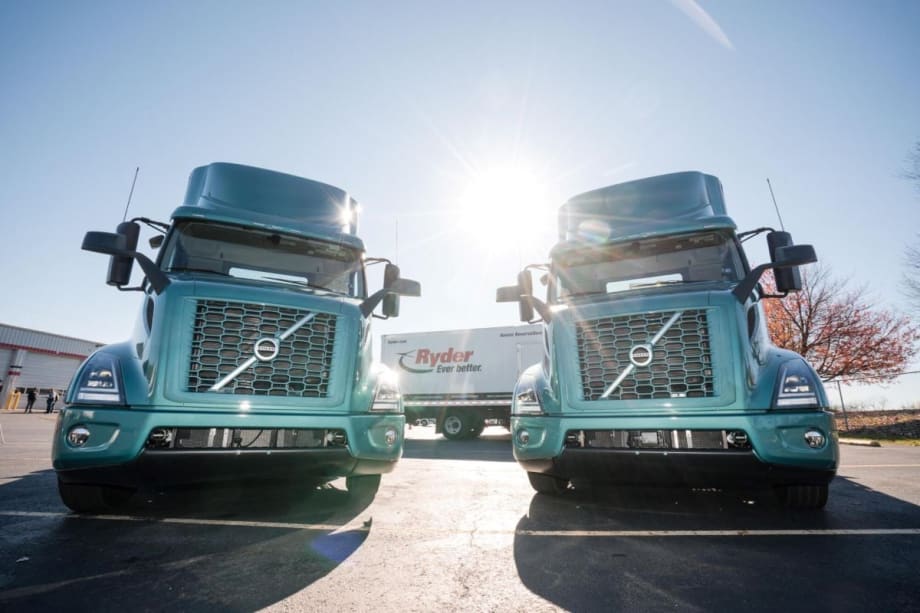
Ryder will utilize Volvo VNR Electric trucks to support local logistics routes servicing the Volvo Group assembly operations in Pennsylvania.
Photo: Volvo Trucks
3 min to read
Volvo Trucks North America delivered seven Volvo VNR Electric trucks to Ryder System to support local supply chain routes servicing the Volvo Group’s Mack truck assembly operations in Pennsylvania. Ryder replaced the diesel trucks that were previously servicing the route and will operate the dedicated zero-tailpipe-emissions Class 8 battery-electric trucks to support the Volvo Group’s sustainability goal of reducing carbon dioxide from its global operations.
Ryder began operating the Volvo VNR Electric trucks on two shifts completing up to eight round trips daily, with all seven trucks transporting assembly kits of components for heavy-duty trucks at the nearby kitting facility to Mack Trucks’ Lehigh Valley Operations (LVO) plant in Macungie, Pennsylvania.
To charge the vehicles, Ryder initially is using five mobile 50-kW chargers available at the plant. These will be replaced with six permanent chargers — five 100-kW chargers and one 150-kW charger — which are currently being installed.
Volvo Financial Services worked with Ryder to place all seven of the VNR Electric trucks on five-year vehicle-as-a-service fair market value (FMV) leases. The FMV lease model, which allows a fleet to lease a vehicle for a specified time period, provides the option for Ryder to purchase the Volvo VNR Electric trucks at the current market cost at the end of the lease term. The leasing program with VFS helps to lower the upfront investment and risk while fleets continue to evolve experience and offerings with battery-electric trucks.
“Ryder has been a long-standing leader in integrating alternative fuel vehicles into our fleet with a goal of driving more sustainable solutions for our customers,” added Steve Sensing, Ryder president for supply chain solutions. “The work that Volvo Trucks has done to accelerate Class 8 battery-electric technology is impressive, with successful working fleets.”
LVO is the second Volvo Group plant to deploy Volvo VNR Electric trucks to transport inbound parts and components daily, with the Volvo Trucks’ New River Valley (NRV) truck assembly operations in Dublin, Virginia, integrating the battery-electric model into its routes earlier this year. Five Volvo VNR Electric trucks are dedicated units for the NRV plant, with each truck running on two shifts for four to five round trips each day, averaging eight miles per route.
Volvo Trucks began taking commercial orders for its Volvo VNR Electric model in December 2020 and in January 2022, announced its enhanced VNR Electric model, which features notable improvements in battery design and storage capacity, resulting in increased range and faster charging, with a dedicated battery thermal management system to maintain ideal environmental temperatures.
“Volvo Trucks is committed to building a decarbonized future and working with supplier and carrier partners, such as Ryder, who are committed to sustainability,” said Peter Voorhoeve, president, Volvo Trucks North America in a statement. “One of our core company values is environmental stewardship, and by manufacturing and utilizing our own zero-tailpipe emission trucks, we are making good on our promise to lead the commercial transport industry toward more sustainable solutions by advancing electromobility.”
More Fuel Smarts

How Volvo Updated Its D13 for EPA 2027 [Watch]
Volvo’s updated D13 promises lower emissions without sacrificing performance or fuel economy. Take a closer look at what changed inside the engine in this HDT Spotlight video.
Read More →
Diesel Price Spike Shortens Payback for Natural Gas Trucks, Report Says
Energy Vision estimates fleets could recover the higher purchase price of an RNG-fueled Class 8 tractor in 1.3 to 2.8 years under current fuel-price scenarios.
Read More →
Calstart Becomes Catalyst Mobility, Reflecting Broader Focus
Calstart is now Catalyst Mobility, reflecting the nonprofit’s growing national role in clean transportation, including zero-emission trucks, infrastructure and incentive programs.
Read More →

Record Diesel Prices Squeeze Trucking Fleets
Average U.S. diesel prices have climbed to nearly $6 a gallon, surpassing the 2022 record as tight refinery capacity and Middle East disruptions keep fuel costs elevated.
Read More →
Sponsored•September 9, 2026
How Fuel Delivery Shapes Engine Performance
Fuel delivery depends on more than what happens at the injector. For fleet, maintenance and technical professionals, looking at the full path from pump to injector can provide useful context for understanding engine performance.
Read More →
East Coast Port Launches $45M Electric Truck Push
The Port Authority of New York and New Jersey announced millions in incentives for zero-emission drayage trucks, yard tractors, and new charging hubs near the port.
Read More →
California Bill Could Shed Light on Electric Truck Prices
Why do battery-electric Class 8 trucks remain so expensive? A California bill headed to Gov. Gavin Newsom would give fleets and state agencies more visibility into what manufacturers charge.
Read More →
Detroit Opens Orders for EPA 2027 Engines
Detroit isn’t starting from scratch to meet EPA 2027 diesel emissions standards. Its Gen 6 DD13 and DD15 engines keep much of today’s platform while updating the fuel and aftertreatment systems.
Read More →
Zero-Emission Truck Corridor Planned for West Coast
California, Oregon, Washington, British Columbia and Baja California are coordinating plans for truck charging and hydrogen fueling from Canada to Mexico.
Read More →
A Closer Look at Kenworth’s Electric T880E Vocational Truck [Video]
Learn more about Kenworth's T880E battery-electric vocational truck at the Paccar Technical Center, including its range, applications, upfitting considerations, and PTO options, in this HDT Spotlight video.
Read More →