





Related: Money and Manpower: Two Transparent Autonomous Truck Trends
Autonomous Trucks Could Radically Transform U.S. Logistics Within a Decade
A new report from a global logistics think tank predicts that autonomous trucks could cause massive disruption and upheaval by 2027.
December 13, 2018
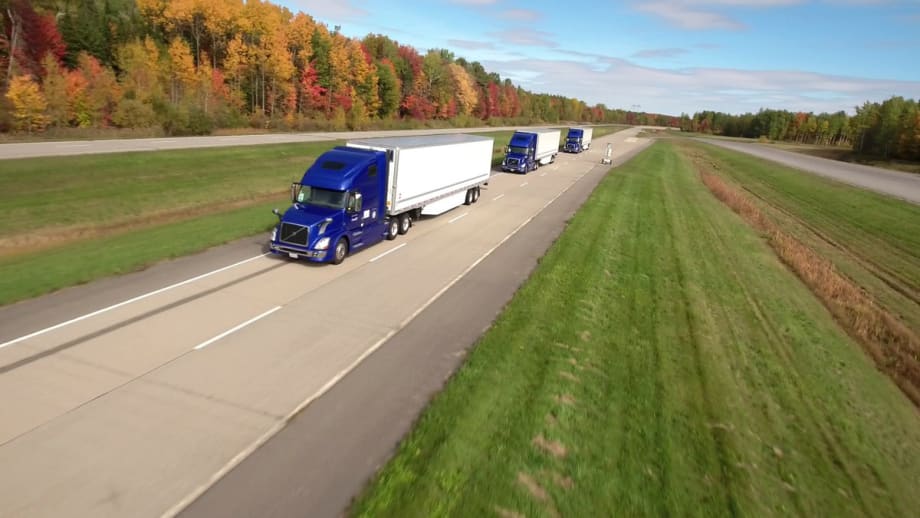
A new report predicts fully autonomous trucks being used in regular operations in little more than a decade. (Above) Test trucks run in a truck platoon on a closed course for evaluation purposes earlier this year.
Photo: PIT Group
4 min to read
Eight years. That’s how long McKinsey & Company, a global logistics think tank based in the United States and Europe, predicts it will be before autonomous trucks with no humans on board could be routinely running routes in North America.
That stunning revelation is the opening salvo in the first of a five-part report on near-term technological disruption in global logistics. The initial report focuses on the advent of autonomous trucks and the remaining parts will look at the effect emerging technologies such as analytics, e-Commerce, automation in the workplace (not including autonomous vehicles), asset sharing and data and analytics.
The report’s look at autonomous truck trend lines opens by noting that trucking moves about two-thirds of all goods shipped in the U.S. and that truck driving is currently the most common occupation in more than half of all U.S. states. Furthermore, the report warns, trucking remains a “deeply traditional” industry that has experienced “few major or structural changes in the preceding decades.”
Autonomous trucks are about to change all of that forever, the report says, noting that companies have already used fully autonomous trucks to make beer deliveries and business agreements between fleets to jointly operate and profit from autonomous truck operations have already been inked and signed. Basic autonomous operating systems today range in price from $30,000 to $100,000, the report’s authors note.
Initial autonomous truck operations are already in their embryonic stages and the report predicts that the overall adoption curve will take place in four major stages, beginning in 2018 and extending out to 2027 and beyond.
In the first wave, two-truck platoons with drivers operating each vehicle with Level 3 automation will take to the roads between now and 2020, taking advantage of aerodynamics and subsequent fuel savings. Connected convoys will develop and operational algorithms and vehicle communications networks will mature and expand, leading to the second wave of autonomous truck development in or around 2023.
In the second phase, the authors predict, driverless platooning on interstate highways will become operational, with a driver in the lead truck of the platoon and unmanned trucks following close behind. When the platoon leaves the highway, the authors say, drivers will once again resume control of each individual truck. According to the report, autonomous operations at this stage of the development curve could deliver fuel and labor savings that will cut total operating costs for each truck in a fleet by approximately 10%.
The report projects that by 2026 unmanned autonomous trucks operating on all segments of the Interstate highway system and on geofenced areas (subject to weather and visibility conditions) will be normal. In this phase of autonomous technology development drivers will meet trucks at the interstate exits and other areas to drive them in more dynamic traffic conditions to their ultimate destinations. This “constrained autonomy” technology, as the report’s authors call it, is projected to produce total savings of about 20%.
And finally, more than a decade from now, McKinsey and Company expects to see the industry’s first Level 5, fully autonomous trucks hit the road, working across their entire operational scale without any human interaction at all. Once this stage of autonomous vehicle technology is attained, the report says fleets will see a stunning 45% reduction in total operating costs for an individual truck compared to today – although the report’s authors point out that even by this stage, it will still be many years before autonomous fleets completely replace fleets operating with human drivers.
The disruption autonomous trucks have on the industry will spread out like ripples across a pond, the report notes, with drivers and other parties experiencing professional upheaval. Other industry segments that could see significant disruption include railroads, warehouses, as well as distribution and fulfillment centers (which will likely bear the brunt of the first wave of disruption caused by this technology), brokers, port operators and shippers.
The trucking industry is expected to experience most of the pain caused by the disruptive nature of autonomous trucks, the report concludes, in four main ways. First, autonomous trucks will cut operating costs for fleets, although capital expenditures will rise. Second, the rise of autonomous trucks could spur consolidation of the national fleets, which are highly fragmented today. Third, autonomous trucks could alleviate the industry’s capacity crunch. And finally, autonomous trucks could create an opportunity for truck OEMs to move downstream and enter transport markets themselves.
More Fleet Management

Sponsored•September 16, 2026
Color Match Smarter: Tools That Restore & Perform
For fleet managers and collision repair professionals keeping heavy-duty trucks on the road, getting the color right the first time isn't just about appearance — it's about efficiency, turnaround time, and bottom-line results. Discover how today's digital color tools are transforming the repair process from guesswork to precision.
Read More →
FMCSA Pauses Biennial-Update Enforcement Amid Motus Transition
Carriers whose updates were due on or after June 1 have more time, while FMCSA works to stabilize its new registration system and warns of phishing sites impersonating its new carrier registration system, Motus.
Read More →
Sponsored•September 14, 2026
2026 Blueprint for Countering Smarter Supply Chain Theft
Cargo theft is no longer just the cost of doing business. It's a multi-billion-dollar criminal enterprise exploiting vulnerabilities across your fleet, drivers, and supply chain.
Read More →


Sponsored•September 1, 2026
How Telematics Improves Visibility, Control, and Performance in Refrigerated Fleets
Explore how telematics help refrigerated fleets improve visibility, uptime, efficiency, compliance, and cargo protection across connected cold chain operations.
Read More →
What the U.S.-Canada Trade War Means for Trucking
Escalating U.S.-Canada tariffs could disrupt cross-border freight, reduce truck volumes, raise costs, and create new uncertainty for carriers on both sides of the border.
Read More →
What Are Trucking’s Top Concerns for 2026?
The American Transportation Research Institute wants to know what's worrying trucking fleet managers, drivers, and other stakeholders in its annual Industry Issues survey.
Read More →
American Trucking Associations Looks for a New Leader
ATA President and CEO Chris Spear abruptly left his job at the association on August 21, at a pivotal time for the trucking industry.
Read More →
Public Wi-Fi Cybersecurity Risks: How Truck Drivers and Fleets Can Protect Their Data
Public Wi-Fi can expose truck drivers and fleets to credential theft, malware, and other cyber threats. Here’s how to reduce the risk on the road.
Read More →
For Nicky Cupp, Fleet Innovation Starts With Frustration
HDT Truck Fleet Innovator Nicky Cupp turns everyday pain points at Fraley & Schilling into opportunities for better technology and smarter processes.
Read More →
Adam Buttgenbach’s Approach to Electric Trucks: Start With Where They Fit
HDT Truck Fleet Innovator Adam Buttgenbach helped PepsiCo build one of North America’s largest EV fleets by focusing on where electric trucks make operational sense.
Read More →