





Related: Report Recommends Improvements to CSA Scoring System
Proposed CSA Scoring-Improvement Method Gets Thumbs Up
ORLANDO - Boiled down to its essence, the review of the Compliance, Safety, Accountability program by the National Academies of Science found that the Federal Motor Carrier Safety Administration should move to a more scientific method to drive the Safety Measurement System that signals which motor carriers are at highest risk for future crashes, according to an FMSCA official.
October 23, 2017
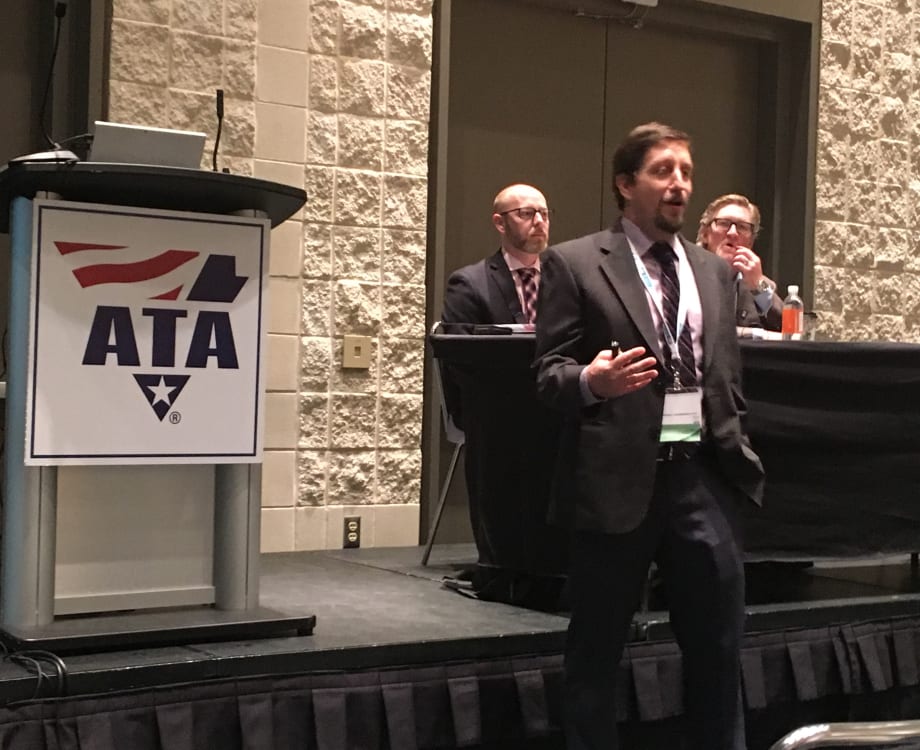
FMCSA's Joe DeLorenzo speaking in Orlando. Photo: David Cullen
3 min to read
FMCSA's Joe DeLorenzo speaking in Orlando.Photo: David Cullen
ORLANDO – Boiled down to its essence, the congressionally mandated review of the Compliance, Safety, Accountability program by the National Academies of Sciences found that the Federal Motor Carrier Safety Administration should move to a more scientific method to drive the Safety Measurement System that signals which motor carriers are at highest risk for future crashes, according to an FMSCA official.
“The National Academies said to FMCSA, ‘The model you have is pretty good, but it’s not based on a principled scientific approach. We would like to see a better statistical model behind SMS,’” FMCSA Director of Compliance and Enforcement Joe DeLorenzo, said on Oct. 22 during an educational session here at the American Trucking Associations’ annual Management Conference & Exhibition.
He said NAS recommended that FMSCA take about two years to study a more scientific modeling approach known as “Item Response Theory” and then consider implementing it to make the SMS function more accurately. “Our focus,” he told the audience, “remains focused on the prevention of crashes, not the prediction of crashes.”
DeLorenzo said the hope is that an IRT-based method would help develop “an estimate of the measure of ‘safety culture’ for each carrier and be used to monitor and identify carriers in need of intervention,” rather than just zero in on violations.
To accomplish all that may take digging into a variety of data points, such as driver pay, driver turnover, and miles travelled. He likened such an approach to the IRT-type scoring used in such standardized tests as the SAT (Scholastic Aptitude Test), familiar to generations of students applying for college admission, that weights answers not just on whether they are “right” or “wrong” but also on how they reflect a student’s depth of understanding.
“This is a long-term development,” DeLorenzo conceded. “The next step will be developing an action plan [in response to the NAS survey] per the FAST Act [which mandated the survey]. FMCSA will continue working with the National Academies on this over the next several years. All this [work] is very data-intensive; it will take a long time to run [all the numbers].”
Steve Bryan, president of president of data analysis firm Vigillo, Inc., which provides safety analytics, told the audience that after attending all of the public meetings on the SMS study held by NAS and digesting the 134-pg. report produced, he is in favor of seeing an IRT-based model adopted.
“IRT is a very sophisticated statistical model,” said Bryan. “But the good news is it has been battle-tested in other industries. IRT won’t predict the next crash, but it will shine a light on the cultural weaknesses of carriers that lead to higher crash rates.
He allowed that incorporating the NAS recommendations into the CSA system will be “a heavy lift,” but said the result will be worth it as trucking will end up with “a much better safety scoring system.”
More Fleet Management

Sponsored•September 16, 2026
Color Match Smarter: Tools That Restore & Perform
For fleet managers and collision repair professionals keeping heavy-duty trucks on the road, getting the color right the first time isn't just about appearance — it's about efficiency, turnaround time, and bottom-line results. Discover how today's digital color tools are transforming the repair process from guesswork to precision.
Read More →
FMCSA Pauses Biennial-Update Enforcement Amid Motus Transition
Carriers whose updates were due on or after June 1 have more time, while FMCSA works to stabilize its new registration system and warns of phishing sites impersonating its new carrier registration system, Motus.
Read More →
Sponsored•September 14, 2026
2026 Blueprint for Countering Smarter Supply Chain Theft
Cargo theft is no longer just the cost of doing business. It's a multi-billion-dollar criminal enterprise exploiting vulnerabilities across your fleet, drivers, and supply chain.
Read More →


Sponsored•September 1, 2026
How Telematics Improves Visibility, Control, and Performance in Refrigerated Fleets
Explore how telematics help refrigerated fleets improve visibility, uptime, efficiency, compliance, and cargo protection across connected cold chain operations.
Read More →
What the U.S.-Canada Trade War Means for Trucking
Escalating U.S.-Canada tariffs could disrupt cross-border freight, reduce truck volumes, raise costs, and create new uncertainty for carriers on both sides of the border.
Read More →
What Are Trucking’s Top Concerns for 2026?
The American Transportation Research Institute wants to know what's worrying trucking fleet managers, drivers, and other stakeholders in its annual Industry Issues survey.
Read More →
American Trucking Associations Looks for a New Leader
ATA President and CEO Chris Spear abruptly left his job at the association on August 21, at a pivotal time for the trucking industry.
Read More →
Public Wi-Fi Cybersecurity Risks: How Truck Drivers and Fleets Can Protect Their Data
Public Wi-Fi can expose truck drivers and fleets to credential theft, malware, and other cyber threats. Here’s how to reduce the risk on the road.
Read More →
For Nicky Cupp, Fleet Innovation Starts With Frustration
HDT Truck Fleet Innovator Nicky Cupp turns everyday pain points at Fraley & Schilling into opportunities for better technology and smarter processes.
Read More →
Adam Buttgenbach’s Approach to Electric Trucks: Start With Where They Fit
HDT Truck Fleet Innovator Adam Buttgenbach helped PepsiCo build one of North America’s largest EV fleets by focusing on where electric trucks make operational sense.
Read More →