





Related: Is SuperTruck Worth the Money?
Peterbilt SuperTruck II Turns Heads at CES 2024
Visitors entering CES 2024 via the West Hall of the Las Vegas Convention Center are being met by the commanding presence of the Peterbilt SuperTruck II.
January 10, 2024
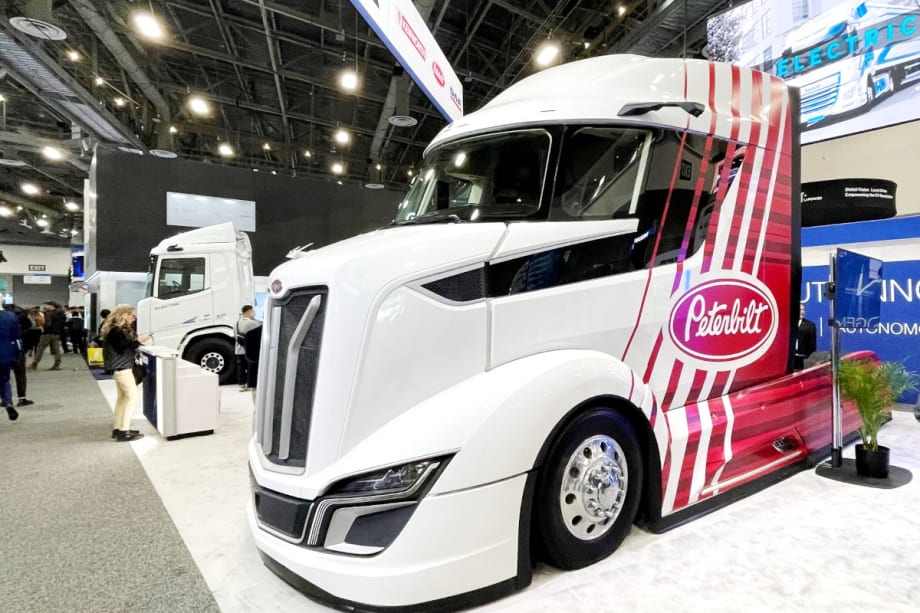
The Peterbilt SuperTruck II is a clean-sheet design focused on production-ready innovations and technology.
Photo: Jack Roberts
4 min to read
Towering over the West Hall entrance of the Las Vegas Convention Center during CES 2024 is the Peterbilt SuperTruck II. Tall, sleek, and decidedly futuristic-looking, the truck is the star of the Paccar booth, which also features a Kenworth hydrogen fuel cell T680 and a DAF 270E electric truck.
CES is a multi-day tech trade show that draws a global audience every year to see the latest and greatest cutting-edge technology and products. Paccar considers the show vital for showcasing its technological innovations to a broader global audience.
The SuperTruck 2 program, a public-private partnership with the U.S. Department of Energy, tasked OEMs with achieving a 100% freight efficiency improvement over their submitted 2009 baseline.
SuperTruck II: Throwing Out the Rulebook
Peterbilt pulled the curtain off of its SuperTruck II more than a year ago, when it stopped attendees in their tracks at the American Trucking Associations' management conference.
Jake White, product marketing manager, Peterbilt, said at CES that the first priority was to show the truck in front of the North American trucking industry.
“There are a lot of technologies being evaluated on this truck,” he says. “We’ve done a lot of testing on public roads in Texas to validate those technologies. And we felt it was important to let our customers know what’s going on first.”
Peterbilt’s SuperTruck I debuted in 2014, and that truck was a more traditional design based on the Peterbilt Model 579, White explained.
“But the SuperTruck II is a complete clean-sheet design,” he said. “We threw out all the rules for this truck. Our goal this time was to see what we could achieve with all-new technology and highly advanced aerodynamics. We wanted to take things as far as we possibly could in terms of new technology and new ideas.”
The SuperTruck II features a 15-liter diesel engine with a 48-volt mild hybrid drivetrain to “augment” its propulsion when necessary.
“The mild hybrid powertrain is more about fuel efficiency than propulsion,” White explained. “Fuel efficiency is really what this truck is all about. The mild hybrid powertrain provides assistance to the diesel engine at launch, going up grades or similar situations.”
Automatic Lowering at Highway Speeds
White said the Peterbilt design team chose not to focus on autonomous technology for the SuperTruck II. “We really wanted to explore technologies that are currently feasible for production trucks,” he said.
One example: the extreme lightweighting efforts that went into the design. This includes the use of new carbon-fiber body panels and expanded use of aluminum body components.
“It’s a Peterbilt,” White quips. “So, you know there’s going to be aluminum in our design!”
All told, White says Peterbilt engineers shaved more than 500 pounds off of the SuperTruck II, making it significantly lighter than a conventional Class 8 long-haul tractor today.
Peterbilt engineers worked hand-in-hand with Great Dane trailers to optimize the SuperTruck II’s complete aerodynamic profile, White added. Those efforts include light-weighting for the trailer, rear-view camera systems, and retractable aerodynamic flaps.
The entire tractor-trailer is designed to automatically lower closer to the road at highway speeds to increase aerodynamic efficiency. It raises up at lower speeds to help maneuver better and avoid impact damage to the lower portions of the trucks caused by potholes, debris, curbs, and other hazards.
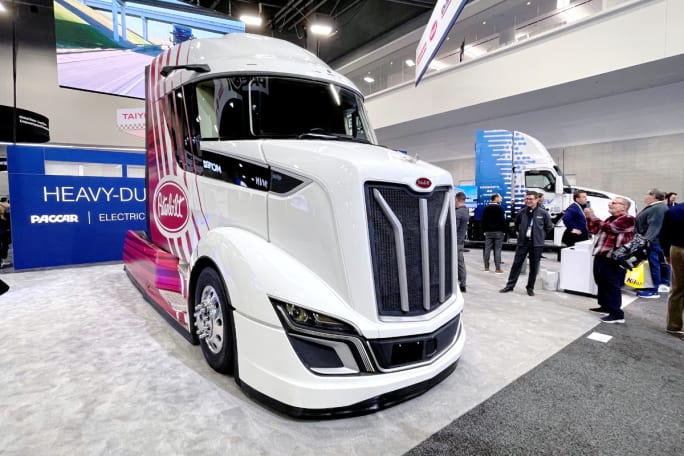
The Peterbilt design team worked with Great Dane Trailers to create an automatic system that lowers the entire tractor.
Photo: Jack Roberts
Human-Centered Truck Cab Design
The Peterbilt SuperTruck II doesn’t have a single conventional rear-view mirror on the truck. But that’s not the only new feature drives will notice. The truck has a center-cab driver’s seat and a “human-centered” interior design aimed squarely at comfort, safety, and efficiency.
“We brought in a lot of drivers and talked to them about all of the new things we were working on,” White said. “We already have the largest center-console display screen in the industry. But they really told us that they deal with a lot of information to do their jobs. So, I think you’ll continue to see larger display screens in the future.”
In addition to aiding with the truck’s propulsion, White said the 48-volt hybrid system also powers all the accessory systems on the truck, such as the lighting systems and HVAC system.
“It’s much more efficient for powering vehicle accessories,” White said. “We really feel this technology has a lot of long-term potential.”
All of these new technologies have combined to give the Peterbilt SuperTruck II a 32% increase in freight ton efficiency, White added.
“What we’ve done with the SuperTruck II is demonstrate that all of these new technologies actually put money back in the pockets of our customers."
More Fuel Smarts

How Volvo Updated Its D13 for EPA 2027 [Watch]
Volvo’s updated D13 promises lower emissions without sacrificing performance or fuel economy. Take a closer look at what changed inside the engine in this HDT Spotlight video.
Read More →
Diesel Price Spike Shortens Payback for Natural Gas Trucks, Report Says
Energy Vision estimates fleets could recover the higher purchase price of an RNG-fueled Class 8 tractor in 1.3 to 2.8 years under current fuel-price scenarios.
Read More →
Calstart Becomes Catalyst Mobility, Reflecting Broader Focus
Calstart is now Catalyst Mobility, reflecting the nonprofit’s growing national role in clean transportation, including zero-emission trucks, infrastructure and incentive programs.
Read More →

Record Diesel Prices Squeeze Trucking Fleets
Average U.S. diesel prices have climbed to nearly $6 a gallon, surpassing the 2022 record as tight refinery capacity and Middle East disruptions keep fuel costs elevated.
Read More →
Sponsored•September 9, 2026
How Fuel Delivery Shapes Engine Performance
Fuel delivery depends on more than what happens at the injector. For fleet, maintenance and technical professionals, looking at the full path from pump to injector can provide useful context for understanding engine performance.
Read More →
East Coast Port Launches $45M Electric Truck Push
The Port Authority of New York and New Jersey announced millions in incentives for zero-emission drayage trucks, yard tractors, and new charging hubs near the port.
Read More →
California Bill Could Shed Light on Electric Truck Prices
Why do battery-electric Class 8 trucks remain so expensive? A California bill headed to Gov. Gavin Newsom would give fleets and state agencies more visibility into what manufacturers charge.
Read More →
Detroit Opens Orders for EPA 2027 Engines
Detroit isn’t starting from scratch to meet EPA 2027 diesel emissions standards. Its Gen 6 DD13 and DD15 engines keep much of today’s platform while updating the fuel and aftertreatment systems.
Read More →
Zero-Emission Truck Corridor Planned for West Coast
California, Oregon, Washington, British Columbia and Baja California are coordinating plans for truck charging and hydrogen fueling from Canada to Mexico.
Read More →
A Closer Look at Kenworth’s Electric T880E Vocational Truck [Video]
Learn more about Kenworth's T880E battery-electric vocational truck at the Paccar Technical Center, including its range, applications, upfitting considerations, and PTO options, in this HDT Spotlight video.
Read More →