




Operation Safe Driver Week to Target Reckless, Careless Driving
The Commercial Vehicle Safety Alliance will focus on reckless, careless, and dangerous driving among both truck drivers and passenger-vehicle drivers during Operation Safe Driver Week July 13-19.

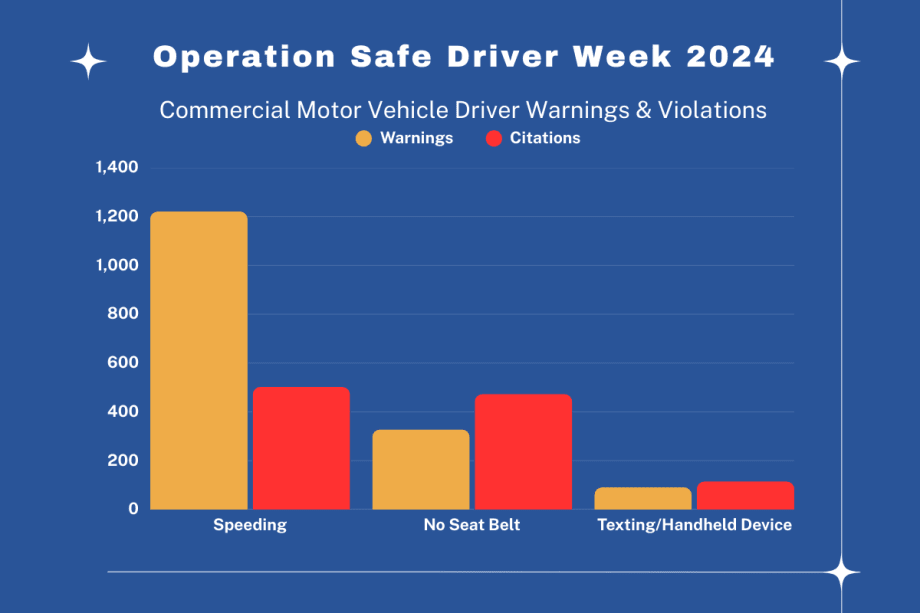
CVSA's Operation Safe Driver Week also focused on reckless driving in 2024.
Image: HDT Graphic
The Commercial Vehicle Safety Alliance will focus on reckless, careless, and dangerous driving among both truck drivers and passenger-vehicle drivers during Operation Safe Driver Week July 13-19.
Operation Safe Driver week is a safe-driving enforcement and outreach initiative aimed at improving driving behaviors through education, traffic-enforcement strategies and driver interactions with law enforcement.
Law enforcement personnel in Canada, Mexico and the U.S. will be on the lookout for commercial motor vehicle drivers and passenger vehicle drivers engaging in unsafe driving behaviors, such as speeding, distracted driving, following too closely, drunk or drugged driving, etc.
Drivers engaging in such behaviors will be pulled over by law enforcement personnel and issued a warning or citation.
The focus of this year’s Operation Safe Driver Week is reckless, careless or dangerous driving.
Any person who drives a vehicle in willful or wanton disregard for the safety of persons or property is driving recklessly.
Careless/dangerous driving is defined as operating a vehicle without due care and attention or reasonable consideration for other motorists or people on the road.
According to the U.S. National Highway Traffic Safety Administration, 42,514 people were killed in traffic crashes in 2022, CVSA noted.
CVSA’s Operation Safe Driver Program aims to address those alarming rates by reducing the number of crashes caused by unsafe driving behaviors.
What Last Year’s Operation Safe Driver Week Found
During the 2024 Operation Safe Driver Week, law enforcement officers in Canada and the U.S. pulled over 11,050 vehicles, according to CVSA.
From July 7 to 13, officers issued 2,439 warnings and 1,583 tickets/citations to commercial motor vehicle drivers and 789 warnings and 1,129 tickets/citations to passenger vehicle drivers for unsafe driving behaviors.
Five warnings and 31 citations were given to drivers for reckless, careless or dangerous driving.
Speeding was a top infraction.
Commercial motor vehicle drivers received 1,221 warnings and 502 tickets/citations.
Passenger vehicle drivers received 473 warnings and 724 citations/tickets for speed-related infractions.
Another top unsafe driving behavior identified during Operation Safe Driver Week was failure to wear a seat belt.
Commercial motor vehicle drivers received 328 warnings and 473 tickets/citations for not wearing their seat belt. According to the U.S. Federal Motor Carrier Safety Administration an estimated 14% of commercial motor vehicle drivers do not wear their seat belt.
Passenger-vehicle drivers were given 26 warnings and 81 tickets/citations for failure to wear a seat belt. NHTSA states that 8.1% of passenger vehicle drivers do not wear their seat belt.
Texting or using a handheld device was another top violation:
Passenger vehicle drivers received 67 warnings and 54 tickets/citations for texting/using a handheld device while behind the wheel.
Commercial motor vehicle drivers received 91 warnings and 115 tickets/citations for texting/using a handheld device while operating a commercial motor vehicle.
More Safety & Compliance

From One Generation to the Next: How Mentorship Builds Safer Truck Drivers
After three decades in trucking, Harold Perry shares what he's learned about driver safety, mentorship, and helping the next generation build confidence behind the wheel.
Read More →
FMCSA Pauses Biennial-Update Enforcement Amid Motus Transition
Carriers whose updates were due on or after June 1 have more time, while FMCSA works to stabilize its new registration system and warns of phishing sites impersonating its new carrier registration system, Motus.
Read More →
ZF Expands Commercial Vehicle Push in North America
ZF is expanding its North American commercial-vehicle presence with new transmission applications, electrification, trailer technology and autonomous-driving systems.
Read More →
Truck Drivers Need More Than Another Alert
Fleets have more visibility into truck health, safety events, and driver activity than ever. The next challenge is turning all that information into useful guidance for the person who has to decide what to do next.
Read More →
Tesla Wants a Self-Driving Semi. Are Cameras Enough?
Could Tesla’s camera-only autonomous driving technology work on an 80,000-pound Semi? In this commentary, HDT's Deborah Lockridge takes a look at Tesla, Cybercab, and how autonomous trucks see the road.
Read More →
What DOT’s Automated Vehicle Strategy Means for Trucking
The U.S. Department of Transportation issued a new automated-vehicle strategy that outlines plans for driverless-truck regulations, cross-state freight corridors, and federal safety standards.
Read More →
NYC Expands Speed, Pedestrian Safety Tech Across Fleet
New York City is expanding intelligent speed assistance and pedestrian-alert systems across its municipal fleet, moving the technologies from pilot programs into vehicle procurement and retrofit requirements.
Read More →
FMCSA Removes 110 Truck Driver Training Schools from Certified ELDT List
Federal regulators also are targeting more than 160 additional training providers and launching a nationwide audit of third-party CDL skills testers as part of a broader crackdown on trucking fraud.
Read More →
Beyond DOT Compliance: What Makes a Trucking Fleet Truly Safe?
A trucking fleet can follow every rule and still make unsafe decisions. The real test comes when safety conflicts with freight, productivity, or cost.
Read More →
Hours of Service Pilot Programs: FMCSA Readies for 2027 Rollout
Two pilot programs could eventually reshape hours-of-service rules, giving truck drivers options to pause their 14-hour clock or use longer split sleeper rest periods.
Read More →