




As the Clinton Administration puts the final touches on proposed driver hours of service regulations, the National Sleep Foundation released a position statement Thursday calling for new rules based on current scientific research regarding sleep.
Citing studies on fatigue, driving performance and fall-asleep crashes, NSF is urging the Department of Transportation to adopt a comprehensive system placing responsible limits on driving within a 24-hour period and mandating on-board monitoring and enforcement by compliance officers. NSF's position statement also calls for highway improvements, as well as sleep disorder screening and comprehensive educational programs to reduce fall-asleep crashes among commercial drivers.
NSF emphasizes off-duty time as one of the most important factors in regulating hours-of-service, and calls for a "12/12" rule. Specifically, says NSF, new rules should limit drivers to 12 hours on duty followed by 12 hours off duty, with one period of nine continuous hours to be used for sleep.
This is very close to what has been widely reported will be in the new rules. It is believed the proposal will call for a 10-hour rest period, with another two hours of rest required during the remaining 14-hour period, for a total of 12 on/12 off.
The NSF also wants to see the elimination of the "sleeper berth split." It says research shows that crash risks increase as the number of hours on duty increase, and that people who sleep in short periods or in environments with excessive noise and light do not obtain adequate sleep. Sleep research shows that most people need at least 8 hours of sleep to maintain proper alertness. Yet a government study found that commercial drivers abiding by today's hours-of-service rules generally obtain about 3 hours less sleep per day than what humans need to function optimally.
"Today's hours-of-service rules for commercial drivers have been in place since 1938, when highway conditions were significantly different and when very little was known about our sleep needs and the effects of fatigue on alertness," says Anne McCartt, PhD, chairman of NSF's Transportation Committee. "Given that we now know our biological clocks run on a 24-hour cycle, with distinct periods where sleepiness naturally occurs, new regulations must be based on a 24-hour clock, rather than the current system now used."
NSF cautions that hours-of-service rules alone cannot regulate driver fatigue and alertness. "Ultimately, responsibility for managing fatigue must be shared by drivers, carriers, shippers, receivers, and the government," says McCartt. "That means establishing scientifically-based rules to set maximum limits on driving time and consistently enforcing them."
In NSF's yet-to-be released 2000 "Sleep in America" omnibus poll, 51% of respondents said they had driven while drowsy during the past two weeks. Fifty-three percent of respondents said they were concerned about the number of hours that transportation workers drive. These statistics and others regarding sleepiness, safety and productivity will be released on March 28, as part of National Sleep Awareness Week 2000 (March 27-April 2).
NSF Calls For New Rules Based on 24-Hour Clock
As the Clinton Administration puts the final touches on proposed driver hours of service regulations, the National Sleep Foundation released a position statement Thursday calling for new rules based on current scientific research regarding sleep
More Safety & Compliance

Deadline Extended for HDT Truck Fleet Innovators Nominations
Heavy Duty Trucking has extended the deadline for nominations for its Truck Fleet Innovators awards. The deadline has been extended to May 22.
Read More →
Supreme Court Ruling Puts Freight Broker Vetting Practices in Spotlight
The unanimous SCOTUS ruling in the closely watched Montgomery v. Caribe case allows state negligence claims against freight brokers that hire unsafe motor carriers, raising new liability and vetting concerns among brokers.
Read More →
The Truck Safety Tech K&B Transportation Says Is Making a Difference [Watch]
Can technology help prevent truck crashes? In this HDT Talks Trucking Short Takes episode, K&B Transportation explains how it’s using cameras, speed management tools, cellphone-blocking technology, and other systems to improve safety and reduce risk across its fleet.
Read More →
Listen: Inside Modern Fleet Safety: AI, Cameras & Speed Control at K&B Transportation
Fleet safety is evolving fast—and technology is at the center of it. Learn how a former commercial vehicle enforcement officer turned director of safety at K&B Transportation is embracing real-world safety technology.
Read More →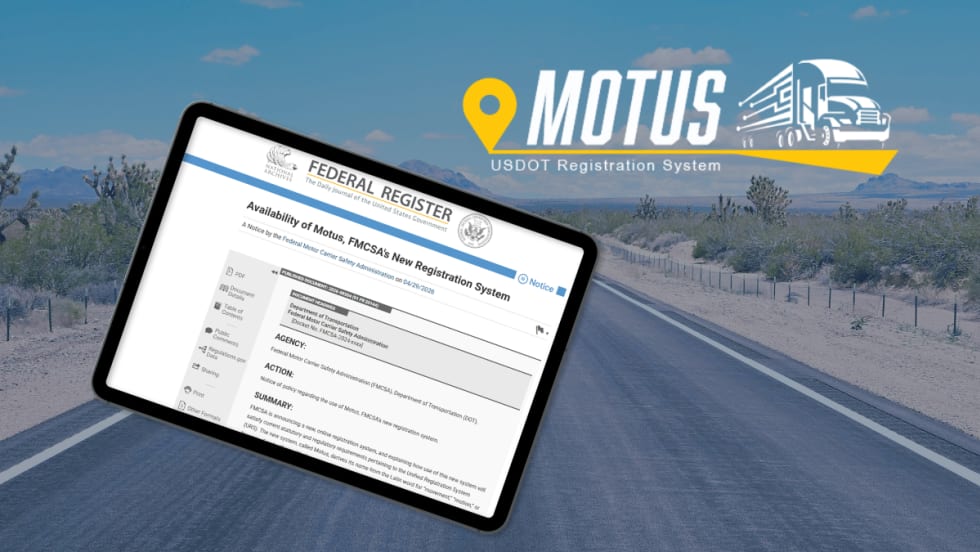
FMCSA’s Motus System Is Coming. What Fleets Need to Know Now
FMCSA's long-awaited registration system promises a single portal — and tighter fraud controls. And there are steps you need to take by May 14.
Read More →
Avoiding Winter Pileups: Don’t Become the Next Link in the Crash-Chain
Winter roadway “pileups” aren’t one crash — they’re a chain reaction. Here’s what triggers them, how truck drivers can spot the danger early, and what to do if you're suddenly trapped in the mess.
Read More →
Freightliner Expands Detroit Assurance with New Intersection and Turning Safety Tech
Detroit’s next-generation ABA6 safety system adds cross-traffic detection and enhanced side guard assist with left-turn protection, targeting high-risk urban scenarios.
Read More →
'Beyond Compliance,' Regulations, Driver Coaching on ATRI’s 2026 Research List
The American Transportation Research Institute will examine driver coaching, regulatory impacts — including the "Beyond Compliance" concept —and weather disruptions that shape trucking operations.
Read More →
FMCSA Revamps DataQs to Improve Fairness, Speed of Reviews
New requirements add firm deadlines and independent review steps, addressing long-standing complaints about inconsistent rulings and slow response times.
Read More →
FMCSA Extends Paper Medical Card Exemption … Again
Five states still aren't ready to accept commercial driver medical exam information directly from the medical examiner's registry.
Read More →