




North America Surpasses 400 RNG Facilities
There are now more than 400 operational renewable natural gas fueling facilities operating in North America, according to a new report from the Coalition for Renewable Natural Gas.

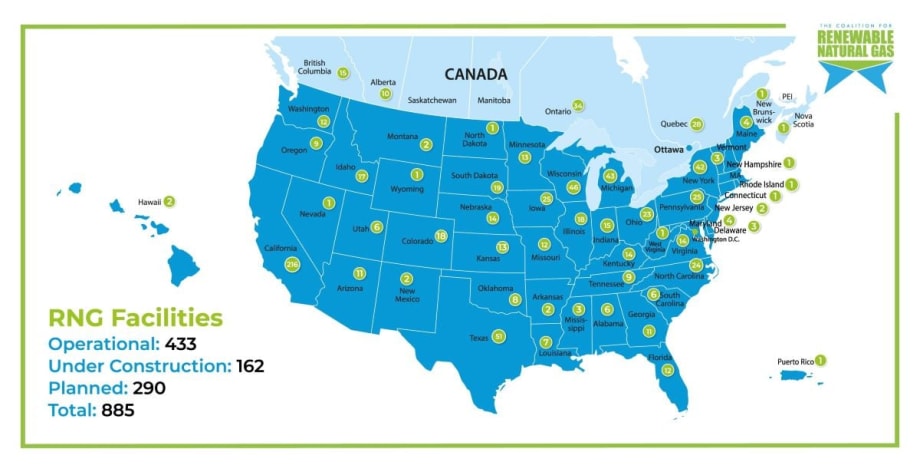
The Coalition for Renewable Natural Gas said its goal is to have 500 RNG facilities operational by 2025, 1,000 by 2030 and 5,000 by 2040.
Image: The Coalition for Renewable Natural Gas
The Coalition for Renewable Natural Gas (RNG Coalition) has announced what it called a “major” milestone in the growth of the renewable natural gas industry. According to the group, there are now 433 RNG fueling facilities now operational across North America.
This achievement represents a significant leap from just a year ago, when the North American RNG industry celebrated the establishment of 300 facilities. The RNG Coalition said this marks 44% growth within just one year.
Increasing Demand
Technological advancements and increasing demand for low-carbon energy solutions have factored into this recent surge, according to the RNG Coalition. The group added that expanding policy support remains front-and-center for the trucking industry.
The group’s goal is to have 500 RNG facilities operational by 2025, 1,000 by 2030 and 5,000 by 2040.
One notable example of encouraging policy growth is New Mexico's recently launched Clean Fuel Standard (CFS) program, which aims to reduce the carbon intensity of transportation fuels. The CFS program follows similar programs implemented successfully in California, Oregon, and Washington, providing a framework for RNG projects to thrive by creating market incentives for low-carbon fuels that displace dirty diesel and other fossil fuels.
“This is a significant milestone in the advancement of our mission and Sustainable Methane Abatement & Recycling Timeline (SMART),” RNG Coalition Founder and CEO Johannes Escudero said. “We are proud of what our organization and industry have accomplished together, but we are focused on the next benchmark, and on even broader energy sector adoption of RNG as a critical component in our society's transition to a cleaner, more sustainable future.”
Agricultural Contributions
Dairy farm-to-RNG projects represent another key driver of recent facility growth, according to the RNG Coalition. Agricultural waste now represents 24% of all feedstocks deployed toward RNG production, marking a new all-time high and an increase from 17% of all feedstocks just a year ago.
The group said that California's strides toward reducing methane emissions, including through its pioneering Low Carbon Fuel Standard program, have helped incentivize methane capture at farms across the state, with over 100 state agricultural sites now attached to operational RNG infrastructure.
As the RNG Coalition celebrates this milestone, the organization remains committed to supporting the continued growth and development of the industry. In addition to currently operational facilities, there are 436 facilities in various stages of planning or construction, creating a robust pipeline of forthcoming projects.
With ongoing collaboration between the public and private sectors, and between legislative and regulatory bodies, the Coalition envisions an even more significant role for RNG and other renewable gases as we work toward cleaner air and energy for current and future generations.
More Fuel Smarts

How Volvo Updated Its D13 for EPA 2027 [Watch]
Volvo’s updated D13 promises lower emissions without sacrificing performance or fuel economy. Take a closer look at what changed inside the engine in this HDT Spotlight video.
Read More →
Diesel Price Spike Shortens Payback for Natural Gas Trucks, Report Says
Energy Vision estimates fleets could recover the higher purchase price of an RNG-fueled Class 8 tractor in 1.3 to 2.8 years under current fuel-price scenarios.
Read More →
Calstart Becomes Catalyst Mobility, Reflecting Broader Focus
Calstart is now Catalyst Mobility, reflecting the nonprofit’s growing national role in clean transportation, including zero-emission trucks, infrastructure and incentive programs.
Read More →

Record Diesel Prices Squeeze Trucking Fleets
Average U.S. diesel prices have climbed to nearly $6 a gallon, surpassing the 2022 record as tight refinery capacity and Middle East disruptions keep fuel costs elevated.
Read More →
How Fuel Delivery Shapes Engine Performance
Fuel delivery depends on more than what happens at the injector. For fleet, maintenance and technical professionals, looking at the full path from pump to injector can provide useful context for understanding engine performance.
Read More →
East Coast Port Launches $45M Electric Truck Push
The Port Authority of New York and New Jersey announced millions in incentives for zero-emission drayage trucks, yard tractors, and new charging hubs near the port.
Read More →
California Bill Could Shed Light on Electric Truck Prices
Why do battery-electric Class 8 trucks remain so expensive? A California bill headed to Gov. Gavin Newsom would give fleets and state agencies more visibility into what manufacturers charge.
Read More →
Detroit Opens Orders for EPA 2027 Engines
Detroit isn’t starting from scratch to meet EPA 2027 diesel emissions standards. Its Gen 6 DD13 and DD15 engines keep much of today’s platform while updating the fuel and aftertreatment systems.
Read More →
Zero-Emission Truck Corridor Planned for West Coast
California, Oregon, Washington, British Columbia and Baja California are coordinating plans for truck charging and hydrogen fueling from Canada to Mexico.
Read More →
A Closer Look at Kenworth’s Electric T880E Vocational Truck [Video]
Learn more about Kenworth's T880E battery-electric vocational truck at the Paccar Technical Center, including its range, applications, upfitting considerations, and PTO options, in this HDT Spotlight video.
Read More →