




Renewable Dairy Fuels Adding RNG Plant
Located in Fair Oaks, Ind., the dairy project will be Renewable Dairy Fuels second biogas facility producing renewable natural gas from dairy waste for transportation fuel.
Imge courtesy of AMP Americas
Imge courtesy of AMP Americas
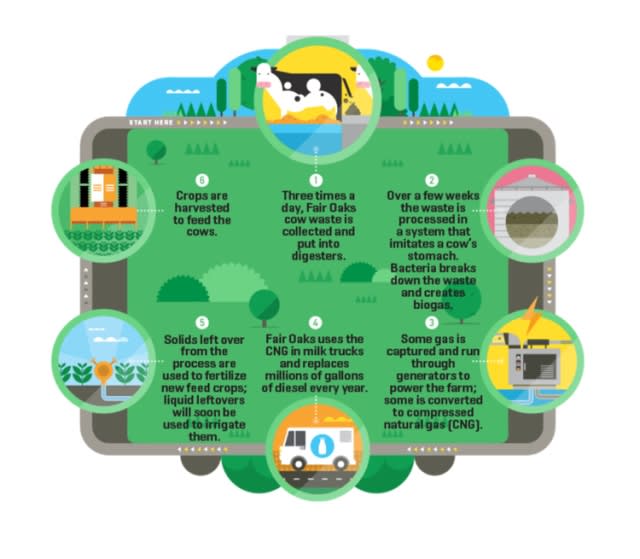
Renewable Dairy Fuels (RDF), a business unit of AMP Americas, announced that construction is underway on the country’s largest on-farm anaerobic digester-to-vehicle fuel operation. Located in Fair Oaks, Ind., the dairy project will be the company’s second biogas facility producing renewable natural gas from dairy waste for transportation fuel.
Amp Americas received the first dairy waste-to-vehicle fuel pathway certified by California's Air Resources Board (CARB) for its first RNG project at Fair Oaks Farms in northwest Indiana. The project was also awarded a Carbon Intensity (CI) score of -254.94 gCO2e/MJ, the lowest ever issued by CARB. In addition to generating renewable American energy, on-farm anaerobic digester operations improve sustainability, environmental stewardship, and energy independence.
The new facility will be 50 percent larger than RDF’s operation at Fair Oaks Farms and will be operational this summer. The site is located in Jasper County, Indiana, just a few miles from Fair Oaks Farms. Every day, three digesters located at three dairy farms will convert 950 tons of dairy waste from 16,000 head of milking cows into 100 percent renewable transportation fuel. The RNG will then be injected into the NIPSCO pipeline. Each of the digesters is a DVO, Inc. designed and built Mixed Plug Flow digester.
“Transportation is now the largest source of greenhouse gases in the U.S. and a major source of smog-causing pollution. It is more important than ever to drive further adoption of clean and efficient domestic RNG within the trucking industry,” said Grant Zimmerman, CEO at AMP Americas. “There isn’t enough RNG being produced to meet customer demand. Our new project will help make strong headway toward closing the supply gap.”
AMP Americas continues to expand its national footprint and to invest heavily in dairy RNG projects by partnering with dairy farmers across the country to bring more ultra-low CI gas to market. The company plans to more than double its dairy gas output by mid-2018, and aims to deliver Amp Renew, its 100% percent RNG product, to all 20 of its fueling stations as it brings on future projects.
More Fuel Smarts

How Volvo Updated Its D13 for EPA 2027 [Watch]
Volvo’s updated D13 promises lower emissions without sacrificing performance or fuel economy. Take a closer look at what changed inside the engine in this HDT Spotlight video.
Read More →
Diesel Price Spike Shortens Payback for Natural Gas Trucks, Report Says
Energy Vision estimates fleets could recover the higher purchase price of an RNG-fueled Class 8 tractor in 1.3 to 2.8 years under current fuel-price scenarios.
Read More →
Calstart Becomes Catalyst Mobility, Reflecting Broader Focus
Calstart is now Catalyst Mobility, reflecting the nonprofit’s growing national role in clean transportation, including zero-emission trucks, infrastructure and incentive programs.
Read More →

Record Diesel Prices Squeeze Trucking Fleets
Average U.S. diesel prices have climbed to nearly $6 a gallon, surpassing the 2022 record as tight refinery capacity and Middle East disruptions keep fuel costs elevated.
Read More →
How Fuel Delivery Shapes Engine Performance
Fuel delivery depends on more than what happens at the injector. For fleet, maintenance and technical professionals, looking at the full path from pump to injector can provide useful context for understanding engine performance.
Read More →
East Coast Port Launches $45M Electric Truck Push
The Port Authority of New York and New Jersey announced millions in incentives for zero-emission drayage trucks, yard tractors, and new charging hubs near the port.
Read More →
California Bill Could Shed Light on Electric Truck Prices
Why do battery-electric Class 8 trucks remain so expensive? A California bill headed to Gov. Gavin Newsom would give fleets and state agencies more visibility into what manufacturers charge.
Read More →
Detroit Opens Orders for EPA 2027 Engines
Detroit isn’t starting from scratch to meet EPA 2027 diesel emissions standards. Its Gen 6 DD13 and DD15 engines keep much of today’s platform while updating the fuel and aftertreatment systems.
Read More →
Zero-Emission Truck Corridor Planned for West Coast
California, Oregon, Washington, British Columbia and Baja California are coordinating plans for truck charging and hydrogen fueling from Canada to Mexico.
Read More →
A Closer Look at Kenworth’s Electric T880E Vocational Truck [Video]
Learn more about Kenworth's T880E battery-electric vocational truck at the Paccar Technical Center, including its range, applications, upfitting considerations, and PTO options, in this HDT Spotlight video.
Read More →