




NHTSA to Hold Hearing on Electronic Stability Control Proposal
The National Highway Traffic Safety Administration will host a public hearing in Washington, D.C., next week to get reaction to its proposed mandate for electronic stability control systems on heavy-duty trucks and buses
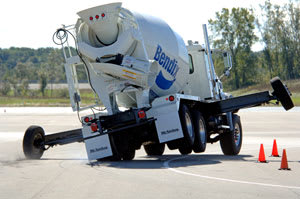
Mack demonstrates how a mixer can start to tip over without stability control.
The National Highway Traffic Safety Administration will host a public hearing in Washington, D.C., next week to get reaction to its proposed mandate for electronic stability control systems on heavy-duty trucks and buses.
The hearing will be held July 24 at the Department of Transportation, from 10 a.m.-1 p.m. Anyone wishing to testify should email Christopher Morris (Christopher.morris@dot.gov) of the NHTSA Office of Rulemaking.
The systems, which already are used by some carriers, detect the risk of rollover or instability and slow the truck by cutting back the throttle and applying the brakes automatically.
The proposed rule, aimed at vehicles rated 26,000 pounds or more, would be phased in over two to four years after it goes through public comment and becomes final, a process that probably will take a year or more.
The agency says ESC systems could prevent up to 56% of rollover crashes each year and another 14% of loss-of-control crashes. That translates to about 2,329 crashes, between 649 and 858 injuries, and between 49 and 60 fatalities a year.
Many carriers already have adopted stability control systems. The agency estimates that 26% of tractors built in the 2012 model year will be equipped with ESC. More than 16% are being built with a related type of system, roll stability control.
The agency is looking for comments on these issues:
- The size of the safety problem related to HD tractors and buses
- How ESC works to prevent rollover and loss of control
- The research and testing that underpin the proposal and the testing maneuvers used to evaluate performance
- The details of the proposal, including ESC equipment and performance criteria, compliance testing and the implementation schedule
Related Stories:
Major Trucking Players React Positively to NHTSA's Stability Control Proposal
Building Safer Trucks
The Feds' Safety Wish List
More Drivers

EEOC Sues Texas Trucking Company Over Driver Age Limits
The agency says Trancasa USA rejected applicants over 65 and applied tougher driving-record standards to those over 60.
Read More →
Nussbaum, Roehl Announce Second Driver Pay Increase This Year
This year has seen a swath of major truck driver pay increases as freight capacity has tightened.
Read More →
From One Generation to the Next: How Mentorship Builds Safer Truck Drivers
After three decades in trucking, Harold Perry shares what he's learned about driver safety, mentorship, and helping the next generation build confidence behind the wheel.
Read More →
Truck Drivers Need More Than Another Alert
Fleets have more visibility into truck health, safety events, and driver activity than ever. The next challenge is turning all that information into useful guidance for the person who has to decide what to do next.
Read More →
FMCSA Removes 110 Truck Driver Training Schools from Certified ELDT List
Federal regulators also are targeting more than 160 additional training providers and launching a nationwide audit of third-party CDL skills testers as part of a broader crackdown on trucking fraud.
Read More →
Hours of Service Pilot Programs: FMCSA Readies for 2027 Rollout
Two pilot programs could eventually reshape hours-of-service rules, giving truck drivers options to pause their 14-hour clock or use longer split sleeper rest periods.
Read More →
Medical Cards, English Proficiency Reshape Roadcheck Violations
Medical-card violations jumped to the top of the driver out-of-service list during CVSA’s 2026 International Roadcheck, while English-language proficiency violations appeared among the leading violations for the first time.
Read More →
Driver Trust Can Make or Break the Success of Fleet Safety Technology
New Teletrac Navman research suggests that onboarding, transparency about driver data, and positive feedback can play a significant role in how commercial drivers respond to safety and coaching technology.
Read More →
EEOC Sues KLLM Over Alleged Sex Discrimination in Driver Training
KLLM is facing a federal sex-discrimination lawsuit over policies the EEOC alleges put female truck driver trainees at a disadvantage.
Read More →
FMCSA Moves to Codify English Language Requirements for Commercial Drivers
By changing regulations on English-language proficiency requirements for commercial drivers, rather than relying on a guidance memo, the FMCSA said future administrations won't be able to walk back the Trump administration's stricter enforcement with just a memo.
Read More →