




NGVA Hails DOT's Adoption of its Recommended CNG Inspection Procedures
U.S. Department of Transportation’s National Highway Traffic Safety Administration for updating its heavy-duty natural gas vehicle fuel system tank inspection labeling requirements now match recommended guidance procedures the NGVA previously developed after a lengthy and collaborative review process.

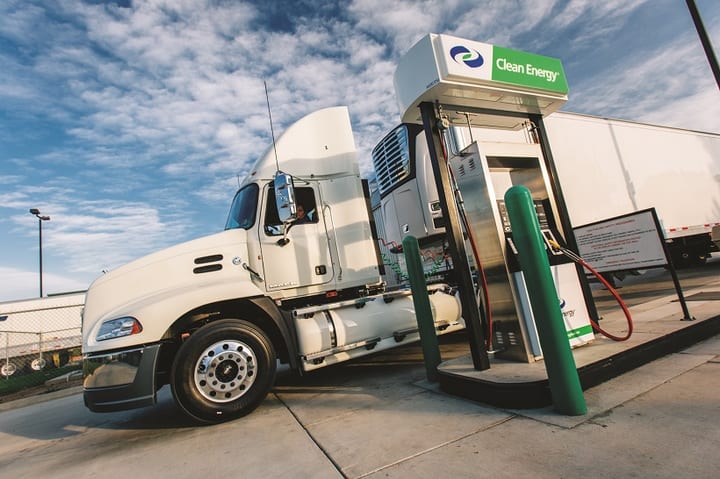
NGVAmerica’s December 2017 guidance breaks down suggested CNG fuel system inspection into four tiers which have been adopted by the U.S. Department of Transportation.
Photo: Clean Energy Fuels
NGVAmerica, (NGVA), the national trade association for natural gas use in transportation, has issued a statement applauding the U.S. Department of Transportation’s National Highway Traffic Safety Administration for updating its heavy-duty natural gas vehicle fuel system tank inspection labelling requirements. The new set of regulations now match recommended guidance procedures the NGVA previously developed after a lengthy and collaborative review.
“This announcement from NHTSA compliments the updated four-tiered inspection and review process NGVAmerica developed with comprehensive industry support and input from the American Trucking Associations,” said NGVAmerica President Daniel Gage. “Per industry recommended practices, full, detailed inspections should be performed annually or whenever cursory reviews uncover signs that a more detailed inspection is needed. Furthermore, recommended reviews and inspections are expanded to cover the entire fuel system and not just the CNG storage system.”
In December 2017, NGVAmerica released itsrecommended Compressed Natural Gas (CNG) Fuel System Inspection Guidance document after two years of discussion and review. After issuing the updated guidance, NGVAmerica petitioned the U.S. Department of Transportation to remove the mileage requirement and change the 36 months to 12 months for heavy-duty vehicles. A summary of the expected June 21st Notice of Proposed Rulemaking (NPRM) reads:
“In response to petitions for rulemaking from the American Trucking Associations (ATA) and the Natural Gas Vehicles for America (NGVAmerica), NHTSA is proposing to amend the visual inspection labelling requirement in Federal Motor Vehicle Safety Standard (FMVSS) No. 304, “Compressed natural gas fuel container integrity,” to state that CNG fuel containers used on heavy vehicles should be inspected at least once every 12 months. NHTSA is proposing this change because CNG heavy vehicles are typically used in high-mileage commercial fleet operations and following the current mileage-based inspection interval on the label means conducting multiple visual inspections per year.
NHTSA has tentatively concluded multiple visual inspections per year based solely on mileage would not improve vehicle safety for these high-mileage CNG heavy vehicles and could potentially reduce safety. Because the current periodic visual inspection interval is intended for light vehicles and is consistent with the operation of these vehicles, no change is proposed to the periodic visual inspection interval for CNG fuel containers on light vehicles.”
NGVAmerica’s December 2017 guidance breaks down suggested CNG fuel system inspection into four tiers. The document recommends detailed visual inspection on an annual basis. A summary of the four-tiered recommendation is as follows:
Pre-service visual inspection: This is a detailed inspection of the complete CNG fuel system prior to the vehicle being placed into service. This inspection is to verify that the CNG fuel system installed meets specifications and applicable codes/standards.
Cursory visual inspection: This inspection should be done every pre- and post-trip by the driver. During this inspection the driver is checking that there is no damage to the exterior of the fuel system, including the fill receptacle, and that vent lines are capped.
General visual inspection: This should be conducted at preventative maintenance events by a trained technician. During this inspection, the technician is inspecting the shields and enclosures of the CNG fuel system along with any readily accessible CNG fuel system components.
Detailed visual inspection: The final level of inspection is intended to be a thorough inspection of the entire CNG fuel system. This level of inspection will likely require the removal of shielding and/or the use of mirrors and cameras to visually access all components.
Work Group Leaders responsible for developing NGVAmerica’s guidance included Duane Lippincott, United Parcel Service; Leo Thomason, Natural Gas Vehicle Institute; and Matt Krasney and Dean Stapleton, Penske Truck Rental. Representatives from Agility Fuel Systems, SoCal Gas, Ryder, PepsiCo, Waste Management, FortisBC, Clean Energy, Chart, McNeilus, Worthington, Hexagon Lincoln, Momentum, Daimler, CSA Group, U.S. DOT, and the American Trucking Association participated in the document development.
Following a scheduled posting by DOT on June 22, 2019, inb the Federal Register, there will be a 60-day for public input before the new Federal rule is finalized. The NPRM can be accessed at https://federalregister.gov/d/2019-12895.
More Fuel Smarts

How Volvo Updated Its D13 for EPA 2027 [Watch]
Volvo’s updated D13 promises lower emissions without sacrificing performance or fuel economy. Take a closer look at what changed inside the engine in this HDT Spotlight video.
Read More →
Diesel Price Spike Shortens Payback for Natural Gas Trucks, Report Says
Energy Vision estimates fleets could recover the higher purchase price of an RNG-fueled Class 8 tractor in 1.3 to 2.8 years under current fuel-price scenarios.
Read More →
Calstart Becomes Catalyst Mobility, Reflecting Broader Focus
Calstart is now Catalyst Mobility, reflecting the nonprofit’s growing national role in clean transportation, including zero-emission trucks, infrastructure and incentive programs.
Read More →

Record Diesel Prices Squeeze Trucking Fleets
Average U.S. diesel prices have climbed to nearly $6 a gallon, surpassing the 2022 record as tight refinery capacity and Middle East disruptions keep fuel costs elevated.
Read More →
How Fuel Delivery Shapes Engine Performance
Fuel delivery depends on more than what happens at the injector. For fleet, maintenance and technical professionals, looking at the full path from pump to injector can provide useful context for understanding engine performance.
Read More →
East Coast Port Launches $45M Electric Truck Push
The Port Authority of New York and New Jersey announced millions in incentives for zero-emission drayage trucks, yard tractors, and new charging hubs near the port.
Read More →
California Bill Could Shed Light on Electric Truck Prices
Why do battery-electric Class 8 trucks remain so expensive? A California bill headed to Gov. Gavin Newsom would give fleets and state agencies more visibility into what manufacturers charge.
Read More →
Detroit Opens Orders for EPA 2027 Engines
Detroit isn’t starting from scratch to meet EPA 2027 diesel emissions standards. Its Gen 6 DD13 and DD15 engines keep much of today’s platform while updating the fuel and aftertreatment systems.
Read More →
Zero-Emission Truck Corridor Planned for West Coast
California, Oregon, Washington, British Columbia and Baja California are coordinating plans for truck charging and hydrogen fueling from Canada to Mexico.
Read More →
A Closer Look at Kenworth’s Electric T880E Vocational Truck [Video]
Learn more about Kenworth's T880E battery-electric vocational truck at the Paccar Technical Center, including its range, applications, upfitting considerations, and PTO options, in this HDT Spotlight video.
Read More →