




New York City Taking 'Cargo Bikes' for a Spin
Aiming to get some diesel-powered delivery trucks off the streets, the Big Apple has approved a pilot to evaluate the performance of "cargo bicycles" on its streets, loading zones, bike lanes, and sidewalks.

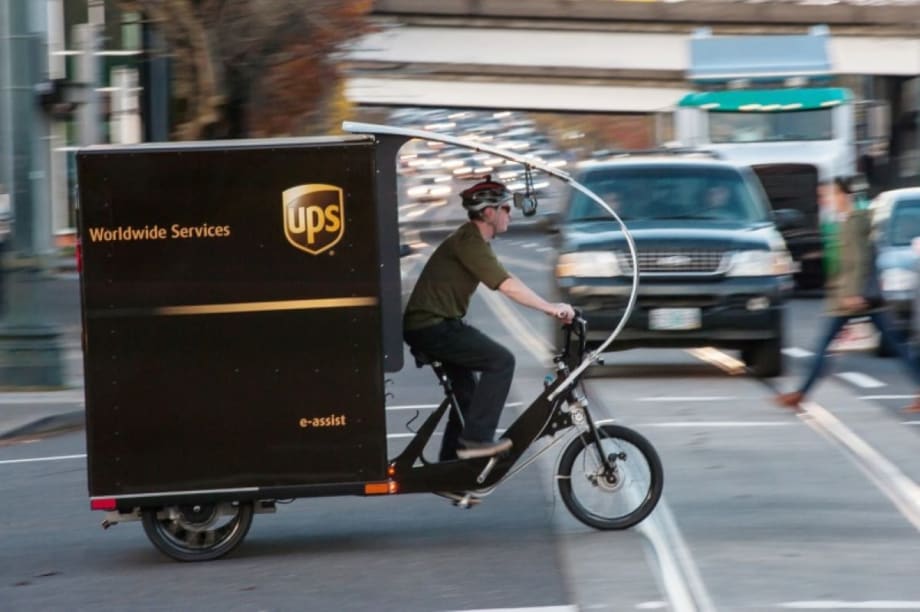
The Big Apple is working with a host of parcel-delivery fleets to evaluate the use of cargo bicycles to reduce congestion and diesel emissions in Manhattan.
Photo: UPS
From truck driver to bike rider? In an autonomous future where robots pilot trucks through city streets, pedaling a "cargo bicycle" may become a new career choice for working adults. In fact, some "truckers" already are pedalers.
Cargo bikes have been an urban delivery staple in major European and Asian cities for some time now. And it appears New York City is about to give this decidedly old-school transportation method a trial run to see if bicycle-driven deliveries can move some delivery trucks off of its crowded streets while reducing diesel emissions.
According to recent news reports, including from The New York Times and StreetsblogNYC, the Big Apple is rolling out a pilot program in conjunction with Amazon, DHL, UPS, and other parcel delivery companies to evaluate how cargo bikes will perform making deliveries that are the domain of diesel-powered trucks.
A report by The New York Times states that the program, announced on Dec. 4, will permit as many as 100 pedal-assisted cargo bikes operated by Amazon, UPS and DHL and other P&D fleets to park in hundreds of existing commercial loading areas that are typically reserved for trucks and vans. Unlike those vehicles, the bikes will not have to feed parking meters.
UPS has long expressed a desire to operate cargo bikes in New York City, according to a StreetsblogNYC post, provided the bicycles would be able to park in loading zones usually reserved for trucks to expedite their deliveries. The carrier began operating cargo bikes with a “modular package delivery trailer” in Seattle last year. UPS said it already operates dozens of cargo bikes in major cities around the globe, after introducing them in Hamburg, Germany, in 2012.
DHL also operates cargo bikes in major cities around the world. ”Cargo bicycles will play an important role in hitting our environmental targets," Mike Parra, DHL Express Americas CEO, said of the New York City initiative. "The DHL Cubicycle has enjoyed great success in Europe, with each bicycle deployed taking at least one conventional delivery van off the road, helping to relieve congestion and increasing our service levels,” “We are grateful to the City of New York for enabling this pilot and hope to see the DHL Cubicycle have a similar positive impact on the city’s transport network.”
The New York Times also reported that smaller cargo bikes will also be allowed to park on wider sidewalks in the Big Apple. And under the pilot program guidelines, cargo bikes wil be able to travel along the city’s growing network of more than 1,400 miles of bike lanes.
Under the pilot program, the cargo bikes will be concentrated in the most congested parts of Manhattan, from 60th Street south to the Battery.
More Fuel Smarts

How Volvo Updated Its D13 for EPA 2027 [Watch]
Volvo’s updated D13 promises lower emissions without sacrificing performance or fuel economy. Take a closer look at what changed inside the engine in this HDT Spotlight video.
Read More →
Diesel Price Spike Shortens Payback for Natural Gas Trucks, Report Says
Energy Vision estimates fleets could recover the higher purchase price of an RNG-fueled Class 8 tractor in 1.3 to 2.8 years under current fuel-price scenarios.
Read More →
Calstart Becomes Catalyst Mobility, Reflecting Broader Focus
Calstart is now Catalyst Mobility, reflecting the nonprofit’s growing national role in clean transportation, including zero-emission trucks, infrastructure and incentive programs.
Read More →

Record Diesel Prices Squeeze Trucking Fleets
Average U.S. diesel prices have climbed to nearly $6 a gallon, surpassing the 2022 record as tight refinery capacity and Middle East disruptions keep fuel costs elevated.
Read More →
How Fuel Delivery Shapes Engine Performance
Fuel delivery depends on more than what happens at the injector. For fleet, maintenance and technical professionals, looking at the full path from pump to injector can provide useful context for understanding engine performance.
Read More →
East Coast Port Launches $45M Electric Truck Push
The Port Authority of New York and New Jersey announced millions in incentives for zero-emission drayage trucks, yard tractors, and new charging hubs near the port.
Read More →
California Bill Could Shed Light on Electric Truck Prices
Why do battery-electric Class 8 trucks remain so expensive? A California bill headed to Gov. Gavin Newsom would give fleets and state agencies more visibility into what manufacturers charge.
Read More →
Detroit Opens Orders for EPA 2027 Engines
Detroit isn’t starting from scratch to meet EPA 2027 diesel emissions standards. Its Gen 6 DD13 and DD15 engines keep much of today’s platform while updating the fuel and aftertreatment systems.
Read More →
Zero-Emission Truck Corridor Planned for West Coast
California, Oregon, Washington, British Columbia and Baja California are coordinating plans for truck charging and hydrogen fueling from Canada to Mexico.
Read More →
A Closer Look at Kenworth’s Electric T880E Vocational Truck [Video]
Learn more about Kenworth's T880E battery-electric vocational truck at the Paccar Technical Center, including its range, applications, upfitting considerations, and PTO options, in this HDT Spotlight video.
Read More →