




Navistar’s Sass Surveys the Road Ahead for HDTX Attendees
As Navistar works to move past the mistakes of the past and looks ahead to the future, International Trucks’ Jeff Sass opened HDT’s inaugural Heavy Duty Trucking eXchange fleet networking conference in Phoenix this week with a peek at the future, from electric trucks to autonomous vehicles


Jeff Sass addressing attendees of first HDTX fleet networking conference.
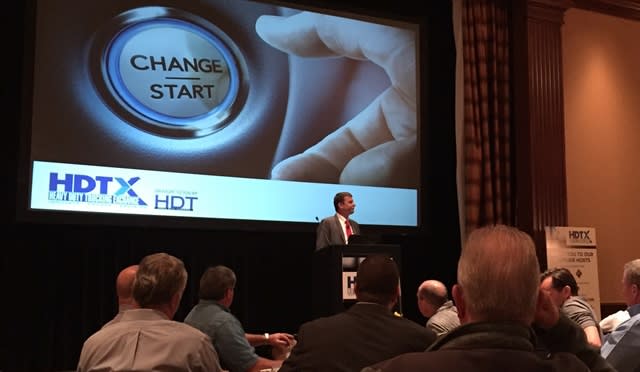
Jeff Sass addressing attendees of first HDTX fleet networking conference.
As Navistar works to move past the mistakes of the past and looks ahead to the future, International Trucks’ Jeff Sass opened HDT’s inaugural Heavy Duty Trucking eXchange fleet networking conference in Phoenix this week with a peek at the future, from electric trucks to autonomous vehicles. HDTX is a new invitation-only event for select truck fleet executives co-hosted by an array of suppliers.
Sass, senior vice president, North America Truck Sales and Marketing, was up front about how the company’s failed emissions compliance strategy is still affecting customers plagued with reliability issues, but forthrightly dealt with customer questions and complaints. And he pointed out that Navistar has an all-new engine, the A26, introduced at the American Trucking Associations’ Technology & Maintenance Council meeting earlier this year.
“All the people involved in the MaxxForce program are gone,” he said. The 12.4-liter A26 is the first product of Navistar’s Project Alpha and was designed with drivers and uptime in mind, he said.
“But connected trucks is really where the industry is headed,” Sass said. Trucks will talk to each other, to the infrastructure around them, and to their owners. Reprogramming trucks remotely and being able to do advanced prognosis on trucks, he said, are “another aspect of making it easier to drive the trucks. Because we have a significant driver shortage.
“We as an industry have adopted advances in automated connected vehicle technology,” he continued, noting that advanced driver assistance systems, such as lane departure warning, collision mitigation and cameras, are making truck driving easier and safer — and, he said, “will lead at some point to autonomous, driverless trucks.
“Now, do I believe that on I-10 out here at 3 o’clock in the afternoon as my wife is driving my two daughters to soccer practice that there will be a truck with no driver in it? No. But there are short-term applications where driverless will make sense.”
He then offered a couple of examples:
Congested intermodal ports. At the Port of Long Beach, there’s a 4-mile-long line as drivers wait to pick up containers. “Every minute that driver is in that truck goes against their hours of service,” he said. “Why can’t that line be completely autonomous, driverless, inching forward minute by minute, and as it gets to be fourth in line the driver gets an alert, hops in the truck, and saves all that time and productivity?
In fleet yards. While visiting a fleet recently, he observed a driver checking in at the guard shack, then going to the fueling bay, to the wash bay, parking the trailer, then parking the truck, a process that took some 17 minutes. “Why couldn’t that driver get out at the guard desk and go to the locker room and then autonomously have that truck go to the fuel bay, go to the wash bay, park the trailer, park the truck?” Sass suggested. “No one is going to have a problem with a truck on private property operating by itself.”
He said another technology on the way is electric trucks. The cost of battery storage is rapidly diminishing, he said, and right now it’s about $185 per kilowatt hour. “If we can get it down to about $100 per kilowatt hour, you will find the inflection point where electric and diesel cross. So, at 100ish dollars per kilowatt hour that’s where it will make economic sense. Elon Musk [of Tesla] says it’s going to be in three years. Most people are saying around 2025.”
Platooning is a reality as far as technology goes, Sass said, but he’s not sure the commercial model is there yet. “I’ve seen it happen at our test track in New Carlisle, Indiana. Two trucks 30 feet apart from each other going at 60 mph. Doesn’t sound like that big of a deal until you’re in that trail truck. It’s really close. Really close. If it brakes or has to veer, they talk to each other, the trucks know, and it’s been very safe for us.”
However, he said, “can you imagine two fleets that are competitors with one another, both on I-10 right here in Phoenix at 2 in the morning, debating who goes in front? Because the trail truck is the one that gets 90% of the benefit. So, until there’s some sort of legislation, or tax credit, or something that provides a commercial aspect to it,” that’s unlikely to happen, he contended.
Looking further down the road, he said that maybe there will be cabless autonomous electric vehicles — “kind of just a battery on wheels that pulls a trailer.” Perhaps there will be remote dispatching, where autonomous trucks that go from hub to hub and autodock at hubs will be controlled by someone pushing buttons on a screen — or a hologram.
But in the nearer future, he said, there’s still a role for drivers, a very important one.
“With all the increases of electronics on the truck … the role of a driver is becoming more like a pilot,” he said — the pilot handles takeoff and landing, with autopilot used in between, with pilots still right there in case there’s a problem. “I was on my 47th American Airlines flight this year this morning, and I’ll tell you, I feel very comfortable walking in and seeing that there’s pilots sitting in the cockpit. I don't know that I would actually get on a plane without a pilot. There will be drivers in our trucks for a long period of time.”
Stay tuned for more information on the Work Truck Exchange, which will be connecting a select group of commercial fleet managers responsible for light and medium-duty truck and van fleets with industry suppliers at the Pointe Hilton Tapatio Cliffs Resort in Phoenix, Arizona, November 6-8, 2017.
More Fleet Management

Nominations Open for HDT Emerging Leaders
Heavy Duty Trucking is looking for accomplished trucking fleet professionals under 40 who are making an impact and helping lead the industry forward.
Read More →
Why Private Fleets Are Taking More Freight
Private fleets are putting their own trucks on demanding customers and high-cost lanes as companies seek greater control over service, costs, and capacity.
Read More →
Color Match Smarter: Tools That Restore & Perform
For fleet managers and collision repair professionals keeping heavy-duty trucks on the road, getting the color right the first time isn't just about appearance — it's about efficiency, turnaround time, and bottom-line results. Discover how today's digital color tools are transforming the repair process from guesswork to precision.
Read More →


FMCSA Pauses Biennial-Update Enforcement Amid Motus Transition
Carriers whose updates were due on or after June 1 have more time, while FMCSA works to stabilize its new registration system and warns of phishing sites impersonating its new carrier registration system, Motus.
Read More →
2026 Blueprint for Countering Smarter Supply Chain Theft
Cargo theft is no longer just the cost of doing business. It's a multi-billion-dollar criminal enterprise exploiting vulnerabilities across your fleet, drivers, and supply chain.
Read More →
How Telematics Improves Visibility, Control, and Performance in Refrigerated Fleets
Explore how telematics help refrigerated fleets improve visibility, uptime, efficiency, compliance, and cargo protection across connected cold chain operations.
Read More →
What the U.S.-Canada Trade War Means for Trucking
Escalating U.S.-Canada tariffs could disrupt cross-border freight, reduce truck volumes, raise costs, and create new uncertainty for carriers on both sides of the border.
Read More →
What Are Trucking’s Top Concerns for 2026?
The American Transportation Research Institute wants to know what's worrying trucking fleet managers, drivers, and other stakeholders in its annual Industry Issues survey.
Read More →
American Trucking Associations Looks for a New Leader
ATA President and CEO Chris Spear abruptly left his job at the association on August 21, at a pivotal time for the trucking industry.
Read More →
Public Wi-Fi Cybersecurity Risks: How Truck Drivers and Fleets Can Protect Their Data
Public Wi-Fi can expose truck drivers and fleets to credential theft, malware, and other cyber threats. Here’s how to reduce the risk on the road.
Read More →