





Related: Navistar Opens Used-Truck Center
Navistar Pins Q2 Loss on New Vehicle Sales, Used Trucks
Navistar International reported a second quarter 2017 net loss of $80 million on revenues of $2.1 billion. The truck and engine maker attributed those results to lower U.S. and Canada sales of its trucks and buses and to heightened used-truck losses.
June 7, 2017
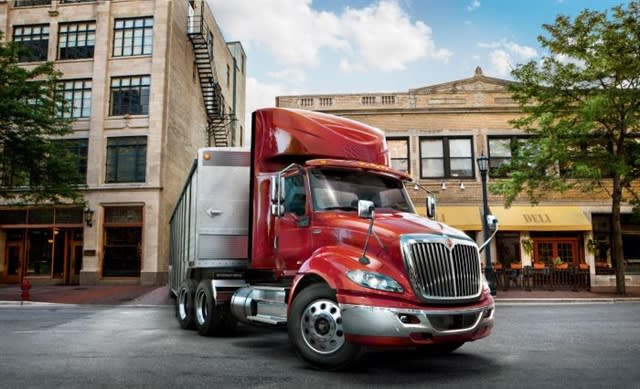
International RH Series Photo: Navistar
4 min to read
International RH SeriesPhoto: Navistar
Navistar International Corp. (NYSE: NAV) reported a second quarter 2017 net loss of $80 million on revenues of $2.1 billion. The truck and engine maker attributed those results to lower U.S. and Canada sales of its trucks and buses and to heightened used-truck losses.
Revenues in the quarter were down 5% (compared to $2.2 billion in Q2 2016), according to the company’s June 7 earnings release. Navistar said that decrease “primarily reflects lower volumes in the company’s core (Class 6-8 trucks and buses in the United States and Canada) market, where chargeouts were down 5%, but [were] higher than industry core market volumes, which were down 13% year-over-year.”
Navistar also reported that higher used truck losses led it to take a $60 million charge in the second quarter, pointing out that its inventory of “legacy” MaxxForce-13-powered used trucks was the largest contributor to the year-over-year decline.
As a result, the company stated it is changing its sales strategy for these units, trying to sell more units into export markets, "a move it expects will accelerate efforts to reduce its inventories of these trucks.”
The Q2 results also included $18 million in adjustments, primarily from pre-existing warranties, asset impairment charges, restructuring of manufacturing operations, and debt financing charges.
“We are on track to improve on last year’s results, but still have quite a bit of work to do in the second half,” said Troy A. Clarke, Navistar chairman, president and CEO. “However, the work we’ve done in the first six months growing share, building our backlog, and managing costs, combined with improving industry conditions, positions us to deliver a stronger second half.”
Navistar reported that Q2 EBITDA was $47 million, compared to $135 million a year earlier. It also said that it ended Q2 with $949 million in consolidated cash, cash equivalents, and marketable securities. Manufacturing cash, cash equivalents and marketable securities were $918 million at the end of the quarter.
Other highlights of the earnings release, as stated by Navistar, include:
Improving core market share, with additions to the company’s production schedule and extensions of the company’s backlog into the fourth quarter.
Strengthening competitive presence in the Class 8 market, including ramped-up deliveries of the new International LT Series with the Cummins ISX 15L engine; introduction of the new RH Series of Class 8 regional haul tractors; and unveiling of the new International A26 12.4L engine, which launches in the LT and RH Series in the coming weeks.
Significant defense wins, including two foreign military contracts to reset, upgrade and support 1,085 long wheel base MaxxPro Mine Resistant Ambush Protected (MRAP) vehicles; and to produce and support 40 MaxxPro Dash DXM MRAP vehicles for foreign military sales.
Progress on new sources of revenue, including full-run-rate production of General Motors’ cutaway G van at Navistar’s Springfield, Ohio, plant; expansion of Navistar’s connected vehicle services under the OnCommand Connection brand, which now includes more than 300,000 subscribers; announcing its Electronic Driver Log app, which will assist smaller fleets and owner-operators in complying with new federal regulations; and the unveiling of OnCommand Connection Marketplace, a new, open-architecture, cloud-based technology platform for a broad range of driver support tools and applications.
Closing its wide-ranging strategic alliance with Volkswagen Truck & Bus, under which the two companies are already collaborating on a number of potential technology projects, and in a procurement joint venture, which is identifying cost-saving opportunities and is expected to be accretive year one.
Naming Persio V. Lisboa as executive vice president and chief operating officer. “Persio played a key role in creating our alliance with Volkswagen Truck & Bus, and led many of the initiatives to improve our operations during the turnaround,” Clarke said. “His focus in this new role will be to build on the progress we’ve made over the last four years.”
Navistar also reiterated its 2017 guidance, including its forecast that retail deliveries of Class 6-8 trucks and buses in the U.S. and Canada will be in the range of 305,000 to 335,000 units for fiscal year 2017. The company added that full-year 2017 revenues are expected to be similar to 2016; full-year 2017 adjusted EBITDA is expected to be higher than 2016, and fiscal year end 2017 manufacturing cash is expected to be about $1 billion.
More Equipment

How Volvo Updated Its D13 for EPA 2027 [Watch]
Volvo’s updated D13 promises lower emissions without sacrificing performance or fuel economy. Take a closer look at what changed inside the engine in this HDT Spotlight video.
Read More →
Michelin Tire Improves Efficiency and Durability for Regional Fleets
The Michelin X Multi Energy D2 is a regional haul drive tire engineered to help fleets improve fuel efficiency, durability and traction in demanding stop-and-go operations.
Read More →
ZF Expands Commercial Vehicle Push in North America
ZF is expanding its North American commercial-vehicle presence with new transmission applications, electrification, trailer technology and autonomous-driving systems.
Read More →
Tesla Wants a Self-Driving Semi. Are Cameras Enough?
Could Tesla’s camera-only autonomous driving technology work on an 80,000-pound Semi? In this commentary, HDT's Deborah Lockridge takes a look at Tesla, Cybercab, and how autonomous trucks see the road.
Read More →
Kodiak: Driverless Long-Haul Truck Launch on Track for 2026
Kodiak AI says its driverless long-haul safety case is 93% complete and it remains on track to begin commercial operations by year-end 2026.
Read More →
What DOT’s Automated Vehicle Strategy Means for Trucking
The U.S. Department of Transportation issued a new automated-vehicle strategy that outlines plans for driverless-truck regulations, cross-state freight corridors, and federal safety standards.
Read More →
East Coast Port Launches $45M Electric Truck Push
The Port Authority of New York and New Jersey announced millions in incentives for zero-emission drayage trucks, yard tractors, and new charging hubs near the port.
Read More →
PlusAI Going Public to Fund Autonomous Truck Launch
A SPAC deal could provide PlusAI with up to $300 million as it works toward a 2027 commercial launch of factory-built autonomous trucks.
Read More →
NHTSA Moves to Rewrite Truck Fuel-Economy Rules
The National Highway Traffic Safety Administration says it lacks authority to regulate medium- and heavy-duty truck engines separately from complete vehicles, but the existing standards have not yet been eliminated.
Read More →
Detroit Opens Orders for EPA 2027 Engines
Detroit isn’t starting from scratch to meet EPA 2027 diesel emissions standards. Its Gen 6 DD13 and DD15 engines keep much of today’s platform while updating the fuel and aftertreatment systems.
Read More →