




National Spot Rates Stuck, Obscuring Regional Strengths
The number of available loads on the spot freight market moved higher during the most recent week as truck capacity was unchanged, but it wasn’t enough to push average rates up, according to DAT Solutions and its network of load boards.

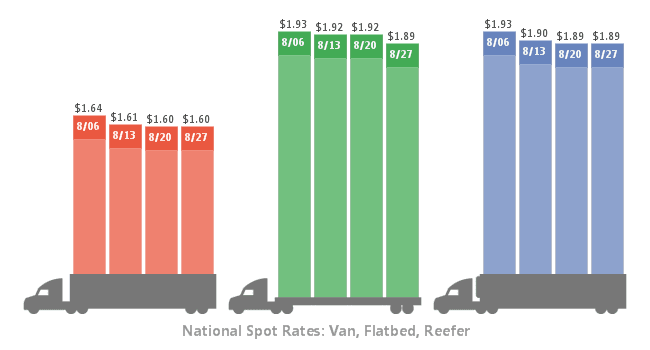
DAT Solutions four-week spot freight rate trends. Graphic: DAT
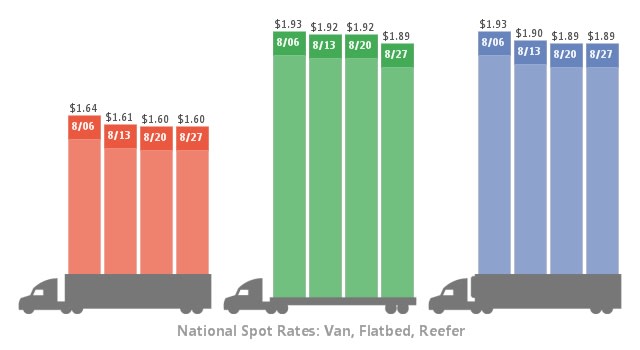
DAT Solutions four-week spot freight rate trends. Graphic: DAT
The number of available loads on the spot freight market moved higher during the most recent week as truck capacity was unchanged, but it wasn’t enough to push average rates up, according to DAT Solutions and its network of load boards.
The number of spot market loads increased 4.7% for the week ending Aug. 27 compared to the previous seven-day period, due primarily to gains in the amount of van and reefer loads.
As for rates, the average for vans was unchanged at $1.60 per mile as outbound rates increased in the Canadian-gateway markets of Buffalo and Seattle, but fell in Houston. Compared to three weeks earlier, the average is down 3 cents.
Reefers also held steady, but slightly higher, at an average of $1.89 per mile. Reefer prices showed gains in Atlanta and Grand Rapids, Mich., but were lower in McAllen, Texas. National average rates are down 4 cents compared to three weeks ago.
The loser of the three main sectors was flatbeds, with the average rate falling 3 cents over the past week to $1.89 per mile – down 4 cents from three weeks earlier.
The lack of increase in rates came as the average price of diesel moved 1.7% higher over the past week to $2.41 per gallon.
Despite rates not moving higher, load-to-truck ratios improved for both reefers and vans. Reefers jumped 12% as reefer load posts increased 12% last week while truck posts were unchanged. That boosted the reefer load-to-truck ratio from 5.3 to 5.9 loads per truck. Van load posts increased 9% last week and truck posts stayed the same, which yielded a 8% increase in the load-to-truck ratio, from 2.6 to 2.8 loads per truck.
In contrast, flatbed load posts declined 8% last week, and truck posts declined 2%. That caused the load-to-truck ratio to fall 5%, from 10.2 to 9.7 loads per truck.
With this lack of any real increases in spot truckload freight rates, some are wondering if both freight volume and rates are stuck in neutral. However, DAT Analyst Mark Montague, writing in the company blog last week, said while overall the picture may seem that way, there is regional growth in the spot freight marketplace.
“The Midwest is gaining traction, which is always a good sign. There is seasonal freight coming out of the Pacific Northwest, too, mostly as a result of late summer produce harvests,” Montague said. “At the national level, those positive trends are obscured by weakness in California freight markets, and the ongoing softness in business sectors that are linked to oil and gas production.”
More Fleet Management

Platform Science Adds Dispatch and Safety Tools
Four additions to PS Fleet help fleets monitor loads, manage driver coaching, share truck locations and adjust video system settings.
Read More →
PrePass Intelligence Mines Fleet Bypass, Toll and Safety Data
PrePass Intelligence helps fleets measure bypass savings, flag potential toll overcharges, and spot suspicious transactions by combining data from separate systems.
Read More →
Motive Adds AI Agents for Fleet Operations
New tools automate follow-up on fleet data, from maintenance work orders to driver alerts, with two-way voice conversations planned for later this year.
Read More →
Can You Beat Our Trucking Trivia Challenge?
Test your truck knowledge with 19 trivia questions from Heavy Duty Trucking Exchange. Can you keep up with the fleet pros?
Read More →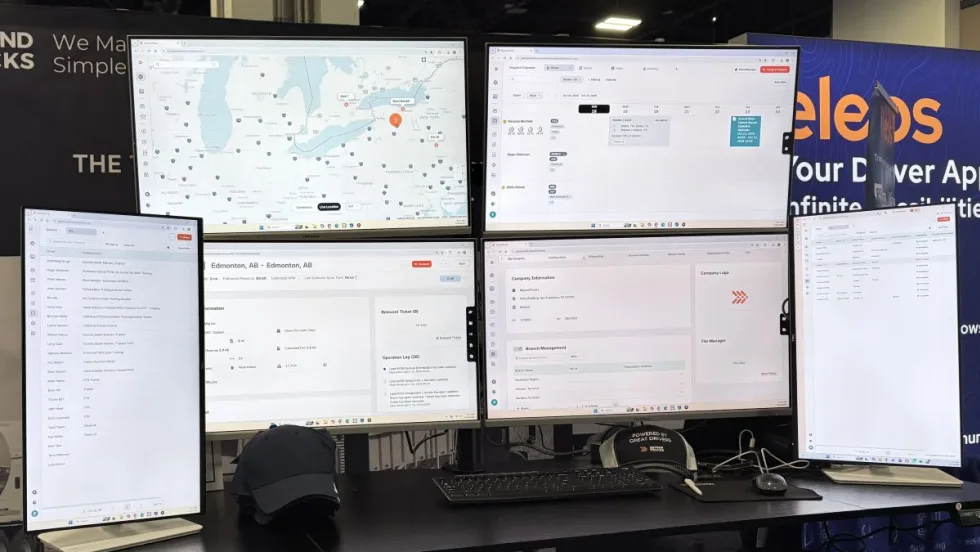
BeyondTrucks Adds Rules Checks to Dispatch
New Compatibility Engine checks driver qualifications, equipment requirements and fleet policies before loads are dispatched.
Read More →
Diesel Prices Hijack Trucking’s Worry List
ATRI’s annual survey finds cautious optimism about freight, but diesel costs, litigation, and insurance continue to squeeze fleets. Drivers have different priorities on several issues.
Read More →
Nomination Deadline Extended for HDT Emerging Leaders
Just a few more days to nominate accomplished trucking fleet professionals under 40 who are making an impact and helping lead the industry forward for the HDT Emerging Leaders award. Deadline extended to October 20!
Read More →
What Will ATA’s New Leader Bring to Trucking's Table?
Incoming President and CEO Mark Colson’s record in Alabama offers clues about his priorities and approach following Chris Spear’s abrupt departure as the head of the American Trucking Associations.
Read More →
Volvo, Waabi Start Commercial Autonomous Operations in Texas
Volvo VNL Autonomous trucks, powered by the Waabi Driver, are hauling freight directly to third-party facilities for a customer in Texas.
Read More →
Samsara Launches Custom AI Agent Builder
Agent Studio lets fleets create AI tools for hours-of-service monitoring, reporting and driver support, including agents that communicate by phone.
Read More →