




National Grid to Conduct Electrification Study of Northeast Freight Corridor
A new study to inform planning and investment for truck charging infrastructure across thousands of miles of highways in the Northeast will be carried out by National Grid.

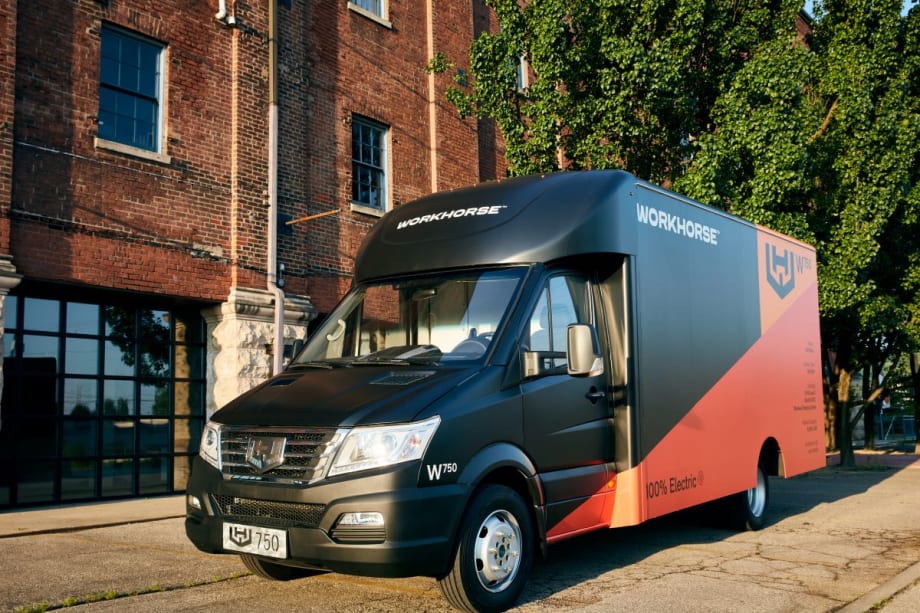
The two-year effort to build a Northeast Freight Corridors Charging Plan will focus on highways with heavy trucking traffic, including I-95 and I-90, and areas with commercial activity, like the Port of New York and New Jersey.
Photo: Workhorse
National Grid announced the kickoff of a landmark study to support the electrification of commercial fleets. The study will map out truck charging needs across nearly 3,000 miles of major highways in the U.S. Northeast. Funded by a $1.2 million grant awarded by the U.S. Department of Energy (DOE), the two-year effort to build a Northeast Freight Corridors Charging Plan will focus on highways with heavy trucking traffic, including I-95 and I-90, and areas with commercial activity, like the Port of New York and New Jersey.
National Grid is an electricity, natural gas, and clean energy delivery company serving more than 20 million people through our networks in New York and Massachusetts. National Grid is focused on building a smarter, stronger, cleaner energy future — transforming networks with more reliable and resilient energy solutions to meet state climate goals and reduce greenhouse gas emissions.
A 20-Year Electrification Forecast for New England
The study led by National Grid will develop 20-year demand forecasts for more than 100 sites across New York, New Jersey, Pennsylvania, and all New England states. This analysis could guide investment and policy decisions, while providing a clear path for states, utilities, businesses, and local communities to plan and build a charging network that supports large-scale electrification of the largest emitting sector of the Northeast's economy.
The Northeast Freight Corridors Charging Plan will expand upon National Grid's first-in-the-nation Electric Highways Study released in 2022, which found that large highway fast-charging sites could require more power than a small town by 2045.
As more electric trucks enter roadways, grid and charging infrastructure must keep pace. Larger electric vehicles require frequent recharging on long haul routes, but charging options for electric trucks remain limited, with most charging stations only equipped to serve smaller passenger vehicles.
"Readying our grid infrastructure for electric trucks will require careful planning and close collaboration across state lines," said Bart Franey, vice president of clean energy development in New York, National Grid. "This DOE grant award brings the right stakeholders into the same room to chart a clear course for electric truck charging across the Northeast. This roadmap will inform efforts by states, utilities, communities, and industry leaders to create a seamless truck charging network across the region."
A Coordinated Effort to Ramp Up an East Coast Charging Network
National Grid is engaging with industry partners to drive transportation electrification in the Northeast and help communities keep pace with policy- and market-driven demand now and in the future. The company is leading this groundbreaking study effort in partnership with RMI, the Northeast States for Coordinated Air Use Management (NESCAUM), Clean Communities of Central New York, and DOE's National Renewable Energy Laboratory (NREL).
National Grid will also closely coordinate with CALSTART, the recipient of a similar DOE grant, to map out truck charging needs south of National Grid's study area. The two studies are set to cover a combined 3,700 miles of highways and freight corridors, including 1,300 miles of I-95 from Georgia all the way to the Canadian border – plotting out what could be one of the longest truck charging corridors in the country. When integrated together, this broader analysis will span 15 states, supporting more than 300 million tons of freight moving through ports on the East Coast each year, as well as several of the largest cities in the U.S.
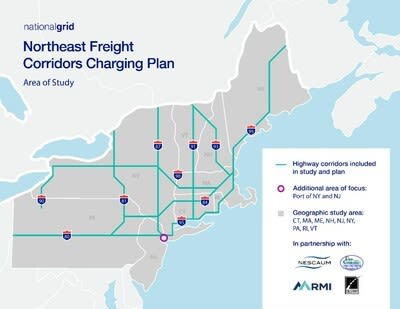
The study led by National Grid will develop 20-year demand forecasts for more than 100 sites across New York, New Jersey, Pennsylvania, and all New England states.
Graphic: National Grid
John Boesel, president and CEO of CALSTART said, "The I-95 Corridor project, once completed, will put into practice the integration of zero-emission vehicles, infrastructure, and addressing climate-change issues that has been carried out in other areas of the country. The successful implementation of this project will put to rest the unfounded concerns of zero-emission opponents by demonstrating that this technology is both economically feasible and a benefit to all."
David Sandbank, vice president, distributed energy resources, New York State Energy Research and Development Authority said, "This study will help deepen the understanding of electrification needs and help New York State and the region strategically put more medium and heavy-duty electric trucks on the road. Growing the number of charging locations throughout key travel corridors will lower emissions and pollution while ensuring goods and services are delivered in a cleaner, more sustainable way."
Paul Miller, executive director of NESCAUM, a regional association of air quality agencies in eight northeast states that will help engage state governments in the Northeast Freight Corridors Charging Plan said, "A rapid transition to zero-emission freight transport is urgently needed to slash greenhouse gas emissions and to improve air quality and public health in the communities along freight routes that have long borne inequitable impacts from diesel-powered trucking. This foundational study will help to expedite a charging network that can scale quickly and cost-effectively as more zero-emission trucks take to the road."
This work is supported by the U.S. Department of Energy's Office of Energy Efficiency and Renewable Energy (EERE) Vehicle Technologies Office (VTO) under the Award Number DE-EE0010647.
More Fuel Smarts

How Volvo Updated Its D13 for EPA 2027 [Watch]
Volvo’s updated D13 promises lower emissions without sacrificing performance or fuel economy. Take a closer look at what changed inside the engine in this HDT Spotlight video.
Read More →
Diesel Price Spike Shortens Payback for Natural Gas Trucks, Report Says
Energy Vision estimates fleets could recover the higher purchase price of an RNG-fueled Class 8 tractor in 1.3 to 2.8 years under current fuel-price scenarios.
Read More →
Calstart Becomes Catalyst Mobility, Reflecting Broader Focus
Calstart is now Catalyst Mobility, reflecting the nonprofit’s growing national role in clean transportation, including zero-emission trucks, infrastructure and incentive programs.
Read More →

Record Diesel Prices Squeeze Trucking Fleets
Average U.S. diesel prices have climbed to nearly $6 a gallon, surpassing the 2022 record as tight refinery capacity and Middle East disruptions keep fuel costs elevated.
Read More →
How Fuel Delivery Shapes Engine Performance
Fuel delivery depends on more than what happens at the injector. For fleet, maintenance and technical professionals, looking at the full path from pump to injector can provide useful context for understanding engine performance.
Read More →
East Coast Port Launches $45M Electric Truck Push
The Port Authority of New York and New Jersey announced millions in incentives for zero-emission drayage trucks, yard tractors, and new charging hubs near the port.
Read More →
California Bill Could Shed Light on Electric Truck Prices
Why do battery-electric Class 8 trucks remain so expensive? A California bill headed to Gov. Gavin Newsom would give fleets and state agencies more visibility into what manufacturers charge.
Read More →
Detroit Opens Orders for EPA 2027 Engines
Detroit isn’t starting from scratch to meet EPA 2027 diesel emissions standards. Its Gen 6 DD13 and DD15 engines keep much of today’s platform while updating the fuel and aftertreatment systems.
Read More →
Zero-Emission Truck Corridor Planned for West Coast
California, Oregon, Washington, British Columbia and Baja California are coordinating plans for truck charging and hydrogen fueling from Canada to Mexico.
Read More →
A Closer Look at Kenworth’s Electric T880E Vocational Truck [Video]
Learn more about Kenworth's T880E battery-electric vocational truck at the Paccar Technical Center, including its range, applications, upfitting considerations, and PTO options, in this HDT Spotlight video.
Read More →