




NACFE Report: Truck Platooning Could Save 4% in Fuel
The money thus conserved will pay back a $1,050 to $2,800 investment for necessary equipment in one to two years, it estimates.

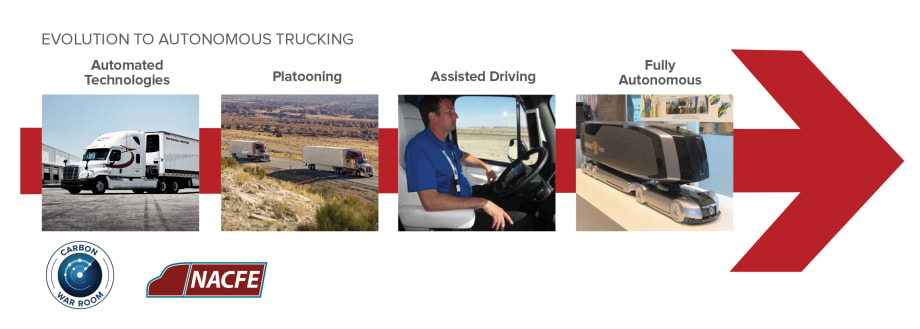
Platooning is one of the steps toward autonomous trucking, but still requires drivers in all trucks, NACFE says.
Platooning is one of the steps toward autonomous trucking, but still requires drivers in all trucks, NACFE says.
Platooning – the electronic linking of trucks where a lead vehicle largely controls the one following -- would save about 4% in fuel compared to a pair of rigs running separately, says the latest “confidence” report from the North American Council on Freight Efficiency.
The money thus saved will pay back an investment for necessary equipment in one to two years, say estimates in “Two-Truck Platooning,” released Wednesday by NACFE.
"Two-truck platooning is showing real promise as a fuel-saving technology, even when considering the actual performance in real-world use,” said Mike Roeth, the organization’s executive director, in a statement.
Fuel savings come from reduced air turbulence between the two tractor-trailers when they operate 40 to 50 feet apart, Roeth said. Reducing that distance should save more fuel, but would introduce operating complications, like reduced air flow to the second truck’s radiator.
Testing shows that reduction in fuel use is 7% as the vehicles move at highway speeds, he explained. But probably one-quarter of the time they would not be operating as a platoon as they split up to pick up and deliver freight, stop for driver rest breaks, etc., during a trip. Taking out those times yields the 4% figure.
Payback estimates outlined in three scenarios set equipment costs at $1,050 and $2,800, with the higher figure including more equipment than the lower dollar amount. Installation cost of $200 was also factored in.
Equipment includes collision avoidance systems, adaptive cruise control, and in-cab cameras – all now available on the market, Roeth said. Vehicle-to-vehicle radios, the key element, are not yet available but should be soon as testing and perfecting progress.
Two scenarios assume a tractor would platoon three-quarters of its running time, and a third scenario assumes it would do so half the time. Fuel was pegged at $3 per gallon, which it might be by the time platooning comes into common use.
Two trucks now comprise a platoon in most testing here and in Europe, said Roeth and two researchers: Jack Roberts, a freelance truck writer and HDT contributing editor, and Rick Mihelic, an industry consultant and former engineer at Peterbilt Motors.
More than two trucks could platoon, explained Roberts, with the number limited by the range of the radio signal that links the vehicles. “Daimler,” which is testing in Germany, “puts that at 200 meters,” he said. “That brings it to 10 trucks.”
Education campaigns will be needed to alert the public to platooning and what trucks engaged in it will look and act like, Roberts said. Law enforcement officers, too, need to be informed because even the 40- to 50-foot interval is close by currently held safety standards, Roeth added.
Stopping distances are not a problem because the brakes of the following vehicle would apply so quickly, in 1 millisecond after the lead driver applies them, Mihelic said. Meanwhile, protocols for which vehicle leads and which follows need to be worked out.
Two-Truck Platooning is NACFE’s 14th project, Roeth said, and it was conducted using a standard method.
“We used our common approach as we’ve done in previous confidence reports,” he said – a search for publically available information on the topic, then interviews with suppliers, manufacturers and fleets. “But rather than sharing experiences, which they don’t have because the technology is not yet in use, they are making predictions.”
The amount of automated control of a platoon’s second and subsequent trucks will likely increase from the current throttle and braking to steering and lane-keeping, Roeth predicted. “The technology will evolve” as it’s shown to be workable.
However, “Platooning is not autonomous trucking, and it is being improperly grouped with that,” he said. “Platooning still requires a driver in the second truck.”
Platooning is not exactly around the corner, but it will begin sooner or later, said those consulted in the study.
“I’m thinking 2018 to 2030 before we see platooning operations on the road," said an anonymous manager for a major truckload fleet quoted in the report. "There are still way too many studies that have to be done on this subject.”
An executive summary of the report is here. The full report is here.
More Fleet Management

Color Match Smarter: Tools That Restore & Perform
For fleet managers and collision repair professionals keeping heavy-duty trucks on the road, getting the color right the first time isn't just about appearance — it's about efficiency, turnaround time, and bottom-line results. Discover how today's digital color tools are transforming the repair process from guesswork to precision.
Read More →
FMCSA Pauses Biennial-Update Enforcement Amid Motus Transition
Carriers whose updates were due on or after June 1 have more time, while FMCSA works to stabilize its new registration system and warns of phishing sites impersonating its new carrier registration system, Motus.
Read More →
2026 Blueprint for Countering Smarter Supply Chain Theft
Cargo theft is no longer just the cost of doing business. It's a multi-billion-dollar criminal enterprise exploiting vulnerabilities across your fleet, drivers, and supply chain.
Read More →


How Telematics Improves Visibility, Control, and Performance in Refrigerated Fleets
Explore how telematics help refrigerated fleets improve visibility, uptime, efficiency, compliance, and cargo protection across connected cold chain operations.
Read More →
What the U.S.-Canada Trade War Means for Trucking
Escalating U.S.-Canada tariffs could disrupt cross-border freight, reduce truck volumes, raise costs, and create new uncertainty for carriers on both sides of the border.
Read More →
What Are Trucking’s Top Concerns for 2026?
The American Transportation Research Institute wants to know what's worrying trucking fleet managers, drivers, and other stakeholders in its annual Industry Issues survey.
Read More →
American Trucking Associations Looks for a New Leader
ATA President and CEO Chris Spear abruptly left his job at the association on August 21, at a pivotal time for the trucking industry.
Read More →
Public Wi-Fi Cybersecurity Risks: How Truck Drivers and Fleets Can Protect Their Data
Public Wi-Fi can expose truck drivers and fleets to credential theft, malware, and other cyber threats. Here’s how to reduce the risk on the road.
Read More →
For Nicky Cupp, Fleet Innovation Starts With Frustration
HDT Truck Fleet Innovator Nicky Cupp turns everyday pain points at Fraley & Schilling into opportunities for better technology and smarter processes.
Read More →
Adam Buttgenbach’s Approach to Electric Trucks: Start With Where They Fit
HDT Truck Fleet Innovator Adam Buttgenbach helped PepsiCo build one of North America’s largest EV fleets by focusing on where electric trucks make operational sense.
Read More →