




Run on Less Shows How Regional-Haul Trucks Can Get Better Fuel Mileage
Ten regional-haul tractor-trailers participating in the North American Council for Freight Efficiency’s Run on Less Regional fuel economy demonstration hit a combined average of 8.3 mpg during the three-week event.

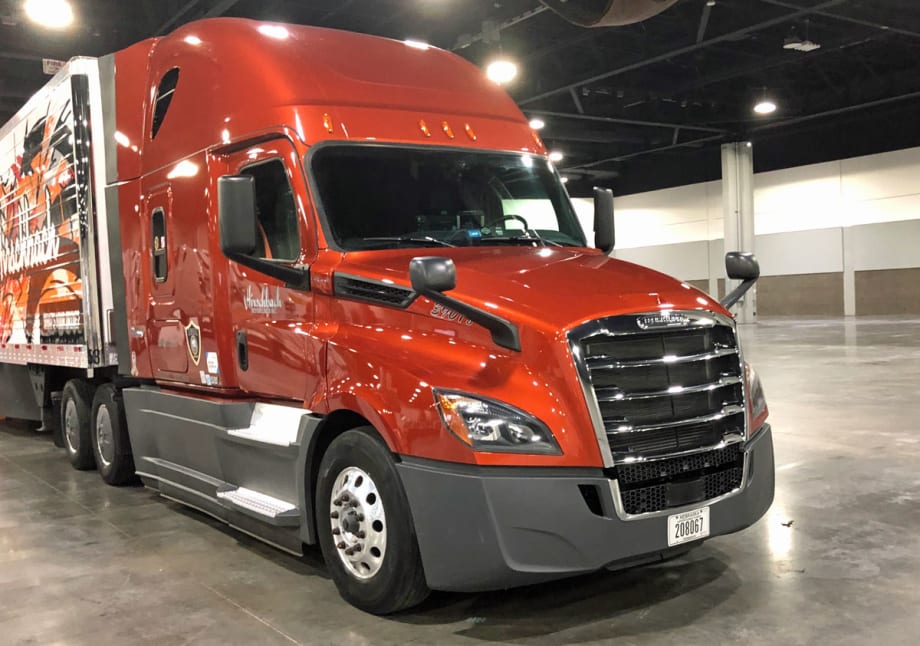
This highly aerodynamic Hirschbach regional haul Freightliner Cascadia was one of 10 trucks to take part in NACFE’s Run on Less Regional fuel efficiency demonstration, which wrapped up in Atlanta at the beginning of the 2019 North American Commerical Vehicle Show.
Photo by Jack Roberts
Regional haul trucking applications are diverse and can be problematic for fleet managers tasked with optimizing tractor-trailer fuel economy averages. However, the North American Council for Freight Efficiency's Run on Less Regional event demonstrated that substantial improvements using commercially available components and technology are possible.
NACFE's Run on Less Regional was an extension of the commercial vehicle fuel efficiency advocacy group’s Run on Less demonstration in 2017, which showcased fuel economy technology and best practices for long-haul tractor-trailers. Executive Director Mike Roeth noted the more challenging nature of regional haul applications, pointing out that fleets running these operations can rarely count on standardized cargo, spend less time at highway speeds, and deal with far more congestion and tight urban operating conditions than long-haul fleets do.
However, at the opening press conference at the 2019 North American Commerical Vehicle Show in Atlanta on Oct. 27, Roeth reported that the trucks and drivers in the Run on Less demonstration hit an impressive average 8.3 mpg for the three-week event, a significant improvement over the national average of 6 mpg.
Run on Less Regional featured 10 trucks from participating fleets — C&S Wholesale Grocers, Hirschbach, Hogan Transportation, J.B. Hunt, Meijer, PepsiCo, Ploger Transportation, Schneider, Southeastern Freight Lines, and United Parcel Service. And all told, Roeth said, at the end of the three-week demonstration, these vehicles and their drivers saved 2,750 gallons of fuel, $8,249, and 27.9 tons of carbon dioxide. If all North American regional carriers reached this benchmark mpg, Roeth noted, annualized potential savings for regional haul trucks alone would be over $9 billion.
“Going into the Run, we had no idea what to expect in terms of just how fuel efficient these fleets could be,” Roeth said. “The numbers these trucks and drivers put up demonstrate that it is possible to achieve high mpg in regional operations.”
NACFE chose to focus this year’s Run on regional haul operations to demonstrate that with the right investment in technology and with skilled drivers it is possible to achieve fuel milag far above those of the average fleet. Over the course of Run on Less, NACFE also discovered that:
High efficiency requires a commitment from both fleet leadership and drivers.
Big data and connectivity can be used to further optimize each route.
Diversity in duty cycles makes it essential that fleet managers understand the nuances of their business so they can spec vehicles properly and coach drivers in efficient driving techniques.
The expansion of regional haul will help attract and retain drivers as drivers get home on a more regular basis.
Because of its return-to-base operation, regional haul is ideal for alternative-fuel vehicles, especially battery electric trucks.
Roeth said that he was surprised to see that the Run on Less Regional demonstration “busted the myth” that aerodynamic devices do not deliver fuel economy savings at less than 55 mph. “We learned that aerodynamic devices do deliver savings for regional haul fleets, even though the payback time for them is definitely longer,” Roeth said.
Most regional-haul fleets “sub-optimize” their new truck specs, Roeth said — meaning that they typically spec a truck to reliably run any route on the roster but do not specialize the vehicle to perform at its best in any given route. “I think this proves that regional haul fleets would benefit from taking the extra time to carefully categorize their routes and spec trucks to run specific routes,” Roeth said. “If you have a set of routes that spend a higher amount of time at highway cruise speeds that others, then assigning trucks to those specific routes and spec’ing them with aerodynamic devices and other technologies designed to save fuel at highway speeds will pay dividends to the fleet in the long run.”
Throughout the Run, the three Freightliners, two Internationals, two Kenworths, one Peterbilt, and two Volvos, piloted by drivers Louis Scaruffi, Mark Casey, Glen Williams, Dustin Whitener, Rita Bare, Lou Martinez, Travis Lauer, Michael Tam, Beau White, and Darin Salgado, were monitored by devices installed by Geotab and by data loggers from the National Renewable Energy Laboratory, both event sponsors. Speed, load, elevation changes, number of stops, and weather were monitored during the three weeks of the Run. Shell was title sponsor for the Run, and a host of other companies were event sponsors and supporters.
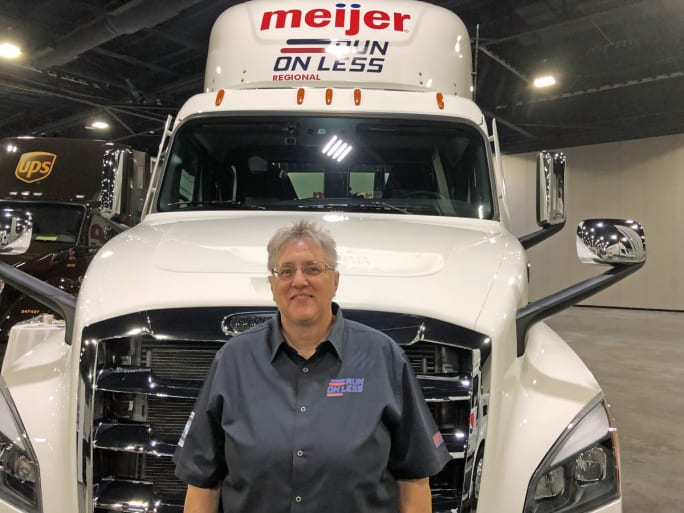
Rita Bare, only woman to participate in Run on Less Regional, did not reach her intended goal of 11 mpg during the demonstration, but said she learned a lot about how fully leverage the technology on her truck better during the event.
Photo by Jack Roberts
The participating drivers benefited from the Run on Less Regional demonstration as well. Ploger’s Travis Lauer said that while he focused more on “being on his game,” during his Run on Less runs, he didn’t really do much different than he does every day behind the wheel of his Volvo tractor. “Everyone around me worked really hard to make this a success for us,” Lauer said. “We had Volvo come in ahead of our runs and help us lower the gear ratios and get us ready. And our maintenance department did their usual outstanding job keeping the truck in peak condition throughout the event.”
Tommy Cottingham, director of maintenance for J.B. Hunt, said that while his team hasn’t had the opportunity yet to dig into the data gathered during the demonstration, the fleet is constantly on the lookout for new technology to bring more value to its customers. “Any time we can run our trucks more efficiently and cost effectively, that, in turn, brings more value to our customers,” Cottingham said. “Additionally, J.B. Hunt is focused on being as ‘green’ a fleet as possible and we want the public and our customers to see that. So this NACFE event is a great way of meeting those sustainability and productivity goals.”
The only woman driver in the Run on Less Regional demonstration, Meijer’s Rita Bare, said that her experience driving in Michigan winters helped her immensely, but that she also learned to rely the technology on her Freightliner Cascadia. “I drove a lot like I do in the winter to boost my fuel economy,” Bare said. “That means long rollouts, lots of coasting, lots of watching traffic and trying to keep momentum going as long as possible without coming to a full stop.”
Bare said a Detroit Diesel engineer rode with her for a day before the event to help her wring the most out of the technology features on her truck. “He helped me dial down my active cruise control from a 3.6-second following interval to 2.4 seconds in heavy traffic conditions,” she said. “That allowed me to coast more in those conditions and meter traffic lights more effectively, without slowing down to the point that other cars can cut me off and kill my forward speed, or having to accelerate more to get as often on congested roads.”
More Fuel Smarts

How Volvo Updated Its D13 for EPA 2027 [Watch]
Volvo’s updated D13 promises lower emissions without sacrificing performance or fuel economy. Take a closer look at what changed inside the engine in this HDT Spotlight video.
Read More →
Diesel Price Spike Shortens Payback for Natural Gas Trucks, Report Says
Energy Vision estimates fleets could recover the higher purchase price of an RNG-fueled Class 8 tractor in 1.3 to 2.8 years under current fuel-price scenarios.
Read More →
Calstart Becomes Catalyst Mobility, Reflecting Broader Focus
Calstart is now Catalyst Mobility, reflecting the nonprofit’s growing national role in clean transportation, including zero-emission trucks, infrastructure and incentive programs.
Read More →

Record Diesel Prices Squeeze Trucking Fleets
Average U.S. diesel prices have climbed to nearly $6 a gallon, surpassing the 2022 record as tight refinery capacity and Middle East disruptions keep fuel costs elevated.
Read More →
How Fuel Delivery Shapes Engine Performance
Fuel delivery depends on more than what happens at the injector. For fleet, maintenance and technical professionals, looking at the full path from pump to injector can provide useful context for understanding engine performance.
Read More →
East Coast Port Launches $45M Electric Truck Push
The Port Authority of New York and New Jersey announced millions in incentives for zero-emission drayage trucks, yard tractors, and new charging hubs near the port.
Read More →
California Bill Could Shed Light on Electric Truck Prices
Why do battery-electric Class 8 trucks remain so expensive? A California bill headed to Gov. Gavin Newsom would give fleets and state agencies more visibility into what manufacturers charge.
Read More →
Detroit Opens Orders for EPA 2027 Engines
Detroit isn’t starting from scratch to meet EPA 2027 diesel emissions standards. Its Gen 6 DD13 and DD15 engines keep much of today’s platform while updating the fuel and aftertreatment systems.
Read More →
Zero-Emission Truck Corridor Planned for West Coast
California, Oregon, Washington, British Columbia and Baja California are coordinating plans for truck charging and hydrogen fueling from Canada to Mexico.
Read More →
A Closer Look at Kenworth’s Electric T880E Vocational Truck [Video]
Learn more about Kenworth's T880E battery-electric vocational truck at the Paccar Technical Center, including its range, applications, upfitting considerations, and PTO options, in this HDT Spotlight video.
Read More →