





Audit Finds Shortfalls in National Medical Examiner Registry
More Delays for Medical Examiner Registry Integration
If you were hoping to get a more paperless experience with commercial driver medical certification requirements this summer, you're out of luck. Find out why rules to digitally integrate medical examiner registry data with licensing offices may be postponed.
April 22, 2021

If the rules are postponed, commercial drivers will still have to give state driver’s licensing agencies a copy of their medical certificate.
HDT file photo
3 min to read
The Federal Motor Carrier Safety Administration again wants to postpone the deadline for several provisions of a rule integrating driver medical certification data in the national registry with state licensing agencies.
What's to blame? IT programming issues following a 2017 hacking incident.
FMCSA regulations require commercial motor vehicle drivers to obtain a valid medical certificate, and since May of 2014, those have been required to be done by qualified health professionals listed on the National Registry of Certified Medical Examiners.
Additional provisions unveiled in 2015 tcalled for integration of the data with state licensing agencies. Those were originally supposed to go into effect June 22, 2018. Days before they were to go into effect, they were delayed for three years.
Now FMCSA proposes to amend its regulations to extend the compliance date for those 2015 regulations from June 22, 2021, to June 23, 2025. The provisions it wants to delay are the requirements for:
FMCSA to electronically transmit, from the National Registry to the state driver licensing agencies, driver identification information, examination results, and restriction information from examinations performed for commercial driver’s license or permit holders
FMCSA to electronically transmit to the state licensing agencies medical variance information for all commercial motor vehicle drivers
State driver licensing agencies post on the Commercial Driver's License Information System (CDLIS) driver record the driver identification, examination results, and restriction information received electronically from FMCSA
Motor carriers to no longer be required to verify that CLP/CDL drivers were certified by a certified medical examiner listed on the National Registry.
The delay is needed, according to the proposal, to give FMCSA time to complete certain information technology system development tasks for the registry and to give state agencies enough time to make the necessary IT programming changes after the new National Registry system is available.
Since the 2015 integration rule was published, FMCSA said, there have been ongoing challenges associated with launching a new National Registry IT system. Among those challenges was an unsuccessful attempt by an intruder to compromise the National Registry website in December 2017. Although no personal information was exposed, FMCSA took the National Registry system offline until mid-2018 to ensure it was secure.
After the integration rule was postponed in 2018 following the hack, there were more setbacks.
The agency attempted to launch the first stage of the replacement system in May 2019, but the system’s performance capabilities fell short of what was needed. The agency issued a request for proposals to obtain the services of a new contractor and selected a vendor in December 2020 to develop the replacement system by early 2022. The work would include delivery of technical specifications to the SDLAs for use in implementing changes to their respective systems.
FMCSA anticipates that once that system is up and running, the state agencies will need another three years to meet their side of the requirements.
The proposal to delay the compliance date means that through June 22, 2025:
Certified medical examiners would continue issuing medical examiner certificates to qualified CLP/CDL applicants/holders;
CLP/CDL applicants/holders would continue to provide the state driver’s licensing agency a copy of their certificate;
Motor carriers would continue verifying that drivers were certified by an ME listed on the National Registry; and
State licensing agencies would continue processing paper copies of the medical examiner certificates they receive from CLP/CDL applicants/holders.
You can submit your comment online on or before May 24, 2021.
More Safety & Compliance

FMCSA Pauses Biennial-Update Enforcement Amid Motus Transition
Carriers whose updates were due on or after June 1 have more time, while FMCSA works to stabilize its new registration system and warns of phishing sites impersonating its new carrier registration system, Motus.
Read More →
ZF Expands Commercial Vehicle Push in North America
ZF is expanding its North American commercial-vehicle presence with new transmission applications, electrification, trailer technology and autonomous-driving systems.
Read More →
Truck Drivers Need More Than Another Alert
Fleets have more visibility into truck health, safety events, and driver activity than ever. The next challenge is turning all that information into useful guidance for the person who has to decide what to do next.
Read More →
Tesla Wants a Self-Driving Semi. Are Cameras Enough?
Could Tesla’s camera-only autonomous driving technology work on an 80,000-pound Semi? In this commentary, HDT's Deborah Lockridge takes a look at Tesla, Cybercab, and how autonomous trucks see the road.
Read More →
What DOT’s Automated Vehicle Strategy Means for Trucking
The U.S. Department of Transportation issued a new automated-vehicle strategy that outlines plans for driverless-truck regulations, cross-state freight corridors, and federal safety standards.
Read More →
NYC Expands Speed, Pedestrian Safety Tech Across Fleet
New York City is expanding intelligent speed assistance and pedestrian-alert systems across its municipal fleet, moving the technologies from pilot programs into vehicle procurement and retrofit requirements.
Read More →
FMCSA Removes 110 Truck Driver Training Schools from Certified ELDT List
Federal regulators also are targeting more than 160 additional training providers and launching a nationwide audit of third-party CDL skills testers as part of a broader crackdown on trucking fraud.
Read More →
Beyond DOT Compliance: What Makes a Trucking Fleet Truly Safe?
A trucking fleet can follow every rule and still make unsafe decisions. The real test comes when safety conflicts with freight, productivity, or cost.
Read More →
Hours of Service Pilot Programs: FMCSA Readies for 2027 Rollout
Two pilot programs could eventually reshape hours-of-service rules, giving truck drivers options to pause their 14-hour clock or use longer split sleeper rest periods.
Read More →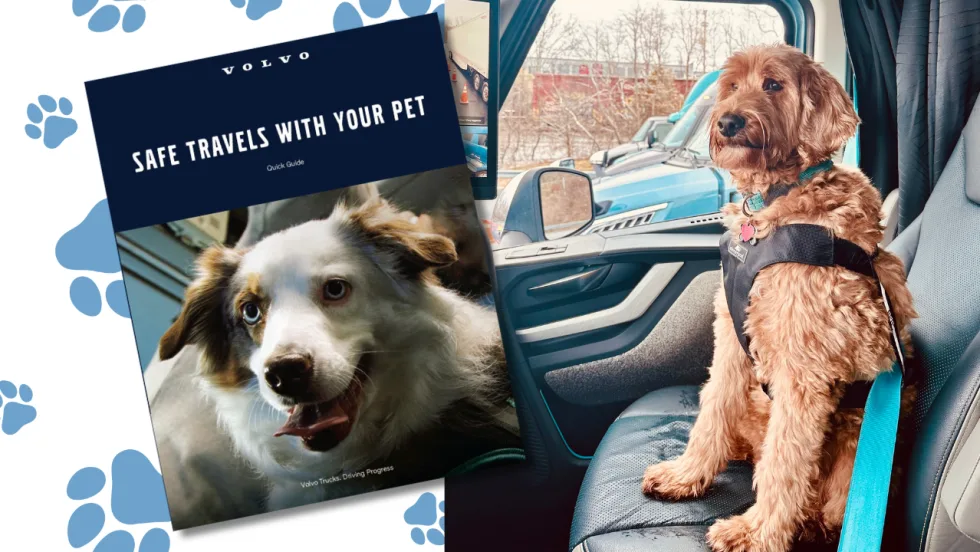
New Guide Offers Pet Safety Tips for Truck Drivers
Hundreds of thousands of pets travel in truck cabs. A new safety guide from Volvo Trucks and the Center for Pet Safety offers practical advice for truck drivers who bring dogs and cats along for the ride.
Read More →