




Mineta Declares Traffic Deaths an Epidemic
U.S. Transportation Secretary Norman Mineta on Thursday called highway traffic deaths a “national epidemic” and encouraged Americans to view safety belts as preventative medicine

U.S. Transportation Secretary Norman Mineta on Thursday called highway traffic deaths a “national epidemic” and encouraged Americans to view safety belts as preventative medicine.
Mineta announced mixed results in the effort to reduce the number of people who die on U.S. highways each year. While the fatality rate dropped and alcohol-related crashes are down from 2003, 42,800 died on the nation’s highways in 2004, up slightly from 42,643 in 2003, according to projected 2004 data compiled by the National Highway Traffic Safety Administration in a preliminary report.
“We are in the midst of a national epidemic,” said Secretary Mineta. “If this many people were to die from any one disease in a single year, Americans would demand a vaccine. The irony is we already have the best vaccine available to reduce the death toll on our highways – safety belts.”
NHTSA’s report projects a fatality rate of 1.46 deaths per 100 million vehicle miles traveled (VMT), a drop from a record low of 1.48 in 2003, Mineta said.
The report also projects the seventh straight increase in motorcycle fatalities. In 2004, 3,927 motorcyclists died, a 7.3 percent increase. In 2003, there were 3,661 motorcycle fatalities, the report said.
Traffic crashes come at an enormous cost to society, Mineta noted. NHTSA estimates show that highway crashes cost society $230.6 billion a year, about $820 per person.
“Sadly, traffic crashes continue to be the leading cause of death in American children and young adults,” said NHTSA Administrator Jeffrey Runge, M.D. “While seat belt use, at 80 percent, is at an all-time high, we could save thousands more lives each year if everyone buckled-up.”
NHTSA collects crash statistics from 50 states and the District of Columbia to produce the annual report on traffic fatality trends. The final 2004 report will be available in August.
Summaries of the preliminary report are available at www-nrd.nhtsa.dot.gov.
More Safety & Compliance
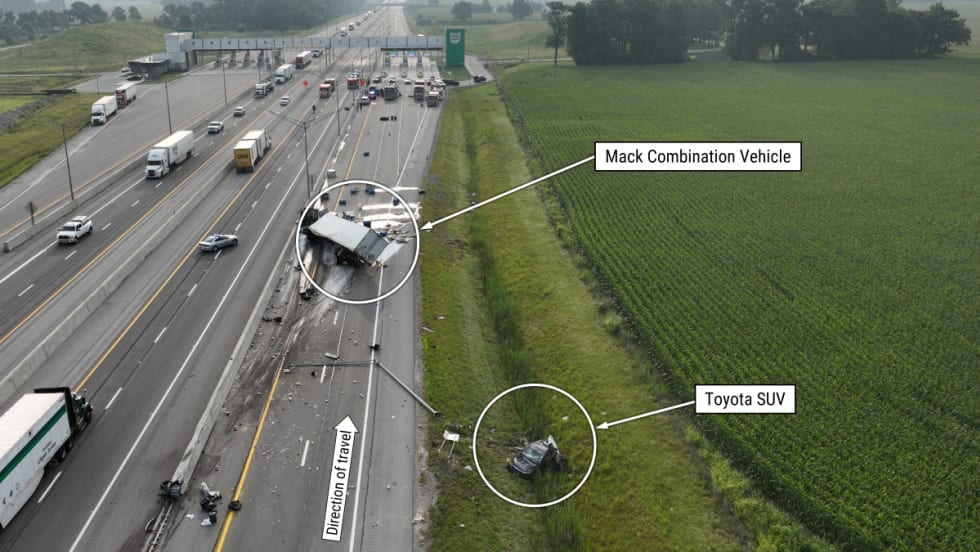
Fatal Crash Exposes Toll Plaza Risks
An NTSB investigation found that last-minute lane changes and large speed differences at an Ohio toll plaza created a hazard the truck driver couldn't avoid in time.
Read More →
When Language Stops the Truck: The Return of ELP Out-of-Service Orders
English language proficiency rules for commercial drivers aren’t new, but renewed out-of-service enforcement has raised the stakes. Here’s what carriers need to know before a driver reaches a roadside inspection.
Read More →
A Camera Isn't a Safety Program. Here's What Brokers Are Screening for Now
Footage alone may not be enough to pass broker vetting processes. Here's what counts as a defensible safety program now.
Read More →

Marijuana and Trucking’s Drug-Testing Dilemma
Marijuana is getting stronger, laws are changing, and drug tests still can’t reliably establish impairment. What does that mean for truck drivers and the fleets that employ them?
Read More →
PrePass, Kodiak Connect Driverless Trucks to Roadside Enforcement
The system will allow enforcement agencies to verify Enhanced Inspection information and decide whether Kodiak’s autonomous trucks can bypass roadside screening sites.
Read More →
From One Generation to the Next: How Mentorship Builds Safer Truck Drivers
After three decades in trucking, Harold Perry shares what he's learned about driver safety, mentorship, and helping the next generation build confidence behind the wheel.
Read More →
FMCSA Pauses Biennial-Update Enforcement Amid Motus Transition
Carriers whose updates were due on or after June 1 have more time, while FMCSA works to stabilize its new registration system and warns of phishing sites impersonating its new carrier registration system, Motus.
Read More →
ZF Expands Commercial Vehicle Push in North America
ZF is expanding its North American commercial-vehicle presence with new transmission applications, electrification, trailer technology and autonomous-driving systems.
Read More →
Truck Drivers Need More Than Another Alert
Fleets have more visibility into truck health, safety events, and driver activity than ever. The next challenge is turning all that information into useful guidance for the person who has to decide what to do next.
Read More →
Tesla Wants a Self-Driving Semi. Are Cameras Enough?
Could Tesla’s camera-only autonomous driving technology work on an 80,000-pound Semi? In this commentary, HDT's Deborah Lockridge takes a look at Tesla, Cybercab, and how autonomous trucks see the road.
Read More →