




Meritor Developing Fuel-Saving Drive Axle
CAMERI, ITALY -- Meritor is developing a new drive axle intended to save fuel by reducing parasitic power losses resulting from oil churn. The company shared its plans for the new fuel-efficient drive axle at a press event for North American trade journalists.

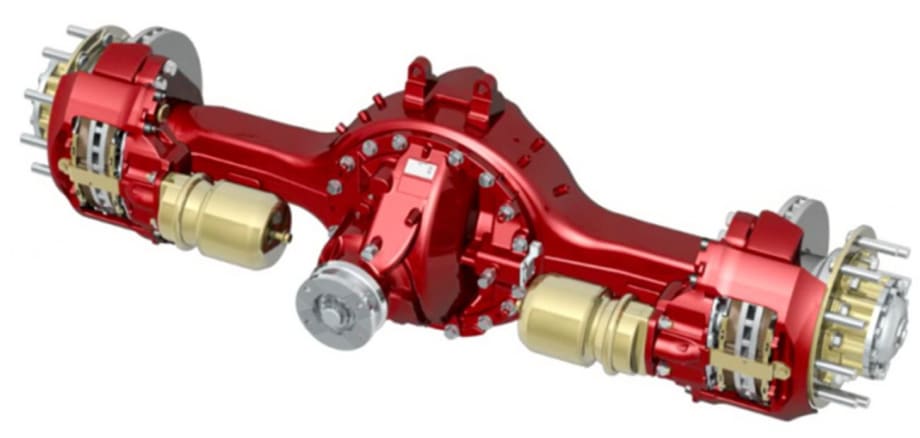
The LogixDrive 17XEVO axle in European trim. It may come to North America in 2015, Meritor says.
CAMERI, ITALY -- Meritor is developing a new drive axle intended to save fuel by reducing parasitic power losses resulting from oil churn. The company shared its plans for the new fuel-efficient drive axle at a press event for North American trade journalists, held at its axle plant in Cameri, Italy. Several prototype LogixDrive systems for the MS17X EVO drive axle are in prototype testing now with select European fleets.
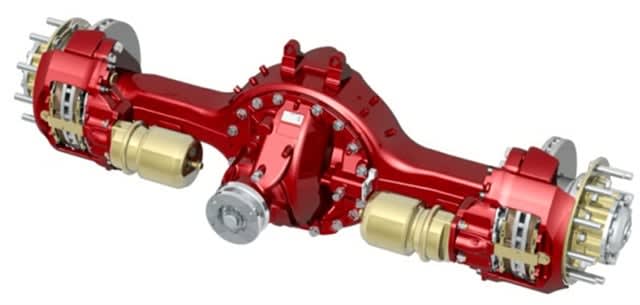
The LogixDrive 17XEVO axle in European trim. It may come to North America in 2015, Meritor says.
The purpose of the system is reduce lube-related churning losses in the axle housing by temporarily reducing lube levels under certain driving conditions.
"We believe there's an opportunity to improve energy efficiency on the order of 0.1% to 0.2%," said Fabio Santinato, chief engineer for axles engineering for Europe. "It's a small but measurable improvement, and we are now doing evaluations for cost and life-cycle benefits."
The LogixDrive system uses an oil internal lubricant reservoir to store lube oil when it's not needed to cool the axle shafts, crown and pinion gears etc. During periods of high-stress operation, such as ascending or descending hills, the reservoir opens, releasing several liters of lube into the axle housing to provide the needed cooling.
"Segregating several liters of oil lowers the lube level in the axle, thus reducing the parasitic loses from churning," Santinato told reporters. "When the vehicle is operating at a steady state on an open flat highway, you don't need a lot of cooling. On a hill under a heavy load, the axle will get hotter and need more oil to cool the components. The tank opens and allows more oil into the axle to facilitate the cooling."
While the oil is not needed, the teeth of crown gear churns oil into an opening at the top of a reservoir built into the differential case. No pump is required to fill the tank. A normally open valve at the bottom of the tank is pneumatically closed to contain the oil. The system is failsafe, and will open in the event of a system failure. Draining the oil from the tank requires only gravity.
When full, the tank hold about 5 liters of oil, lowering the oil level in the axle to 7 liters from 12, and reducing the amount of oil that is churned up by the drive gears.
A cab-mounted electronic control unit monitors operating conditions for heat, torque, load, etc. to predict cooling needs of the axle. Santinato also noted the system can optimize oil change intervals by predicting the possible life expectancy of the lubricating oil.
MS17X
Meritor says the 17X is currently the most popular drive axle in the European heavy-duty market, occupying positions at Volvo, DAF, Scania, and Iveco, among others as well as the motorcoach market. It was introduced to the market in 2007.
In current applications, the 17X is rated for up to 88,000-pound gross combination weight with a 26,000-pound axle weight rating -- which are common European ratings. It's rated for up to 540 horsepower with 1,900 pounds-feet of torque and axle ratios of 2.64 to 6.17.
The high-efficiency 17XEVO was launched with Volvo in November 2013, allowing for faster ratios of 2.31 and 2.47, and a higher, 50-ton (100,000-pound) gross combination weight rating, as well as an upgraded torque rating of 2,065 pounds-feet.
The axle has not yet been introduced in North America, but company officials say North American fleet evaluations could begin sometime in 2015.
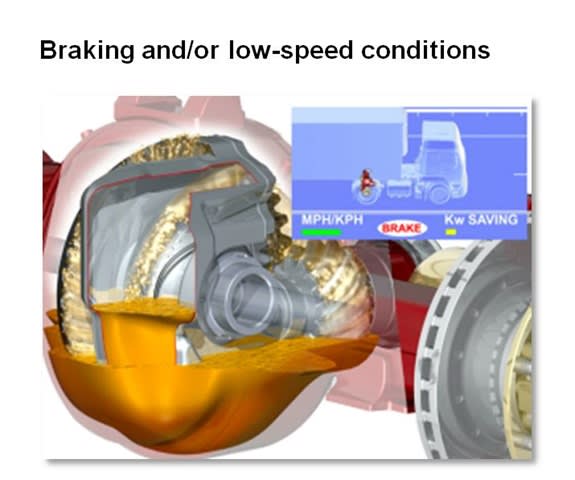
Additional lube oil can be drained from the reservoir by a cab-mounted ECM and a cable release-drain. The additional oil adds cooling and lubricating capacity under heavily loaded operating conditions.
The 17XEVO family are the first axles to use Meritor's patented laser welding process, which makes the differential case extremely rigid allowing for higher- torque capacity. Laser-welding eliminates 38 bolts in comparison with its predecessor, which yields a significant weight savings. Ring gear-to-case and case-to-case joints are laser-welded.
"Laser welding brings a very high energy level to a very localized area," said Santinato. "If you tried to use traditional welding methods to get those temperatures you would risk heat-related distortions to adjacent material."
Meritor says it is still early days for LogixDrive and the business case hasn't yet been solidified, but feedback from the first few fleets to uses the system has been positive.
More Fuel Smarts

How Volvo Updated Its D13 for EPA 2027 [Watch]
Volvo’s updated D13 promises lower emissions without sacrificing performance or fuel economy. Take a closer look at what changed inside the engine in this HDT Spotlight video.
Read More →
Diesel Price Spike Shortens Payback for Natural Gas Trucks, Report Says
Energy Vision estimates fleets could recover the higher purchase price of an RNG-fueled Class 8 tractor in 1.3 to 2.8 years under current fuel-price scenarios.
Read More →
Calstart Becomes Catalyst Mobility, Reflecting Broader Focus
Calstart is now Catalyst Mobility, reflecting the nonprofit’s growing national role in clean transportation, including zero-emission trucks, infrastructure and incentive programs.
Read More →

Record Diesel Prices Squeeze Trucking Fleets
Average U.S. diesel prices have climbed to nearly $6 a gallon, surpassing the 2022 record as tight refinery capacity and Middle East disruptions keep fuel costs elevated.
Read More →
How Fuel Delivery Shapes Engine Performance
Fuel delivery depends on more than what happens at the injector. For fleet, maintenance and technical professionals, looking at the full path from pump to injector can provide useful context for understanding engine performance.
Read More →
East Coast Port Launches $45M Electric Truck Push
The Port Authority of New York and New Jersey announced millions in incentives for zero-emission drayage trucks, yard tractors, and new charging hubs near the port.
Read More →
California Bill Could Shed Light on Electric Truck Prices
Why do battery-electric Class 8 trucks remain so expensive? A California bill headed to Gov. Gavin Newsom would give fleets and state agencies more visibility into what manufacturers charge.
Read More →
Detroit Opens Orders for EPA 2027 Engines
Detroit isn’t starting from scratch to meet EPA 2027 diesel emissions standards. Its Gen 6 DD13 and DD15 engines keep much of today’s platform while updating the fuel and aftertreatment systems.
Read More →
Zero-Emission Truck Corridor Planned for West Coast
California, Oregon, Washington, British Columbia and Baja California are coordinating plans for truck charging and hydrogen fueling from Canada to Mexico.
Read More →
A Closer Look at Kenworth’s Electric T880E Vocational Truck [Video]
Learn more about Kenworth's T880E battery-electric vocational truck at the Paccar Technical Center, including its range, applications, upfitting considerations, and PTO options, in this HDT Spotlight video.
Read More →