





Related: Senate Bill Touted as Largest Highway Legislation in History
Massive 'Green' Highway Bill Heads to House Floor
A nearly $500 billion highway funding bill headed to the House floor faces an uphill battle, with critics saying it's partisan and focuses too much on "green" transport.
June 19, 2020
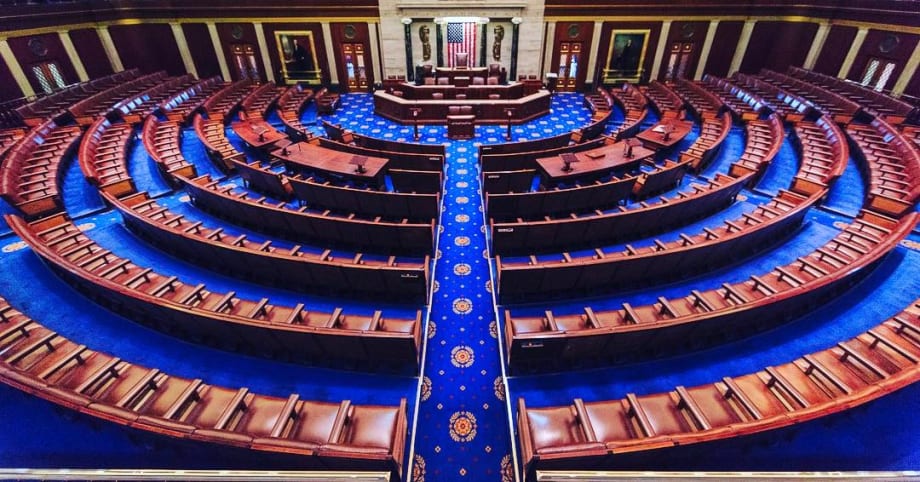
The highway bill now goes to the full House for a vote.
Photo: U.S. House of Representatives / Public domain
4 min to read
After more than 24 hours of debate that included the consideration of 177 amendments, the House Committee on Transportation and Infrastructure approved the Investing in a New Vision for the Environment and Surface Transportation in America (INVEST in America) Act by a party-line vote of 35 to 25.
The INVEST in America Act “puts an emphasis on tackling the massive maintenance needs and building smarter, safer infrastructure, all while putting our nation on a path toward zero emissions from the transportation sector,” according to a press release.
During the markup, the committee adopted amendments from both sides of the aisle, including 34 Republican amendments and 23 Democratic amendments. The INVEST in America Act now moves to the House floor.
“For far too long, Congress has taken a pass on trying to solve the toughest problems plaguing our surface transportation system, allowing it to limp along and fall farther and farther behind the rest of the world,” noted Peter DeFazio, D-Ore., the committee’s chair, in a statement following the bill’s passage.
“The time is now to fix our crumbling infrastructure, cut carbon pollution from the transportation sector, and create millions of good-paying jobs in urban, suburban and rural communities,” he said.
The bill is the largest component of a larger $1.5 trillion proposal known as the Moving Forward Act, which also promises funding for drinking water, broadband, clean energy projects, low-income schools, public housing, the postal service and more.
The House plans to bring the surface bill to the floor on June 30. Democrats have not yet said how they propose to pay for it.
The nearly $500 billion, five-year infrastructure bill was introduced by House Democrats on June 3. The bill would not only fund highways and advance clean transportation efforts, but also would delay implementation of FMCSA’s hours-of-service final rule, require the agency to initiate a rulemaking on driver detention, and pushes it to finish its work to revise how motor carrier safety is measured under the CSA program.
Complaints About Insurance Amendment, Partisanship
The Owner-Operator Independent Drivers Association, which said it was cautiously optimistic about the original version of the bill, now says it is opposing it because of an amendment requiring the minimum insurance requirements for motor carriers to be increased from $750,000 to $2 million.
OOIDA has long contended that there is no correlation between insurance coverage and highway safety and that drastically increasing the insurance minimum would likely force many small motor carriers out of business.
The American Trucking Associations praised the House Transportation and Infrastructure Committee for their work in advancing the INVEST in America Act to the House floor.
“Chairman DeFazio and the entire committee have produced a solid piece of legislation that authorizes a real and significant increase in funding for our roads and bridges, as well as a broad range of policies to improve highway safety,” said ATA President and CEO Chris Spear. “We look forward to working with Congress to further improve this important bill as it continues through the process, and securing bipartisan support for an infrastructure investment package that provides real money for our roads and bridges.”
House Republicans complained that they were left out of the bill-writing process and say the bill won’t get passed as is. One of their biggest complaints are the “green” measures in the proposal, leading some to complain that it’s the “Green New Deal 2.0.”
They introduced their own version of a five-year surface transportation reauthorization bill. TheSurface Transportation Advanced through Reform, Technology, & Efficient Review (STARTER) Act was introduced by the Committee’s Ranking Member Sam Graves (R-MO) and other Committee Republicans. The legislation, which was also proposed as an amendment during the markup but failed, reflects Republicans’ surface transportation principles.
“The STARTER Actis a reasonable, commonsense approach to improving our infrastructure that focuses on state flexibility, reasonable regulation reform, traditional core transportation needs, preparing our system for future transportation technologies, and a greater emphasis on rural America’s often neglected infrastructure needs,” Gravessaid. “The Senate has worked in a bipartisan manner so far, and House Republicans remain ready to work constructively if this process moves forward in a meaningful way. The Majority’s bill that was approved in committee today isn’t going to get signed into law, and the only path to improving our infrastructure and putting America’s back to work is through partnership, not partisanship.”
Jim Tymon, executive director of the American Association of State Highway and Transportation Officials, expressed disappointment that the T&I committee markup did not produce a bill that has bipartisan support.
“Last summer the Senate Environment and Public Works Committee proved that Democrats and Republicans can work together to write a bipartisan transportation bill,” he said in a statement.
He pointed out that the STARTER Act “focuses on formula funding programs, streamlining project delivery and ensuring state flexibility – all principles adopted by the AASHTO Board of Directors.”
More Fleet Management

Sponsored•September 16, 2026
Color Match Smarter: Tools That Restore & Perform
For fleet managers and collision repair professionals keeping heavy-duty trucks on the road, getting the color right the first time isn't just about appearance — it's about efficiency, turnaround time, and bottom-line results. Discover how today's digital color tools are transforming the repair process from guesswork to precision.
Read More →
FMCSA Pauses Biennial-Update Enforcement Amid Motus Transition
Carriers whose updates were due on or after June 1 have more time, while FMCSA works to stabilize its new registration system and warns of phishing sites impersonating its new carrier registration system, Motus.
Read More →
Sponsored•September 14, 2026
2026 Blueprint for Countering Smarter Supply Chain Theft
Cargo theft is no longer just the cost of doing business. It's a multi-billion-dollar criminal enterprise exploiting vulnerabilities across your fleet, drivers, and supply chain.
Read More →


Sponsored•September 1, 2026
How Telematics Improves Visibility, Control, and Performance in Refrigerated Fleets
Explore how telematics help refrigerated fleets improve visibility, uptime, efficiency, compliance, and cargo protection across connected cold chain operations.
Read More →
What the U.S.-Canada Trade War Means for Trucking
Escalating U.S.-Canada tariffs could disrupt cross-border freight, reduce truck volumes, raise costs, and create new uncertainty for carriers on both sides of the border.
Read More →
What Are Trucking’s Top Concerns for 2026?
The American Transportation Research Institute wants to know what's worrying trucking fleet managers, drivers, and other stakeholders in its annual Industry Issues survey.
Read More →
American Trucking Associations Looks for a New Leader
ATA President and CEO Chris Spear abruptly left his job at the association on August 21, at a pivotal time for the trucking industry.
Read More →
Public Wi-Fi Cybersecurity Risks: How Truck Drivers and Fleets Can Protect Their Data
Public Wi-Fi can expose truck drivers and fleets to credential theft, malware, and other cyber threats. Here’s how to reduce the risk on the road.
Read More →
For Nicky Cupp, Fleet Innovation Starts With Frustration
HDT Truck Fleet Innovator Nicky Cupp turns everyday pain points at Fraley & Schilling into opportunities for better technology and smarter processes.
Read More →
Adam Buttgenbach’s Approach to Electric Trucks: Start With Where They Fit
HDT Truck Fleet Innovator Adam Buttgenbach helped PepsiCo build one of North America’s largest EV fleets by focusing on where electric trucks make operational sense.
Read More →