




New to Electric School Bus Adoption? Experienced Operators Share 6 Tips
Lion Electric to Build Battery Manufacturing Plant, Innovation Center in Quebec
The electric vehicle manufacturer expects the plant, projected to begin operating in 2023, to significantly cut manufacturing costs. The innovation center will research new technological advancements.
by SBF Staff
March 16, 2021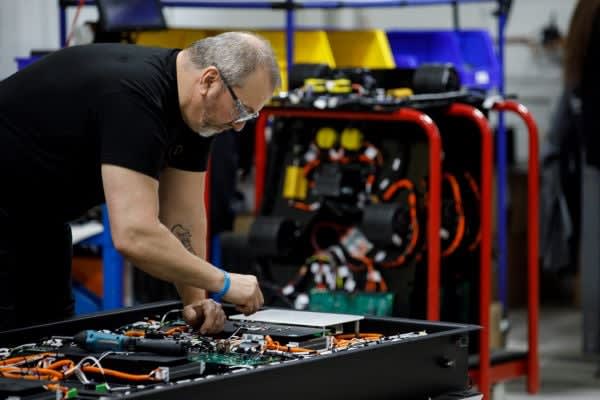
The Lion Electric Co. plans to construct a battery manufacturing plant and innovation center in Quebec. Shown here is the electric vehicle manufacturer's St. Jerome factory.
Photo courtesy The Lion Electric Co.
3 min to read
Electric vehicle manufacturer The Lion Electric Co. (Lion) announced on Monday plans to construct a battery manufacturing plant and innovation center in Quebec.
Utilizing cutting-edge technology, the factory is expected to begin operating in early 2023, according to a news release from Lion, and will produce battery packs and modules made from lithium-ion cells. Construction is projected to break ground over the next few months at a location to be confirmed soon.
The project and its development represent an investment of approximately $185 million Canadian dollars (CAD) by Lion. Additionally, the project will receive support from the federal and provincial governments of approximately $100 million CAD (amounting to $50 million CAD each), according to the news release.
With the construction of the plant, Lion anticipates a considerable reduction in vehicle manufacturing costs while ensuring control and optimization of a key component of its vehicle supply chain. Given that the battery is the most expensive component of an electric vehicle, Lion added in the news release, this new manufacturing capability will have a direct impact on the development of heavy-duty electric transportation while also offering environmental and economic benefits.
The Prime Minister of Canada Justin Trudeau; the Prime Minister of Quebec François Legault; the Minister of Innovation, Science and Industry François-Philippe Champagne; and the Minister of the Economy and Innovation Pierre Fitzgibbon, made the announcement, accompanied by Marc Bédard, CEO and founder of Lion Electric, at the Palais des congrès de Montréal convention center.
“This factory will allow Lion to integrate a fundamental element to the supply chain of our electric vehicles,” Bédard said. “Thanks to the financing provided by the federal and provincial governments, we will now be able to manufacture in Canada what we previously imported. Lion, Quebec, and Canada will gain from this, both on the economic and environmental fronts, to the great benefit of generations to come.”
“With today’s announcement, we are continuing to take steps to support our Canadian businesses, invest in innovation, and protect the environment,” Trudeau said. “It is because of companies like Lion Electric that we are accelerating our transition to a resilient and competitive clean growth economy.”
With a planned yearly production capacity of 5 gigawatt-hours in battery storage, Lion will be able to electrify approximately 14,000 medium- and heavy-duty vehicles annually. The manufacturing plant and innovation center will offer Lion many strategic advantages, including a reduction in its battery system production cost as well as a stable line of procurement of battery packs. The highly automated factory is projected to produce one battery module every 11 seconds and a full battery pack every five minutes.
Lion Electric will reportedly be the first Canadian manufacturer of medium- and heavy-duty vehicles to equip itself with its own automated battery pack manufacturing capability, according to the bus manufacturer.
Meanwhile, Lion’s innovation center will focus on research and development, with the goal of exploring and achieving new advancements in performance, range, energy capacity, and product development, and will allow the company the necessary flexibility to rapidly adapt to emerging technologies. (Similarly, the manufacturer has two Experience Centers, which offer training programs to help educate companies and school districts about electrification, in New York and California.)
Beyond the creation of numerous quality jobs in Quebec — including a projected 135 direct jobs, as well as hundreds more indirect regional jobs — the new facility will become an essential link in a chain of specialized suppliers essential to the electrification of transportation, according to Lion.
Originally posted on School Bus Fleet
More Fuel Smarts

How Volvo Updated Its D13 for EPA 2027 [Watch]
Volvo’s updated D13 promises lower emissions without sacrificing performance or fuel economy. Take a closer look at what changed inside the engine in this HDT Spotlight video.
Read More →
Diesel Price Spike Shortens Payback for Natural Gas Trucks, Report Says
Energy Vision estimates fleets could recover the higher purchase price of an RNG-fueled Class 8 tractor in 1.3 to 2.8 years under current fuel-price scenarios.
Read More →
Calstart Becomes Catalyst Mobility, Reflecting Broader Focus
Calstart is now Catalyst Mobility, reflecting the nonprofit’s growing national role in clean transportation, including zero-emission trucks, infrastructure and incentive programs.
Read More →

Record Diesel Prices Squeeze Trucking Fleets
Average U.S. diesel prices have climbed to nearly $6 a gallon, surpassing the 2022 record as tight refinery capacity and Middle East disruptions keep fuel costs elevated.
Read More →
Sponsored•September 9, 2026
How Fuel Delivery Shapes Engine Performance
Fuel delivery depends on more than what happens at the injector. For fleet, maintenance and technical professionals, looking at the full path from pump to injector can provide useful context for understanding engine performance.
Read More →
East Coast Port Launches $45M Electric Truck Push
The Port Authority of New York and New Jersey announced millions in incentives for zero-emission drayage trucks, yard tractors, and new charging hubs near the port.
Read More →
California Bill Could Shed Light on Electric Truck Prices
Why do battery-electric Class 8 trucks remain so expensive? A California bill headed to Gov. Gavin Newsom would give fleets and state agencies more visibility into what manufacturers charge.
Read More →
Detroit Opens Orders for EPA 2027 Engines
Detroit isn’t starting from scratch to meet EPA 2027 diesel emissions standards. Its Gen 6 DD13 and DD15 engines keep much of today’s platform while updating the fuel and aftertreatment systems.
Read More →
Zero-Emission Truck Corridor Planned for West Coast
California, Oregon, Washington, British Columbia and Baja California are coordinating plans for truck charging and hydrogen fueling from Canada to Mexico.
Read More →
A Closer Look at Kenworth’s Electric T880E Vocational Truck [Video]
Learn more about Kenworth's T880E battery-electric vocational truck at the Paccar Technical Center, including its range, applications, upfitting considerations, and PTO options, in this HDT Spotlight video.
Read More →