




Labor Day Holiday Traffic Expected to be Greatest Since 2008
Nearly 35 million million Americans are expected to journey 50 miles or more from home Thursday through Monday, a 1.3% percent increase over 2013.

Photo: Evan Lockridge
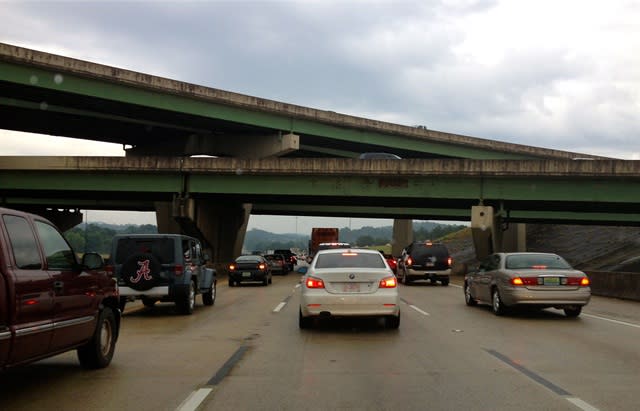
Photo: Evan Lockridge
Traffic during the upcoming Labor Day holiday is forecast to be the heaviest since 2008, according to a forecast by the motorist group AAA.
It projects 34.7 million Americans will journey 50 miles or more from home Thursday through Monday, a 1.3% percent increase over 2013. Nearly 86.5% of those travelers, 29.7 million, will celebrate the holiday with a final road trip.
Part of the reason for the expected hike, said AAA, is that consumer spending is continuing to rise in spite of stagnant income growth. In the third quarter of this year spending is expected to increase 3.8% year-over-year, while disposable personal income is only expected to increase 1.4%.
“Reliance on credit cards, rather than increasing income, is fueling holiday travel spending this year,” the group said, while it also noted economic growth is slow, consumers are feeling more comfortable taking on debt.
With the Labor Day holiday and more people out on the roadways, traffic crashes along with related injuries and fatalities are expected to jump.
The National Safety Council estimates 395 people will be killed and an additional 42,300 will be injured in car crashes beginning at 6 p.m. on Friday ending at the last of Monday.
The NSC said in 2012 and 2011, it estimated at or just slightly more than 400 people would be killed in Labor Day holiday traffic crashes. The actual number was around 375. In 2007, the year before the Great Recession, 508 people were killed on roadways over the Labor Day weekend.
Increased traffic isn't the only risk over the long weekend. One logistics security services provider has issued an advisory on another matter.
FreighWatch International cautions that holiday weekends historically show an increase in cargo theft risks for transportation companies, shippers, and manufacturers.
“Organized theft rings are active and understand that holiday weekends mean more shipments left unattended for extended periods of time,” the company said in a bulletin. “Labor Day Weekend of 2013 recorded thefts at a rate of 4.75 per day, which is an 81% increase in cargo theft for the holiday weekend when compared to the annual average."
FreightWatch International recommends logistics and security professionals ensure security protocols are up-to-date and in line with industry best practices for both in-transit and warehouse operations, both of which are expected to be heavily targeted over the weekend.
For instance, “to mitigate criminal’s attempts to exploit cargo at rest, ensure that the receiver’s hours of operation for the holiday weekend are consistent with scheduled delivery times,” said FreightWatch.
More Safety & Compliance

FMCSA Pauses Biennial-Update Enforcement Amid Motus Transition
Carriers whose updates were due on or after June 1 have more time, while FMCSA works to stabilize its new registration system and warns of phishing sites impersonating its new carrier registration system, Motus.
Read More →
ZF Expands Commercial Vehicle Push in North America
ZF is expanding its North American commercial-vehicle presence with new transmission applications, electrification, trailer technology and autonomous-driving systems.
Read More →
Truck Drivers Need More Than Another Alert
Fleets have more visibility into truck health, safety events, and driver activity than ever. The next challenge is turning all that information into useful guidance for the person who has to decide what to do next.
Read More →
Tesla Wants a Self-Driving Semi. Are Cameras Enough?
Could Tesla’s camera-only autonomous driving technology work on an 80,000-pound Semi? In this commentary, HDT's Deborah Lockridge takes a look at Tesla, Cybercab, and how autonomous trucks see the road.
Read More →
What DOT’s Automated Vehicle Strategy Means for Trucking
The U.S. Department of Transportation issued a new automated-vehicle strategy that outlines plans for driverless-truck regulations, cross-state freight corridors, and federal safety standards.
Read More →
NYC Expands Speed, Pedestrian Safety Tech Across Fleet
New York City is expanding intelligent speed assistance and pedestrian-alert systems across its municipal fleet, moving the technologies from pilot programs into vehicle procurement and retrofit requirements.
Read More →
FMCSA Removes 110 Truck Driver Training Schools from Certified ELDT List
Federal regulators also are targeting more than 160 additional training providers and launching a nationwide audit of third-party CDL skills testers as part of a broader crackdown on trucking fraud.
Read More →
Beyond DOT Compliance: What Makes a Trucking Fleet Truly Safe?
A trucking fleet can follow every rule and still make unsafe decisions. The real test comes when safety conflicts with freight, productivity, or cost.
Read More →
Hours of Service Pilot Programs: FMCSA Readies for 2027 Rollout
Two pilot programs could eventually reshape hours-of-service rules, giving truck drivers options to pause their 14-hour clock or use longer split sleeper rest periods.
Read More →
New Guide Offers Pet Safety Tips for Truck Drivers
Hundreds of thousands of pets travel in truck cabs. A new safety guide from Volvo Trucks and the Center for Pet Safety offers practical advice for truck drivers who bring dogs and cats along for the ride.
Read More →