





Kodiak: Ease of Sensor Replacement a Step toward Autonomous-Truck Deployment
Kodiak Robotics Announces Gen 5 Autonomous Truck
Kodiak Robotics introduced its fifth-generation autonomous truck with an increased number of sensors for added redundancy.
April 11, 2023
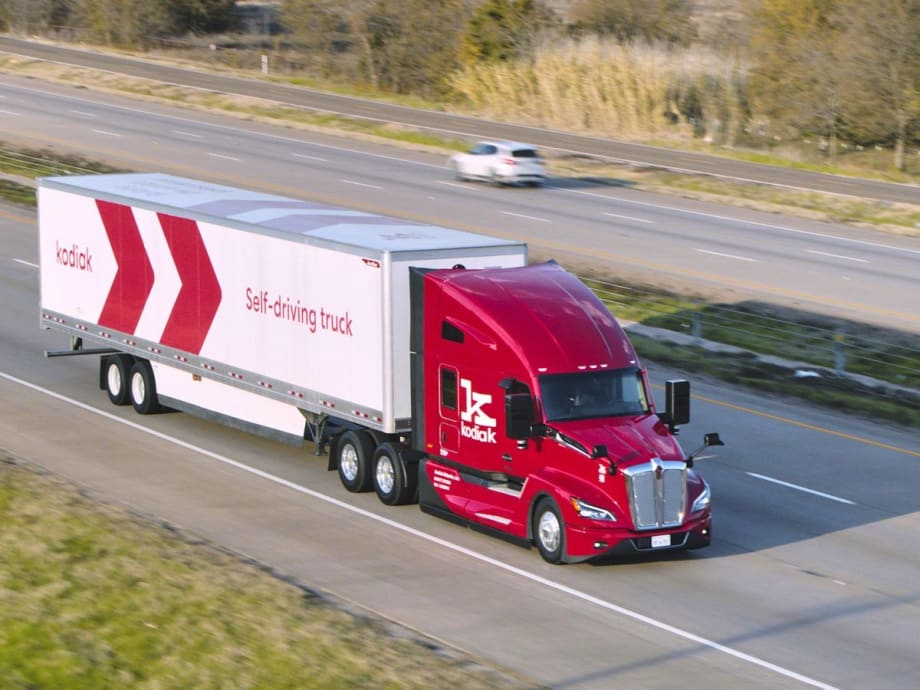
Kodiak's 5th generation truck (Gen5) has mirror-mounted SensorPods that eliminate the need for hard-to-maintain roof-mounted hardware.
Photo: Kodiak
3 min to read
Kodiak Robotics introduced its fifth-generation autonomous truck hardware platform with increased sensor redundancy and processing power.
The latest iteration removes the roof-mounted “center pod” sensor suite, relocating the front-facing Luminar Iris Lidar and wide field-of-view camera to each of its mirror-mounted SensorPods. By integrating sensors into the SensorPods, Kodiak says Lidar coverage is doubled at long range. With sensors located in an easy-to-reach location on the mirrors, drivers and technicians can avoid having to access the roof to maintain sensors.
Kodiak’s SensorPods are also designed to place sensors at the same height as a driver, maximizing road safety and improving perception. The SensorPods offer a better dual vantage point, according to the company, as they provide redundancy and visibility on either side of the truck, as opposed to the single vantage point above the cab. In the event of sensor damage, dual-redundant front-facing sensors increases resiliency.
In addition, an on-the-fly replacement of SensorPods, which are compatible with any truck platform, can be performed in about 10 minutes, according to Kodiak. The damaged SensorPod can then be returned to Kodiak for evaluation and repair.
“By removing the sensors from the top of the truck and incorporating them at a human driver’s line of sight, we have designed a system for the real world," said Don Burnette, founder and CEO of Kodiak Robotics, in a statement. “Additionally, having sensors on top of the cab is actually very difficult to service while on the road and requires specialized equipment, which is nearly impossible to find roadside.”
Like Kodiak's fourth-generation truck, Kodiak's fifth-generation truck includes Cummins X15 Series engines and Bridgestone’s smart-sensing tire technology.
A More Robust Sensor Array
The fifth-generation Kodiak truck improves upon the sensor array announced as part of its prior-generation platform. When removing the center pod, the company added a second forward-facing Lidar and additional camera to add redundancy in the left and right SensorPods. The new truck increases the total number of sensors on-board from 14 to 18, including one new Lidar and three new cameras — bringing the total camera count to 10. Two wide-angle cameras were added to the hood-mounted mirrors to cover blind spots.
Kodiak’s long-range sensor suite includes the following, split evenly between the two side-mounted mirror SensorPods:
Four ZF Full Range Radar for redundancy
Two Hesai 360-degree scanning Lidars for side- and rear-view detection
Two Luminar Iris Lidar sensors
Eight cameras, which include both wide and narrow field-of-views.
The new truck includes the recently announced Ambarella CV2 perception system-on-chip (SoC) which handles all camera data processing. The Ambarella CV2 SoC improves image quality for longer range detections and unlocks improved dynamic range for nighttime driving.
Improved Hardware Stack for Better Performance
Kodiak’s hardware stack is designed for three activities:
Sensing, through its SensorPods.
Thinking, through its main computer.
Acting, which is controlled through two onboard custom-designed safety computers, the Kodiak Actuation Control Engine, or ACE.
Kodiak also reduced the electrical power requirements for its fifth-generation truck, while improving the processing power of the system. In addition to 130% more GPU processing power, the new system provides 60% more central processing power, and additional system redundancy. The reduced power consumption allowed for a 50% reduction in the size of the fifth-generation power system, and also decreased cooling needs.
The company is also taking a modular approach to building its computing system with a consolidated its in-house compute system, networking, and power distribution into one physical unit, giving more options for integration. The computer hardware is manufactured by Crystal Group, a manufacturer of military and ruggedized computers, and is designed to handle the heavy and persistent vibrations onboard long-haul trucks.
More Equipment

How Volvo Updated Its D13 for EPA 2027 [Watch]
Volvo’s updated D13 promises lower emissions without sacrificing performance or fuel economy. Take a closer look at what changed inside the engine in this HDT Spotlight video.
Read More →
Michelin Tire Improves Efficiency and Durability for Regional Fleets
The Michelin X Multi Energy D2 is a regional haul drive tire engineered to help fleets improve fuel efficiency, durability and traction in demanding stop-and-go operations.
Read More →
ZF Expands Commercial Vehicle Push in North America
ZF is expanding its North American commercial-vehicle presence with new transmission applications, electrification, trailer technology and autonomous-driving systems.
Read More →
Tesla Wants a Self-Driving Semi. Are Cameras Enough?
Could Tesla’s camera-only autonomous driving technology work on an 80,000-pound Semi? In this commentary, HDT's Deborah Lockridge takes a look at Tesla, Cybercab, and how autonomous trucks see the road.
Read More →
Kodiak: Driverless Long-Haul Truck Launch on Track for 2026
Kodiak AI says its driverless long-haul safety case is 93% complete and it remains on track to begin commercial operations by year-end 2026.
Read More →
What DOT’s Automated Vehicle Strategy Means for Trucking
The U.S. Department of Transportation issued a new automated-vehicle strategy that outlines plans for driverless-truck regulations, cross-state freight corridors, and federal safety standards.
Read More →
East Coast Port Launches $45M Electric Truck Push
The Port Authority of New York and New Jersey announced millions in incentives for zero-emission drayage trucks, yard tractors, and new charging hubs near the port.
Read More →
PlusAI Going Public to Fund Autonomous Truck Launch
A SPAC deal could provide PlusAI with up to $300 million as it works toward a 2027 commercial launch of factory-built autonomous trucks.
Read More →
NHTSA Moves to Rewrite Truck Fuel-Economy Rules
The National Highway Traffic Safety Administration says it lacks authority to regulate medium- and heavy-duty truck engines separately from complete vehicles, but the existing standards have not yet been eliminated.
Read More →
Detroit Opens Orders for EPA 2027 Engines
Detroit isn’t starting from scratch to meet EPA 2027 diesel emissions standards. Its Gen 6 DD13 and DD15 engines keep much of today’s platform while updating the fuel and aftertreatment systems.
Read More →