




Related: Q&A – Kenworth General Manager Talks Trucking's Future Challenges
Kenworth Prepares to Launch Fuel-Economy Spec'ed Day Cab T680
Kenworth will extend its T680 fuel economy Advantage package into vocational applications soon with the launch of two new, T680 Advantage Day Cab models,, but will cut production of the T660 by the end of the year.
by Jack Roberts
August 12, 2016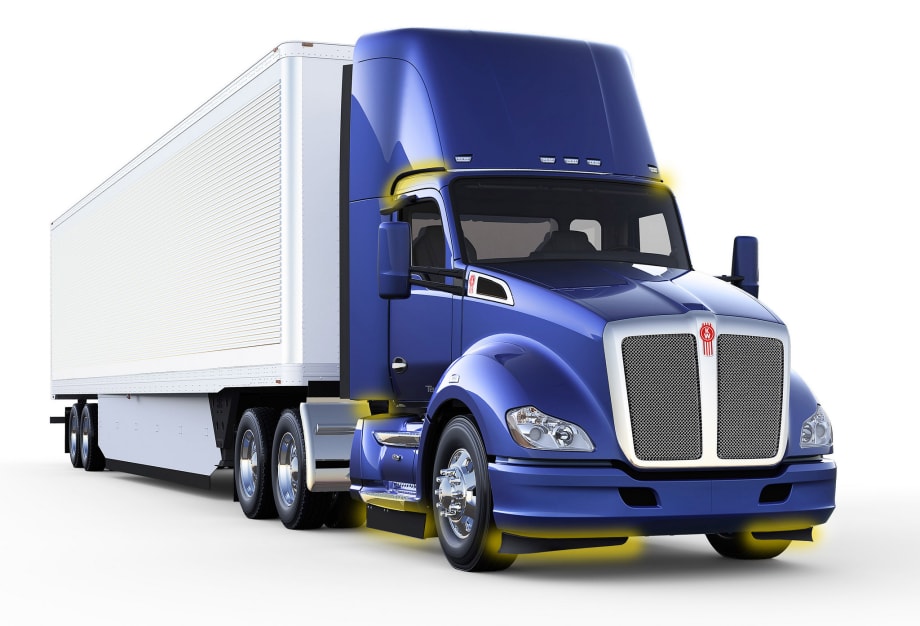
Kenworth now offers the fuel-efficient Kenworth T680 Advantage Day Cab for pickup and delivery and regional haul operators.
4 min to read
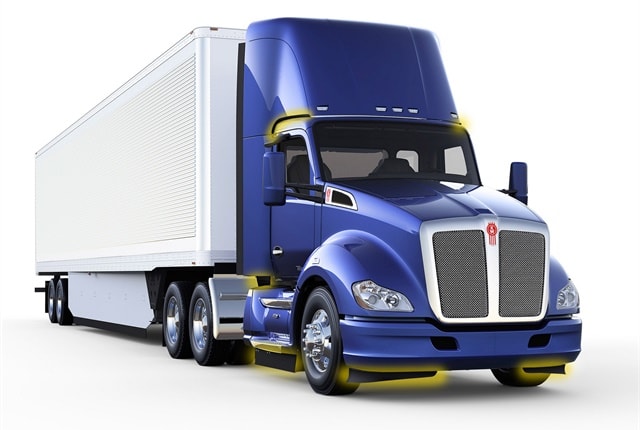
Kenworth now offers the fuel-efficient Kenworth T680 Advantage Day Cab for pickup and delivery and regional haul operators.
Kirkland, Wash. – Kenworth will extend its T680 fuel economy Advantage package into vocational applications soon with the launch of two new, T680 Advantage Day Cab models, but will cut production of the T660 by the end of the year.
The announcement came Friday at Kenworth headquarters in Kirkland, Wash.*, ahead of a demonstration of Bendix's new Fusion Advanced Vehicle Safety system.
Kenworth Chief Engineer Kevin Baney said the new trucks will help pickup and delivery and regional haul operators save money with enhanced fuel economy benefits pioneered and refined on the company's Advantage highway tractor.
The new T680 Advantage Day Cab features an optimized powertrain built around the 2016 Paccar MX-13 or MX-11 engine. A fuel efficiency-optimized Eaton Fuller Advantage series 10-speed automated transmission is standard, combined with Meritor MT40-14X drive axles rated at 40,000 lbs. Other key features include Kenworth Driver Performance Assistant, Kenworth Predictive Cruise Control, Kenworth Neutral Coast, and FlowBelow aero wheel covers.
Aerodynamics provide the foundation for any fuel-efficient truck design today, and the T680 Advantage Day Cab is no different, with aerodynamic treatments designed to further reduce aerodynamic drag and improve fuel economy. These include a front air dam, roof cap “bulb” seal, lower fairing extensions, and lower fairing closeouts – all carefully engineered to expedite airflow across all surface areas on the truck and negate aerodynamic drag and vacuum areas as much as possible.
All told, Baney said, the combination of a highly efficient powertrain and super-slippery aerodynamic profile give the T680 Day Cab up to a 6% boost in fuel economy, compared to a non-optimized version of the truck.
The new model will debut later this month.
Kenworth upgrades T370 medium-duty vocational truck
In other news, Kenworth announced that it is enhancing its T370 medium-duty truck with additional new options that further expand its capabilities for vocational customers.
These upgrades include a new, durable straight steel channel bumper, larger size 385/65R22.5 steer tires, and rugged, molded thermoplastic fender extensions. The heavy front axles can be paired with 46,000-lb. rear axles to create specifications ideally suited for vocational applications, such as dump, fuel delivery, utility, crane, service trucks, or mixers.
Additionally, Kenworth CEO Mike Dozier noted that after a successful 10-year run, the company will "sunset" production of its T660 Class 8 tractor. The final production run of 500 units is underway now. Dozier noted that more than 60,000 T660s have been sold over the past decade.
Low- and Zero-Emission T680 Day Cabs to be Tested in California Ports
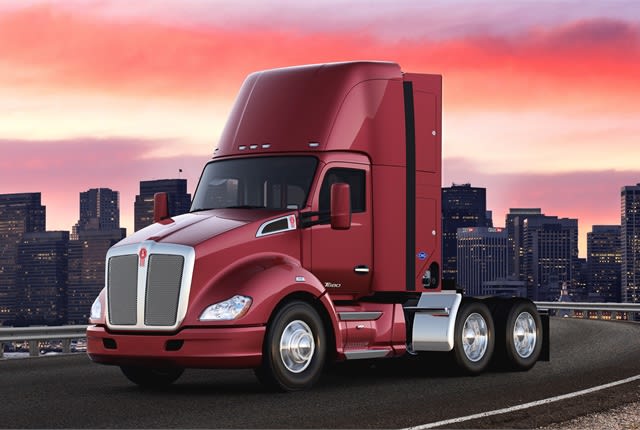
Kenworth plans to build two proof-of-concept Kenworth T680 Day Cab drayage tractors, like the CNG-fueled truck pictured here, to transport freight from the Ports of Los Angeles and Long Beach to warehouses and railyards along the I-710 corridor in the Los Angeles basin.
Kenworth also announced it has received $8.6 million in grants for low-emission T680 Day Cab drayage truck projects in California. The three government grants will support low-emissions projects involving Kenworth T680 Day Cabs targeted for use as drayage tractors in Southern California ports.
The first two projects are funded at $1.9 million each by the U.S. Department of Energy Office of Energy Efficiency and Renewable Energy, with Southern California’s South Coast Air Quality Management District as the prime applicant. Kenworth will build two proof-of-concept T680 Day Cab drayage tractors to transport freight from the Ports of Los Angeles and Long Beach to warehouses and railyards along the I-710 corridor in the Los Angeles basin.
The first will be a hybrid electric drayage truck producing near-zero emissions using a currently available compressed natural gas engine to generate electrical power. The second will feature a hydrogen fuel cell offering true zero-emissions operation. These trucks are expected to be identical, except for their power generation systems. Both trucks will have an all-electric range of 30 miles, as well as on-board CNG and hydrogen capacity, respectively, of 100 diesel gallons equivalent.
The third project is funded at $4.8 million by the California Air Resources Board, again with the SCAQMD as the prime applicant. Kenworth will build four hybrid-electric T680 Day Cabs and support the customer field test of the units in Southern California drayage operations.
“Hybrid-electric powertrains are expected to be required within seven to 10 years to meet emissions requirements in several major metropolitan areas of the United States," said Mike Dozier, Kenworth general manager and Paccar vice president. "Already California is considering regulations requiring port drayage trucks to run at zero-emission levels when operating in economically disadvantaged communities. These T680 Day Cab projects are a great opportunity for Kenworth to advance the development of key technologies that may play a critical role in the trucks of the future.”
(* Article updated to correct Kenworth headquarters city, Aug. 14, 2016, 4:30 EDT)
More Fuel Smarts

How Volvo Updated Its D13 for EPA 2027 [Watch]
Volvo’s updated D13 promises lower emissions without sacrificing performance or fuel economy. Take a closer look at what changed inside the engine in this HDT Spotlight video.
Read More →
Diesel Price Spike Shortens Payback for Natural Gas Trucks, Report Says
Energy Vision estimates fleets could recover the higher purchase price of an RNG-fueled Class 8 tractor in 1.3 to 2.8 years under current fuel-price scenarios.
Read More →
Calstart Becomes Catalyst Mobility, Reflecting Broader Focus
Calstart is now Catalyst Mobility, reflecting the nonprofit’s growing national role in clean transportation, including zero-emission trucks, infrastructure and incentive programs.
Read More →

Record Diesel Prices Squeeze Trucking Fleets
Average U.S. diesel prices have climbed to nearly $6 a gallon, surpassing the 2022 record as tight refinery capacity and Middle East disruptions keep fuel costs elevated.
Read More →
Sponsored•September 9, 2026
How Fuel Delivery Shapes Engine Performance
Fuel delivery depends on more than what happens at the injector. For fleet, maintenance and technical professionals, looking at the full path from pump to injector can provide useful context for understanding engine performance.
Read More →
East Coast Port Launches $45M Electric Truck Push
The Port Authority of New York and New Jersey announced millions in incentives for zero-emission drayage trucks, yard tractors, and new charging hubs near the port.
Read More →
California Bill Could Shed Light on Electric Truck Prices
Why do battery-electric Class 8 trucks remain so expensive? A California bill headed to Gov. Gavin Newsom would give fleets and state agencies more visibility into what manufacturers charge.
Read More →
Detroit Opens Orders for EPA 2027 Engines
Detroit isn’t starting from scratch to meet EPA 2027 diesel emissions standards. Its Gen 6 DD13 and DD15 engines keep much of today’s platform while updating the fuel and aftertreatment systems.
Read More →
Zero-Emission Truck Corridor Planned for West Coast
California, Oregon, Washington, British Columbia and Baja California are coordinating plans for truck charging and hydrogen fueling from Canada to Mexico.
Read More →
A Closer Look at Kenworth’s Electric T880E Vocational Truck [Video]
Learn more about Kenworth's T880E battery-electric vocational truck at the Paccar Technical Center, including its range, applications, upfitting considerations, and PTO options, in this HDT Spotlight video.
Read More →