




Judge Rules Against Maritime Commission in Port Dispute
A District Court judge has denied the Federal Maritime Commission's request for an injunction of certain elements of the Ports of Los Angeles and Long Beach's Clean Truck Program
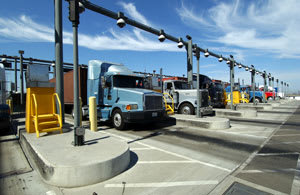
Trucks entering the Port of Los Angeles.
A District Court judge has denied the Federal Maritime Commission's request for an injunction of certain elements of the Ports of Los Angeles and Long Beach's Clean Truck Program.
The commission argued that the Port of Los Angeles employee mandate to phase out independent contractors and both Ports' container fee exceptions and subsidy programs violated the Federal Shipping Act because they were likely to unreasonably reduce competition at the Ports and lead to unreasonable increases in transportation costs.
The judge found that although it was likely that those provisions would force some owner-operators and motor carriers out of the drayage market, the drayage market would remain competitive enough to meet the Shipping Act's standards. The judge said the Maritime Commission had not demonstrated that transportation costs would be unreasonably increased.
The FMC has the ability to take action against agreements in the ocean shipping industry that it believes are likely, by a reduction in competition, to unreasonably raise rates and decrease services.
The Ports "are implementing ambitious, multi-faceted programs to reduce high levels of air pollution while also striving to improve the Ports' safety and security and to enable future development," noted Judge Richard J. Leon. "Given the protracted and public deliberative process that led to the development of the CTPs and the responsibility the [Ports] have for improving the area's public health and managing the Ports' efficient operations, the Court finds that the public interest, at this point, favors denying the FMC's motion" for a preliminary injunction."
The American Trucking Associations emphasizes that the legal requirements associated with the Shipping Act are completely different from those at issue in the separate ATA challenge to the Ports' Concession Plans.
The ATA lawsuit involves the federal rates, routes, and services pre-emption provision, which prohibits states and political subdivisions from imposing any law that affects a motor carrier's operations in those areas.
As the Ninth Circuit found in the ATA case, it "can hardly be doubted" that the Ports' Concession Plans (one element of the Clean Trucks Program) have such a prohibited effect. The Ninth Circuit ruling rests upon the basis that the reshaping/re-regulation of the market is itself a violation of the rates, routes, and services preemption provision -- regardless of whether some level of competition remains in the re-regulated market.
ATA did not participate in the FMC court challenge and formally communicated to the agency its support of the Ports being allowed to collect and distribute the container fees to motor carriers in furtherance of the Ports' Clean Truck Program. ATA officials say that because of the differing legal standards applicable in the ATA and FMC cases, the FMC ruling has no relevance to the legal issues in the ATA challenge. (See "U.S. Court of Appeals Rules in Favor of ATA in Lawsuit Against Ports," 3/23/09.)
More Fleet Management

Nominations Open for HDT Emerging Leaders
Heavy Duty Trucking is looking for accomplished trucking fleet professionals under 40 who are making an impact and helping lead the industry forward.
Read More →
Why Private Fleets Are Taking More Freight
Private fleets are putting their own trucks on demanding customers and high-cost lanes as companies seek greater control over service, costs, and capacity.
Read More →
Color Match Smarter: Tools That Restore & Perform
For fleet managers and collision repair professionals keeping heavy-duty trucks on the road, getting the color right the first time isn't just about appearance — it's about efficiency, turnaround time, and bottom-line results. Discover how today's digital color tools are transforming the repair process from guesswork to precision.
Read More →


FMCSA Pauses Biennial-Update Enforcement Amid Motus Transition
Carriers whose updates were due on or after June 1 have more time, while FMCSA works to stabilize its new registration system and warns of phishing sites impersonating its new carrier registration system, Motus.
Read More →
2026 Blueprint for Countering Smarter Supply Chain Theft
Cargo theft is no longer just the cost of doing business. It's a multi-billion-dollar criminal enterprise exploiting vulnerabilities across your fleet, drivers, and supply chain.
Read More →
How Telematics Improves Visibility, Control, and Performance in Refrigerated Fleets
Explore how telematics help refrigerated fleets improve visibility, uptime, efficiency, compliance, and cargo protection across connected cold chain operations.
Read More →
What the U.S.-Canada Trade War Means for Trucking
Escalating U.S.-Canada tariffs could disrupt cross-border freight, reduce truck volumes, raise costs, and create new uncertainty for carriers on both sides of the border.
Read More →
What Are Trucking’s Top Concerns for 2026?
The American Transportation Research Institute wants to know what's worrying trucking fleet managers, drivers, and other stakeholders in its annual Industry Issues survey.
Read More →
American Trucking Associations Looks for a New Leader
ATA President and CEO Chris Spear abruptly left his job at the association on August 21, at a pivotal time for the trucking industry.
Read More →
Public Wi-Fi Cybersecurity Risks: How Truck Drivers and Fleets Can Protect Their Data
Public Wi-Fi can expose truck drivers and fleets to credential theft, malware, and other cyber threats. Here’s how to reduce the risk on the road.
Read More →