




Iveco's New Stralis Series Includes Gas Power
“Stralis NP is the first and only gas truck that has demonstrated it can be used in long-haul missions,” said Pierre Lahutte, brand president. Its range on LNG is up to 900 miles.
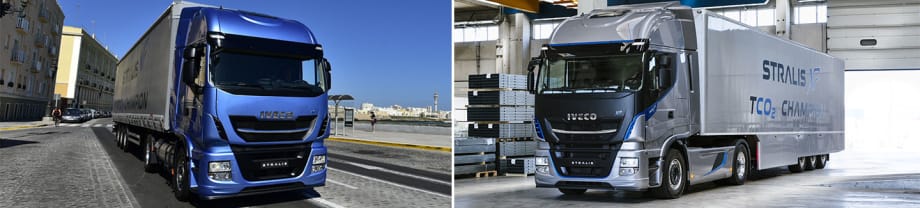
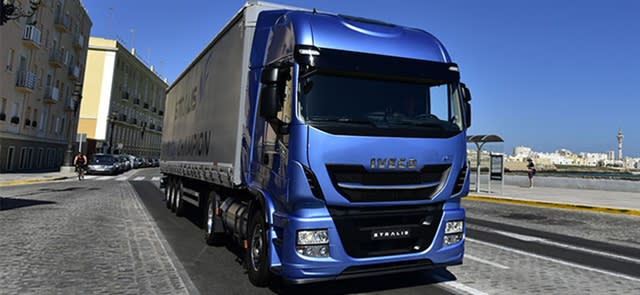
Iveco, the Italy-based commercial vehicle manufacturer, has announced a New Stralis series of heavy trucks that includes a natural gas-fueled NP version, which officials call “a CO2 champion in every mission” for its low carbon dioxide emissions.
It also includes a diesel-powered XP, and boasts a new 12-speed automated transmission and other drivetrain advances. Iveco’s brand president, Pierre Lahutte, claimed New Stralis-series trucks will deliver the lowest total cost of ownership, or TCO.
The trucks will be assembled in Madrid, Spain, for the European market.
“Stralis NP is the first and only gas truck that has demonstrated it can be used in long-haul missions,” Lahutte said. “We are about to open new frontiers in sustainable transport, and we will make it in partnership with our customers.”
Using liquified natural gas, the NP has a range of 1,500 kilometers (900 miles), the company claimed.
The NP’s 8.7-liter Iveco Cursor 9 Natural Power engine will burn liquefied or compressed natural gas and meets Euro VI exhaust-gas limits without diesel-type aftreatment equipment, the company said. The engine is rated at 400 hp and 1,700 Newton-meters (1,254 lb-ft) of torque, equal to its diesel equivalent.
The New Stralis has “a completely redesigned driveline, a new electrical and electronic architecture, the new best-in-class transmission, rear axle and a rear suspension, and introduces the latest-generation GPS predictive functions and new features to enhance fuel economy and sustainability,” Iveco’s press release said. “In addition, Iveco has developed a new generation of services aimed at reducing the TCO of each model.”
Lahutte added, “The New Stralis has been designed to lower the TCO and CO2 of transporters as well providing the very best reliability to its owners. We have added for the customer a new set of services to reduce their TCO.
“The long-range freight hauling business will drive the whole commercial vehicle market in the years to come (and) Stralis has all that is needed to lead such a completely reshaped market.”
More Fuel Smarts

How Volvo Updated Its D13 for EPA 2027 [Watch]
Volvo’s updated D13 promises lower emissions without sacrificing performance or fuel economy. Take a closer look at what changed inside the engine in this HDT Spotlight video.
Read More →
Diesel Price Spike Shortens Payback for Natural Gas Trucks, Report Says
Energy Vision estimates fleets could recover the higher purchase price of an RNG-fueled Class 8 tractor in 1.3 to 2.8 years under current fuel-price scenarios.
Read More →
Calstart Becomes Catalyst Mobility, Reflecting Broader Focus
Calstart is now Catalyst Mobility, reflecting the nonprofit’s growing national role in clean transportation, including zero-emission trucks, infrastructure and incentive programs.
Read More →

Record Diesel Prices Squeeze Trucking Fleets
Average U.S. diesel prices have climbed to nearly $6 a gallon, surpassing the 2022 record as tight refinery capacity and Middle East disruptions keep fuel costs elevated.
Read More →
How Fuel Delivery Shapes Engine Performance
Fuel delivery depends on more than what happens at the injector. For fleet, maintenance and technical professionals, looking at the full path from pump to injector can provide useful context for understanding engine performance.
Read More →
East Coast Port Launches $45M Electric Truck Push
The Port Authority of New York and New Jersey announced millions in incentives for zero-emission drayage trucks, yard tractors, and new charging hubs near the port.
Read More →
California Bill Could Shed Light on Electric Truck Prices
Why do battery-electric Class 8 trucks remain so expensive? A California bill headed to Gov. Gavin Newsom would give fleets and state agencies more visibility into what manufacturers charge.
Read More →
Detroit Opens Orders for EPA 2027 Engines
Detroit isn’t starting from scratch to meet EPA 2027 diesel emissions standards. Its Gen 6 DD13 and DD15 engines keep much of today’s platform while updating the fuel and aftertreatment systems.
Read More →
Zero-Emission Truck Corridor Planned for West Coast
California, Oregon, Washington, British Columbia and Baja California are coordinating plans for truck charging and hydrogen fueling from Canada to Mexico.
Read More →
A Closer Look at Kenworth’s Electric T880E Vocational Truck [Video]
Learn more about Kenworth's T880E battery-electric vocational truck at the Paccar Technical Center, including its range, applications, upfitting considerations, and PTO options, in this HDT Spotlight video.
Read More →