




Infrastructure the Greatest Barrier to EV Deployment: DTNA’s O’Leary
Daimler Truck North America chief John O'Leary talks about electric trucks, truck sales projections, and the future of diesel and zero emissions.

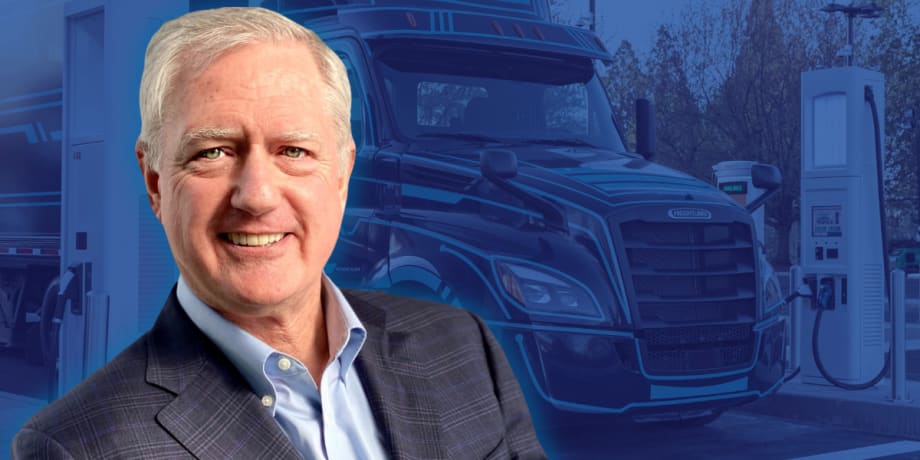
Daimler Truck North America President and CEO John O'Leary offered his industry outlook in Las Vegas.
Photos: DTNA
While fleets might be very interested in electrification, their expansion plans are thwarted by delays in charging infrastructure development.
“Overwhelmingly, infrastructure is slowing us down in terms of EV deployment,” said Daimler Truck North America President and CEO John O’Leary. “Site prep, permitting, and construction delays all contribute to deployment times being measured in years, not weeks or months.”
Speaking to a group of truck journalists in Las Vegas ahead of the unveiling of the company’s SuperTruck II project, O’Leary said customers are happy with the EV products they have received so far, but any expansion plans they might have to go from two or three trucks to perhaps 50 or 100 have to be shelved because of the lack of charging infrastructure.
“There's a lot of will in the regulatory and political arenas to make that happen, but when you start talking about moving large megawatt lines of electricity around and building new substations, it just takes time,” he said.
O’Leary says the current focus is on behind-the-fence charging in truck yards and the like, but Daimler is working to build out public networks, too. Last year Daimler announced a proposal for a joint venture with NextEra Energy Resources LLC and BlackRock Renewable Power to design, develop, install and operate a nationwide, high-performance charging network.
Today, O’Leary said, they are in the process of hiring the leadership team that will run the program.
“We want to get the best executive team we can find and install them and let them come up with a strategy,” he said. “We think they'll be a lot smarter about it than we are, and obviously, there'll be a lot more ownership if it's their strategy and not ours. You’ll hear more about this later this year.”
2023 Looks Much Like 2022 for Truck Sales
Despite immense headwinds in the supply chain, DTNA still delivered 186,717 units in 2022, an increase of 15.2% over the previous year.
O’Leary noted the biggest supply chain challenges came from sourcing heavy parts such as frame rails, brakes, tires and wheels, along with the more well-known problems with semi-conductors. The parts shortages eased somewhat over the Christmas period, and he said they are no longer using brokers to source sensitive electronics from overseas suppliers.

Helping to drive truck sales this year is fleet age, O'Leary said. “Customers have gotten out of their sweet spot, and operating costs are rising."
Photo: Jim Park
“Pretty much during the entire year of 2022 we had tiger teams working around the clock around the globe, sourcing CPUs,” he told reporters. “By the end of the year, our usual suppliers were getting caught up so we didn't have to resort so much to the brokers and other third parties.”
He said supply is currently at about the 90-95% level.
Output for 2023 will look a lot like 2022, he said, citing a very healthy order backlog for DTNA and the rest of the industry. That’s driven in part by the average age of the nation’s fleet, with carriers holding on to their trucks longer than they normally would because of the supply-chain problems and big backorders.
“Customers have gotten out of their sweet spot, and operating costs are rising,” O’Leary noted. “They have capital to deploy, and they want to lower the average age of their fleet and get into a more healthy situation.”
O’Leary is expecting elevated sales in Class 6 through Class 8 and says vocational purchases will be helped along by infrastructure spending.
Despite extremely constrained used-truck inventory, Daimler Trucks Remarketing saw record profit generation last year. September saw the opening of the 41st SelecTrucks store.
On the parts front, the company’s distribution centers achieved record parts sales and profitability, with a 23% year-on-year increase in current revenue.
DTNA’s dealer network added 237 service bays in 2022. Plans are in place to bring another 800 bays on line in 40 new or significantly remodeled locations before the end of this year. That would bring the network total up to just about 10,000 service bays, O’Leary said.
Outlook for 2023
O’Leary’s outlook on the economy is more positive than negative, but don’t look for a banner year, he suggested. Any risk of a general recession should be mild, he said.
“Consumer spending has slowed, but remains more resilient than the Fed or anyone else has forecast so far,” he said. “Inflation seems to be losing momentum, but while still very high, it seems to have plateaued.”
With the unveiling of the SuperTruck II project scheduled for later that evening, O’Leary defended the company’s continued investment in diesels and diesel technology, saying, “Diesel would remain the predominant propulsion choice for the foreseeable future because it suits 100% of all applications, and it remains the most cost effective and efficient way to move goods and people.”
He also reaffirmed his commitment to zero emissions, saying the choice between the two is not an either/or proposition.
“We are committed to both, at least until 2039, when we have previously announced that we will be out of the diesel business, at least in Triad Countries.”
Look for continued growth in the EV sector, especially with medium-duty and last mile. DTNA will launch the eM2 later this year at ACT Expo. And following a successful deployment of Freightliner Custom Chassis’ walk-in van platform at Penske, expectations are high that the product will be well accepted by package delivery operators.
More Equipment

Used-Truck Remarketing Math Is Changing
Used-truck value is no longer just a concern at trade-in. Decisions made throughout a truck’s first life can influence what it’s worth years later.
Read More →
How Volvo Updated Its D13 for EPA 2027 [Watch]
Volvo’s updated D13 promises lower emissions without sacrificing performance or fuel economy. Take a closer look at what changed inside the engine in this HDT Spotlight video.
Read More →
Michelin Tire Improves Efficiency and Durability for Regional Fleets
The Michelin X Multi Energy D2 is a regional haul drive tire engineered to help fleets improve fuel efficiency, durability and traction in demanding stop-and-go operations.
Read More →
ZF Expands Commercial Vehicle Push in North America
ZF is expanding its North American commercial-vehicle presence with new transmission applications, electrification, trailer technology and autonomous-driving systems.
Read More →
Tesla Wants a Self-Driving Semi. Are Cameras Enough?
Could Tesla’s camera-only autonomous driving technology work on an 80,000-pound Semi? In this commentary, HDT's Deborah Lockridge takes a look at Tesla, Cybercab, and how autonomous trucks see the road.
Read More →
Kodiak: Driverless Long-Haul Truck Launch on Track for 2026
Kodiak AI says its driverless long-haul safety case is 93% complete and it remains on track to begin commercial operations by year-end 2026.
Read More →
What DOT’s Automated Vehicle Strategy Means for Trucking
The U.S. Department of Transportation issued a new automated-vehicle strategy that outlines plans for driverless-truck regulations, cross-state freight corridors, and federal safety standards.
Read More →
East Coast Port Launches $45M Electric Truck Push
The Port Authority of New York and New Jersey announced millions in incentives for zero-emission drayage trucks, yard tractors, and new charging hubs near the port.
Read More →
PlusAI Going Public to Fund Autonomous Truck Launch
A SPAC deal could provide PlusAI with up to $300 million as it works toward a 2027 commercial launch of factory-built autonomous trucks.
Read More →
NHTSA Moves to Rewrite Truck Fuel-Economy Rules
The National Highway Traffic Safety Administration says it lacks authority to regulate medium- and heavy-duty truck engines separately from complete vehicles, but the existing standards have not yet been eliminated.
Read More →