




I-95 to Reopen in Philadelphia in Less Than 2 Weeks
The portion of Interstate 95 that collapsed earlier this month in Philadelphia is now expected to reopen within two weeks, Pennsylvania Gov. Josh Shapiro said following an aerial tour of the site with President Joe Biden over the weekend.

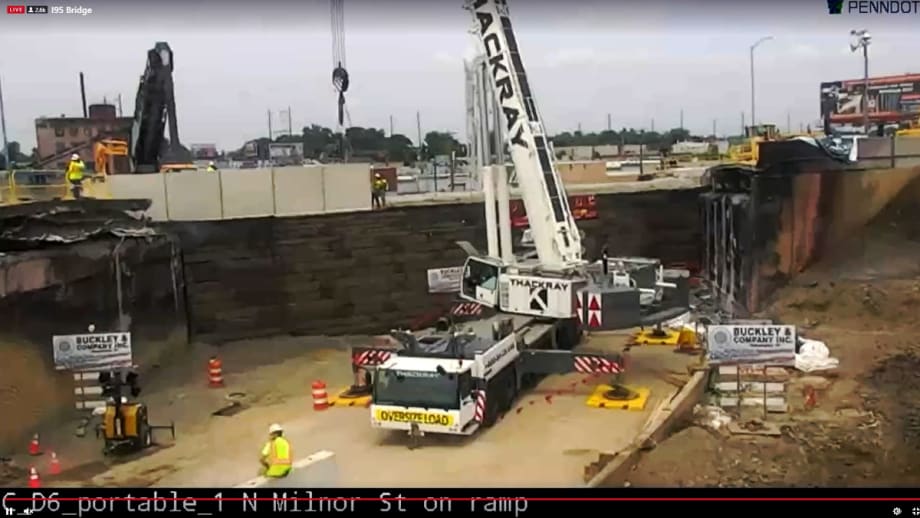
Work is underway to backfill the area where I-95 collapsed in Philadelphia so the interstate can be reopened.
Photo: PennDot Live Feed
The portion of Interstate 95 that collapsed earlier this month in Philadelphia is now expected to reopen within two weeks, Pennsylvania Gov. Josh Shapiro said following an aerial tour of the site with President Joe Biden over the weekend.
A portion of the northbound lanes of I-95 collapsed on June 11 following a tanker fire beneath the roadway. The incident also left the southbound lanes impassable.
“I can state with confidence that we will have I-95 reopened within the next two weeks,” said Shapiro at the briefing with President Biden at Philadelphia International Airport. “We are going to get traffic moving again thanks to the extraordinary work of those here and our incredible union trade workers.”
Demolition of the bridges, one collapsed and one heavily damaged, was done in just four days and was completed last Thursday.
The plan to reopen traffic on I-95 entails backfilling the site and then later rebuilding the bridges.
Filling the Void
That same day as demolition wrapped up, the Pennsylvania State Police escorted truckloads of foamed glass aggregate fill from AeroAggregates in Delaware County up I-95 to the construction site to make sure they arrived as quickly as possible.
Members of the Philadelphia Building Trades, working for Philadelphia-based contractor Buckley & Company, have begun pouring the foamed glass aggregate into the gap in the roadway, building it up to the surface level of I-95, reports the governor’s office.
They will continue working 24/7 to reopen the highway as quickly as possible. PennDOT is providing a live feed where people can view the progress of the work 24/7.
Emergency Declaration
Soon after the collapse, Shapiro signed a proclamation of disaster emergency, which he said allowed the commonwealth to immediately draw down federal funds to move quickly in repair and reconstruction.
The proclamation, according to the governor, makes $7 million of state funds immediately available for the reconstruction of the roadway and authorizes the Pennsylvania Emergency Management Agency, the Department of Transportation, and the Pennsylvania State Police to use all available resources and personnel as necessary.
The proclamation waived bidding and contracting procedures, as well as other formalities normally prescribed by law, Shapiro said in a press release. Per the constitutional amendment approved in 2021, the proclamation will remain in place for 21 days, unless extended by the legislature.
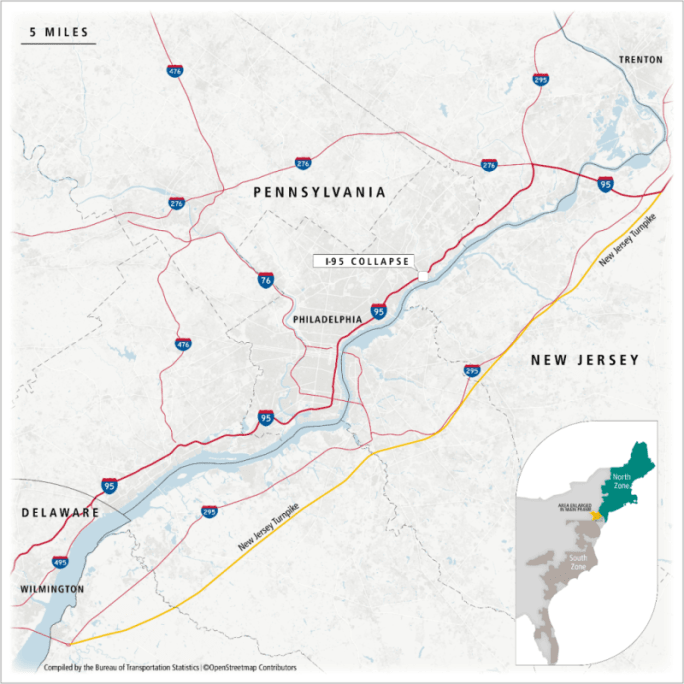
The collapse occurred in an area where there are alternative routes for trucks.
Impact on Truck Traffic
According to the Bureau of Transportation Statistics, trucks carry millions of tons of freight and billions in dollar-value through the region annually. In 2021, trucks carried 21 million tons of freight worth $104 billion between major goods producing and consuming areas to the north and south of the Philadelphia region.
Fortunately for freight movement in the I-95 corridor, said BTS, the bridge collapse occurred in a part of the highway network that has major alternative routes. Freight can travel around Philadelphia on the New Jersey Turnpike and I-295 without significant additions to the distances traveled.
The major disruption is to local freight movements between central Philadelphia and its northeastern suburbs such as Bucks County. Displaced traffic from I-95 to I-295 and the New Jersey Turnpike may cause increased congestion and affect the travel times of trucks.
More Fleet Management

Color Match Smarter: Tools That Restore & Perform
For fleet managers and collision repair professionals keeping heavy-duty trucks on the road, getting the color right the first time isn't just about appearance — it's about efficiency, turnaround time, and bottom-line results. Discover how today's digital color tools are transforming the repair process from guesswork to precision.
Read More →
FMCSA Pauses Biennial-Update Enforcement Amid Motus Transition
Carriers whose updates were due on or after June 1 have more time, while FMCSA works to stabilize its new registration system and warns of phishing sites impersonating its new carrier registration system, Motus.
Read More →
2026 Blueprint for Countering Smarter Supply Chain Theft
Cargo theft is no longer just the cost of doing business. It's a multi-billion-dollar criminal enterprise exploiting vulnerabilities across your fleet, drivers, and supply chain.
Read More →


How Telematics Improves Visibility, Control, and Performance in Refrigerated Fleets
Explore how telematics help refrigerated fleets improve visibility, uptime, efficiency, compliance, and cargo protection across connected cold chain operations.
Read More →
What the U.S.-Canada Trade War Means for Trucking
Escalating U.S.-Canada tariffs could disrupt cross-border freight, reduce truck volumes, raise costs, and create new uncertainty for carriers on both sides of the border.
Read More →
What Are Trucking’s Top Concerns for 2026?
The American Transportation Research Institute wants to know what's worrying trucking fleet managers, drivers, and other stakeholders in its annual Industry Issues survey.
Read More →
American Trucking Associations Looks for a New Leader
ATA President and CEO Chris Spear abruptly left his job at the association on August 21, at a pivotal time for the trucking industry.
Read More →
Public Wi-Fi Cybersecurity Risks: How Truck Drivers and Fleets Can Protect Their Data
Public Wi-Fi can expose truck drivers and fleets to credential theft, malware, and other cyber threats. Here’s how to reduce the risk on the road.
Read More →
For Nicky Cupp, Fleet Innovation Starts With Frustration
HDT Truck Fleet Innovator Nicky Cupp turns everyday pain points at Fraley & Schilling into opportunities for better technology and smarter processes.
Read More →
Adam Buttgenbach’s Approach to Electric Trucks: Start With Where They Fit
HDT Truck Fleet Innovator Adam Buttgenbach helped PepsiCo build one of North America’s largest EV fleets by focusing on where electric trucks make operational sense.
Read More →