




Hydrogen Opposed-Piston Engine Working Group Formed
The Hydrogen Opposed Piston Engine Working Group will host a series of meetings of its members to exchange research results, insights and ideas regarding opposed-piston engines with hydrogen combustion.

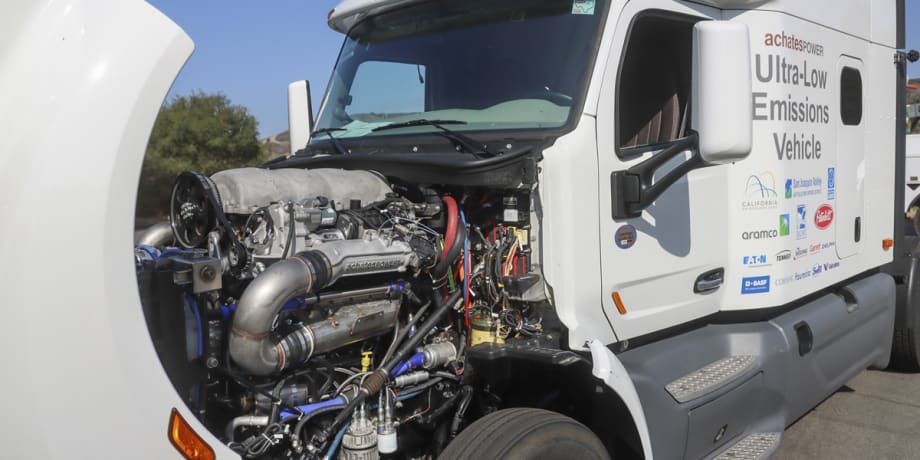
The newly formed organization will host a series of meetings of its members to exchange research results, insights and ideas regarding opposed-piston engines with hydrogen combustion.
File Photo: Achates Power
Several organizations, encompassing companies, research labs, and academia, have formed the Hydrogen Opposed Piston Engine Working Group, a collaborative forum to advance sustainable transportation technology.
The newly formed organization will host a series of meetings of its members to exchange research results, insights and ideas regarding opposed-piston engines with hydrogen combustion.
“An opposed piston engine with hydrogen combustion could well provide the best-known thermal efficiency from a reciprocating engine, with the potential to match the in-vehicle efficiency of a hydrogen fuel cell,” said James Turner, a professor of mechanical engineering at the Clean Combustion Research Center at King Abdullah University of Science and Technology. “If so, it is a valuable potential option for long haul transit in our quest for sustainable transportation.”
The founding members of the Hydrogen Opposed Piston Engine Working Group include:
Achates Power. Achates Power has an experienced staff of engineers and scientists working with leading engine manufacturers to bring the opposed piston engine to market. Achates Power is backed by the Oil and Gas Climate Investments and other investors.
Aramco Americas. Aramco Services is the U.S.-based subsidiary of Aramco, is a contributor to the U.S. energy sector through research and development, venture fund activities, asset ownership, as well as technology and digital transformation.
Bourns College of Engineering – Center for Environmental Research and Technology, University of California. UC Riverside Bourns College of Engineering, Center for Environmental Research & Technology strives to be a recognized leader in environmental education as it collaborates with industry and government to improve the technical basis for regulation and policy, and to be a creative source of new technology.
Combustion and Propulsion Systems, Chalmers University of Technology. Chalmers University of Technology Combustion and Propulsion Systems in Gothenburg, Sweden, uses it expertise in combustion and emissions formation to contribute to a sustainable future by minimizing emissions from combustion engines.
Department of Automotive Engineering, Clemson University. Clemson is a public research institution in South Carolina. The University’s International Center for Automotive Research brings together faculty, facilities, and graduate students to lead basic and translational research with an emphasis on industry relevance. Vehicle Propulsion is one of the three strength areas, pursuing a range of topics focused on advanced IC Engine concepts and powertrain electrification.
DI2S Consulting & Training. DI2S Consulting and Training in France is run by Pierre Duret, the former director of powertrains and sustainable mobility at IFP School in Paris. The firm provides consulting services in the field of two-stroke direct injection engines.
Engine Research Center, University of Wisconsin-Madison. The University of Wisconsin-Madison is a public and prolific research institution. The University’s Engine Research Center is dedicated to investigating the fundamental thermo-physical process that control combustion performance and pollutant emissions formed during combustion in internal combustion engines.
ID-Technologies. ID-Technologies is a Swiss engineering company specialized in energy technologies. The core business is the production of renewable fuels and clean, efficient energy conversion technologies.
Indian Institute of Science. IISc Bangalore is a public institution of higher learning, research and teaching in India. The Combustion & Spray Research Laboratory and the Engines & Energy Systems Laboratory in the Department of Mechanical Engineering undertake research in the fields of combustion, atomization, plasma ignition using laser-based diagnostics and develop alternate fuel-based technologies, particularly for small engines.
King Abdullah University of Science and Technology. King Abdullah University of Science and Technology Saudi Arabia advances science and technology through distinctive and collaborative research integrated with graduate education.
Mahle Powertrain. Mahle Powertrain is a global engineering and consultancy services provider, owned by the Mahle Group, a global Tier 1 supplier to the automotive industry. Mahle Powertrain specializes in research, development, and application of future powertrain systems.
Marquette University. Marquette University is a private research university in Wisconsin. The mechanical engineering department has an up-and-coming research program focused on alternative fuels for internal combustion engines with support from the DOE, ARPA-e, and NSF.
Powertrain Control Laboratory, University of Michigan. The Powertrain Control Laboratory undertakes leading research in the fields of automation of hydrogen fuel cells, fuel reforming for hydrogen on-demand, and hydrogen storage for hybrid and electrified powertrains with support from U.S. Army’s Automotive Research Center, DOE and NSF.
Shell. Shell is a global energy company with operations in more than 70 countries. Shell uses advanced technologies.
SuperTurbo Technologies. SuperTurbo specializes in the design, development, and commercialization of the SuperTurbo mechanically driven turbocharger for on-highway and off-highway commercial vehicles.
“The direct injection two-stroke engine could be a very promising and interesting option for hydrogen combustion to achieve zero NOx because of its advantages of high-power density and inherent much lower NOx emissions,” said Pierre Duret of DI2S Consulting & Training and former director of powertrain and sustainable mobility at the IFP School in France. “These two-stroke advantages are even more significant with an opposed-piston engine thanks to its higher power density and efficiency.”
More Equipment

How Volvo Updated Its D13 for EPA 2027 [Watch]
Volvo’s updated D13 promises lower emissions without sacrificing performance or fuel economy. Take a closer look at what changed inside the engine in this HDT Spotlight video.
Read More →
Michelin Tire Improves Efficiency and Durability for Regional Fleets
The Michelin X Multi Energy D2 is a regional haul drive tire engineered to help fleets improve fuel efficiency, durability and traction in demanding stop-and-go operations.
Read More →
ZF Expands Commercial Vehicle Push in North America
ZF is expanding its North American commercial-vehicle presence with new transmission applications, electrification, trailer technology and autonomous-driving systems.
Read More →
Tesla Wants a Self-Driving Semi. Are Cameras Enough?
Could Tesla’s camera-only autonomous driving technology work on an 80,000-pound Semi? In this commentary, HDT's Deborah Lockridge takes a look at Tesla, Cybercab, and how autonomous trucks see the road.
Read More →
Kodiak: Driverless Long-Haul Truck Launch on Track for 2026
Kodiak AI says its driverless long-haul safety case is 93% complete and it remains on track to begin commercial operations by year-end 2026.
Read More →
What DOT’s Automated Vehicle Strategy Means for Trucking
The U.S. Department of Transportation issued a new automated-vehicle strategy that outlines plans for driverless-truck regulations, cross-state freight corridors, and federal safety standards.
Read More →
East Coast Port Launches $45M Electric Truck Push
The Port Authority of New York and New Jersey announced millions in incentives for zero-emission drayage trucks, yard tractors, and new charging hubs near the port.
Read More →
PlusAI Going Public to Fund Autonomous Truck Launch
A SPAC deal could provide PlusAI with up to $300 million as it works toward a 2027 commercial launch of factory-built autonomous trucks.
Read More →
NHTSA Moves to Rewrite Truck Fuel-Economy Rules
The National Highway Traffic Safety Administration says it lacks authority to regulate medium- and heavy-duty truck engines separately from complete vehicles, but the existing standards have not yet been eliminated.
Read More →
Detroit Opens Orders for EPA 2027 Engines
Detroit isn’t starting from scratch to meet EPA 2027 diesel emissions standards. Its Gen 6 DD13 and DD15 engines keep much of today’s platform while updating the fuel and aftertreatment systems.
Read More →