




Hurricane Florence Prompts Emergency Declaration Along the East Coast
In advance of Hurricane Florence making landfall, the FMCSA has issued an emergency declaration along the East Coast, suspending certain regulations for drivers and carriers in 11 states and Washington D.C.

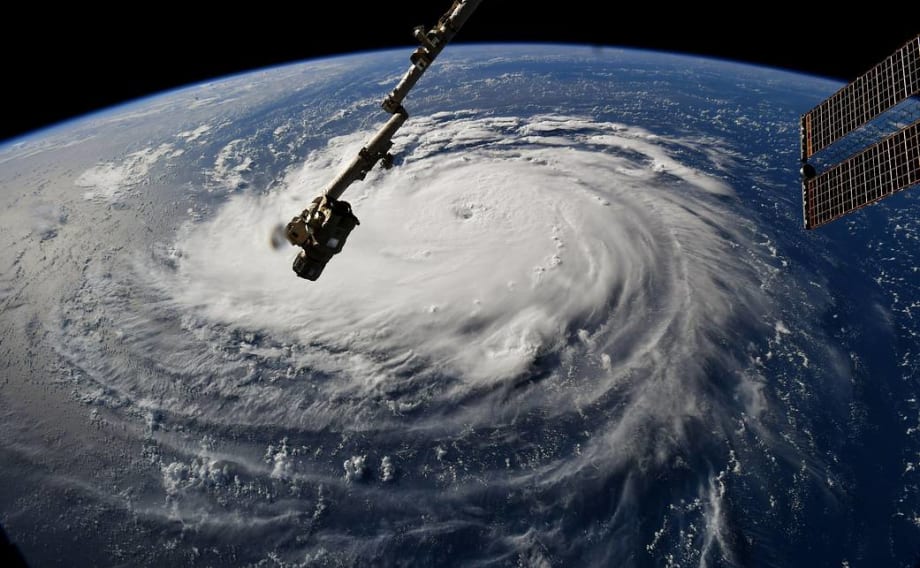
The FMCSA has declared an emergency in multiple states along the east coast in anticipation of Hurricane Florence, seen here from the International Space Station.
Photo via NASA
The Federal Motor Carrier Safety Administration has issued a regional emergency declaration response for the East Coast states stretching from Florida to New York state as the region prepares for Hurricane Florence to make landfall.
As the storm approaches the most densely populated region of the U.S. with the power of a Category 4 hurricane, it has the potential to bring devastating wind, rain, and flooding along the coast and inland. The FMCSA’s emergency declaration will temporarily grant an exemption to certain regulations for carriers and drivers that deliver aid and assistance in the affected states and jurisdictions. Parts 390 through 399 of the Title 49 code of federal regulations, which includes hours of service, will be suspended for drivers and fleets participating in relief efforts.
The emergency declaration is in effect for the following states: Delaware, District of Columbia, Florida, Georgia, Maryland, New Jersey, New York, North Carolina, Pennsylvania, South Carolina, Virginia, and West Virginia.
The rules are only suspended while a truck is providing direct assistance. This terminates when transport cargo or provide services not directly supporting the emergency relief effort or when a carrier dispatches a driver or commercial motor vehicle to another location to begin operations in commerce. Upon termination of direct assistance to the emergency relief effort, the carrier and driver are once again subjected to the normal regulations. However, a driver may return empty to a terminal or the driver's normal work reporting location without complying with Parts 390 through 399. Upon return a truck driver must be relieved of duty and receive a minimum of 10 hours off duty.
The storm is projected to make landfall in the Carolinas on Sept. 13, and could potentially sit there, dumping rain in the region for several days, potentially in the range of 20-30 inches. Hurricanes in the region usually travel up the coast and weaken as they move over land and colder waters, but Florence started at higher latitude than is typical. This makes Florence’s impact potentially unique because storms that originate where Florence has tend to curve northward and may miss land altogether.
More Safety & Compliance

FMCSA Pauses Biennial-Update Enforcement Amid Motus Transition
Carriers whose updates were due on or after June 1 have more time, while FMCSA works to stabilize its new registration system and warns of phishing sites impersonating its new carrier registration system, Motus.
Read More →
ZF Expands Commercial Vehicle Push in North America
ZF is expanding its North American commercial-vehicle presence with new transmission applications, electrification, trailer technology and autonomous-driving systems.
Read More →
Truck Drivers Need More Than Another Alert
Fleets have more visibility into truck health, safety events, and driver activity than ever. The next challenge is turning all that information into useful guidance for the person who has to decide what to do next.
Read More →
Tesla Wants a Self-Driving Semi. Are Cameras Enough?
Could Tesla’s camera-only autonomous driving technology work on an 80,000-pound Semi? In this commentary, HDT's Deborah Lockridge takes a look at Tesla, Cybercab, and how autonomous trucks see the road.
Read More →
What DOT’s Automated Vehicle Strategy Means for Trucking
The U.S. Department of Transportation issued a new automated-vehicle strategy that outlines plans for driverless-truck regulations, cross-state freight corridors, and federal safety standards.
Read More →
NYC Expands Speed, Pedestrian Safety Tech Across Fleet
New York City is expanding intelligent speed assistance and pedestrian-alert systems across its municipal fleet, moving the technologies from pilot programs into vehicle procurement and retrofit requirements.
Read More →
FMCSA Removes 110 Truck Driver Training Schools from Certified ELDT List
Federal regulators also are targeting more than 160 additional training providers and launching a nationwide audit of third-party CDL skills testers as part of a broader crackdown on trucking fraud.
Read More →
Beyond DOT Compliance: What Makes a Trucking Fleet Truly Safe?
A trucking fleet can follow every rule and still make unsafe decisions. The real test comes when safety conflicts with freight, productivity, or cost.
Read More →
Hours of Service Pilot Programs: FMCSA Readies for 2027 Rollout
Two pilot programs could eventually reshape hours-of-service rules, giving truck drivers options to pause their 14-hour clock or use longer split sleeper rest periods.
Read More →
New Guide Offers Pet Safety Tips for Truck Drivers
Hundreds of thousands of pets travel in truck cabs. A new safety guide from Volvo Trucks and the Center for Pet Safety offers practical advice for truck drivers who bring dogs and cats along for the ride.
Read More →