





Related: President Obama Inks Highway Patch
House Ways & Means Gets Earfuls on Fixing Highway Funding Mess
In testimony Wednesday, transportation stakeholders pressed the House Committee on Ways & Means to quickly and finally figure out how to fix the nation’s broken highway-funding system.
June 18, 2015
5 min to read
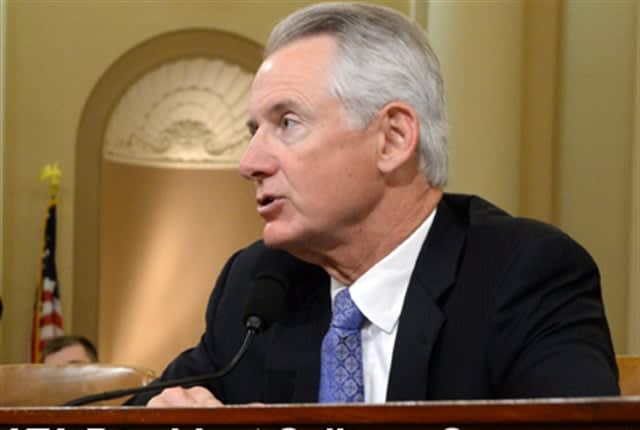
ATA chief Gov. Bill Graves testifying on June 17 before the House Ways & Means CommitteePhoto: ATA
Perhaps hoping against hope that this time at bat their arguments would hit home, in testimony Wednesday transportation stakeholders pressed the House Committee on Ways & Means to quickly and finally figure out how to fix the nation’s broken highway-funding system.
But the committee's chairman, Rep. Paul Ryan (R-WI), at the outset of the hearing stated his continued opposition to increasing the per-gallon tax on motor fuels, a solution advocated by many interested parties.
American Trucking Associations president and CEO, Bill Graves, painted a picture of the impact of the problem, pointing out that Interstate highway congestion alone cost trucking $9.2 billion in 2013 and wasted more than 141 million hours, which he said was the equivalent of 51,000 drivers sitting idle for a full working year.
Graves sought to make Ways & Means members aware that the scope of the infrastructure debate should extend beyond how it affects trucking as an industry.
“Regrettably,” he said, “a staggering lack of investment in our nation’s highway system has produced a $740 billion backlog in funding required to address deteriorating highways and bridges, and the traffic congestion that routinely chokes passenger and freight travel.
“This is not just an esoteric debate about a line item in a budget,” Graves said. “Congress’ actions have real consequences, and the decisions this Committee makes will determine whether a business succeeds or fails and whether a job is created or eliminated.
"And most importantly, these decisions will determine the safety of the motoring public as well as the safety and efficiency of the millions of professional drivers operating daily on our highway system.”
The ATA chief delved into the long-term nature of the problem, as well.
“It is important for all to understand that the decisions made by this Committee over the next few months will have effects beyond the immediate solvency issues,” he said. “The federal commitment to investment in transportation, if not properly addressed this year, could be placed in jeopardy for many years, or even decades, to come.”
Graves worked out the simple math that adds up to the yawning infrastructure gap.
“Current highway capital investment across all government agencies is approximately $88 billion per year,” he explained, but it’s “estimated that $120 billion to $144 billion annually is required to address all needs. Federal funding, which accounted for 52% of state capital outlay in 2013, is an indispensable revenue source and cannot be easily replaced, especially by states with low populations and large highway networks.”
In his testimony, Graves also explained how “multiple short-term extensions of highway policy, coupled with the Highway Trust Fund’s continued funding uncertainty” have stymied efforts by states to carry out many key infrastructure projects.
“Prior to the 2014 extension of MAP-21, transportation officials in 35 states indicated publicly that their programs would be impacted by a shutdown of federal surface transportation funds, and nine states retracted or delayed projects totaling over $366 million due to uncertainty about future federal investment,” he stated.
“This year, 19 states have so far indicated concerns about the feasibility of future transportation projects, and state DOT officials have suggested that over $1.1 billion in projects is at risk if federal funding is disrupted,” Graves continued. “Seven states have already delayed or canceled projects valued at $1.63 billion. This represents more than 45,000 lost jobs.”
Given the magnitude of the highway funding morass and its seeming intractability, Graves said that the trucking industry was “willing to support an even greater commitment” to the Highway Trust Fund.
However, any new revenue sources rolled out to ensure that HTF funding is both stable and long-term should apply uniformly across all types of highway users; be based on verifiable highway and vehicle use; not be easily evaded; and be “inexpensive and efficient to administer and not impede interstate commerce.”
Graves said mechanisms fitting that bill are increasing and indexing the fuel tax, levying a new highway access fee, royalties from oil and gas leases, and a per-barrel tax on imported petroleum and domestic crude oil production.
On the other hand, the ATA chief said that upping such other user fees as the Heavy Vehicle Use Tax and the federal excise tax on trucks or truck tires “would not raise sufficient revenue, and a vehicle miles-traveled tax or tolling are highly inefficient.”
In his testimony, John Cox, president of the American Association of State Highway and Transportation Officials and director of the Wyoming Department of Transportation, pointed out that the HTF “provided stable, reliable and substantial highway and transit funding” for almost 60 years until 2008, when the downward trend began.
That has resulted in almost $62 billion being transferred from the General Fund to the Highway Trust Fund to keep it solvent over the past seven years, he said.
Also looking beyond how highways benefit any one industry, Cox stated that "there is ample documented evidence that shows infrastructure investment is critical for long-term economic growth, increasing productivity, employment, household income, and exports.
"Conversely,” he continued, “without prioritizing our nation's infrastructure needs, deteriorating conditions can produce a severe drag on the overall economy. Whichever revenue tools are utilized, at a minimum, it is crucial to identify solutions that will sustain the MAP-21 level of surface transportation investment in real terms."
In his opening remarks to the hearing, Rep. Ryan, Ways and Means Committee's chairman, conceded there is a highway-funding problem—and it is a big one.
“The roads, bridges, and highways of this country are in a sorry state and the Highway Trust Fund that pays for them is broke,” he said. “But instead of fixing the problem, we’ve dodged it.
"Five times we’ve come up with temporary solutions and transferred money from the general fund into the trust fund— which, in English, means we’ve patched a pothole and not fixed the problem.
"We’re talking over $63 billion in total. And according to the latest projections, we’re looking at a $168 billion shortfall over the next 10 years.”
He also called for finding “a real, long-term solution,” and noted that “there are lots of ideas out there... There's talk of handing more authority over to the states; making greater use of tolls; creating more public-priavte partnerships. There are a lot of ideas worthy of consideraton."
However, Ryan made it plain that in his view, unlike that of ATA among other groups, a funding idea that is not worth considering is raising the motor fuel tax.
Arguing that “we can’t just chase fuel efficiency with higher taxes,” Ryan said he wanted to “make very clear” that he is “against raising the gas tax. There’s not much happening in this economy to help it grow, but lower gas prices is one of them.”
More Fleet Management

Sponsored•September 16, 2026
Color Match Smarter: Tools That Restore & Perform
For fleet managers and collision repair professionals keeping heavy-duty trucks on the road, getting the color right the first time isn't just about appearance — it's about efficiency, turnaround time, and bottom-line results. Discover how today's digital color tools are transforming the repair process from guesswork to precision.
Read More →
FMCSA Pauses Biennial-Update Enforcement Amid Motus Transition
Carriers whose updates were due on or after June 1 have more time, while FMCSA works to stabilize its new registration system and warns of phishing sites impersonating its new carrier registration system, Motus.
Read More →
Sponsored•September 14, 2026
2026 Blueprint for Countering Smarter Supply Chain Theft
Cargo theft is no longer just the cost of doing business. It's a multi-billion-dollar criminal enterprise exploiting vulnerabilities across your fleet, drivers, and supply chain.
Read More →


Sponsored•September 1, 2026
How Telematics Improves Visibility, Control, and Performance in Refrigerated Fleets
Explore how telematics help refrigerated fleets improve visibility, uptime, efficiency, compliance, and cargo protection across connected cold chain operations.
Read More →
What the U.S.-Canada Trade War Means for Trucking
Escalating U.S.-Canada tariffs could disrupt cross-border freight, reduce truck volumes, raise costs, and create new uncertainty for carriers on both sides of the border.
Read More →
What Are Trucking’s Top Concerns for 2026?
The American Transportation Research Institute wants to know what's worrying trucking fleet managers, drivers, and other stakeholders in its annual Industry Issues survey.
Read More →
American Trucking Associations Looks for a New Leader
ATA President and CEO Chris Spear abruptly left his job at the association on August 21, at a pivotal time for the trucking industry.
Read More →
Public Wi-Fi Cybersecurity Risks: How Truck Drivers and Fleets Can Protect Their Data
Public Wi-Fi can expose truck drivers and fleets to credential theft, malware, and other cyber threats. Here’s how to reduce the risk on the road.
Read More →
For Nicky Cupp, Fleet Innovation Starts With Frustration
HDT Truck Fleet Innovator Nicky Cupp turns everyday pain points at Fraley & Schilling into opportunities for better technology and smarter processes.
Read More →
Adam Buttgenbach’s Approach to Electric Trucks: Start With Where They Fit
HDT Truck Fleet Innovator Adam Buttgenbach helped PepsiCo build one of North America’s largest EV fleets by focusing on where electric trucks make operational sense.
Read More →