




House Highway Bill Clears Committee on Party-Line Vote
The House Transportation and Infrastructure Committee did its job last week, reporting out a bill that would reauthorize the federal transportation program for five years at current funding levels. It was a squeaker, though, and the outlook for Congress finishing the job before the current program expires on March 31 is not rosy
The House Transportation and Infrastructure Committee did its job last week, reporting out a bill that would reauthorize the federal transportation program for five years at current funding levels. It was a squeaker, though, and the outlook for Congress finishing the job before the current program expires on March 31 is not rosy.
The American Energy & Infrastructure Jobs Act cleared by a narrow, party-line vote of 29 to 24 at 3 a.m. after an 18-hour mark-up session. No Democrats voted for the bill, and one Republican, Rep. Thomas Petri of Wisconsin, voted against it.
Transportation has in the past been considered relatively bipartisan terrain but in this bitterly divided Congress that is no longer the case.
"The traditional tenor of bipartisanship has changed in this Congress," said veteran transportation policy analyst Norma Krayem of the Washington, D.C., legal services firm, Patton Boggs.
While the committee passed numerous small, non-controversial amendments by acclamation, much of the session was marked by partisan bickering.
The Democratic minority took issue, for instance, with the way the committee chairman, Rep. John Mica, R-Fla., handled the drafting and presentation of the legislation.
Rep. Nick Rahall, D-W.Va., complained that the first draft of the measure was not available in time for members to read it before they had to vote on it, and made a motion to postpone the mark-up. The committee rejected his motion on party lines. (It should be noted that the minority side, whether Democrat or Republican, always makes such complaints.)
Rep. Peter DeFazio, D-Ore., angrily decried the bill's conservative approach to funding.
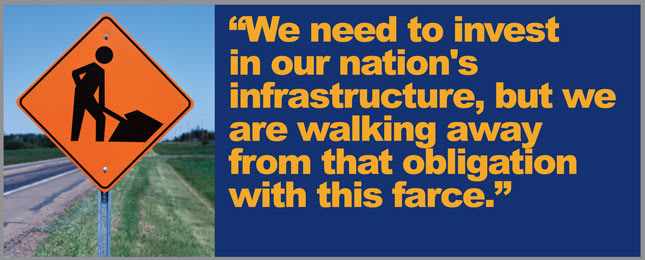
"This committee needs to be about investment," DeFazio said. "We need to invest in our nation's infrastructure, but we are walking away from that obligation with this farce. We are going back to the pre-1980s with respect to transit. This is a very sad day."
Republican Bill Shuster of Pennsylvania defended the committee's approach. "The money isn't there," he said. "This bill attempts to make the system more efficient by speeding up construction process."
The bill would spend $260 billion over five years, approximately the same level being spent now.
In keeping with the consensus on the need for reform at the Department of Transportation, it consolidates programs and makes changes designed to streamline the process of vetting and launching construction projects.
It would boost funding for the Transportation Infrastructure Finance and Innovation program, which leverages federal money by providing loans, loan guarantees and lines of credit to pay for highway projects of national and regional significance.
The committee stripped an important trucking provision from the bill that would have given states authority to increase weight limits on Interstate highways from 80,000 to 97,000 pounds, with the addition of a sixth axle.
But another important truck provision survived, this one on hours of service. The bill could force Federal Motor Carrier Safety Administration to rewrite the 34-hour restart, which limits the restart to once a week with two sleep periods from 1 a.m. to 5 a.m.
If this provision survives the rest of the legislative process, the agency would have to do a field study of the restart. The study would have to be completed by March 31, 2013, three months before the rule is scheduled to go into effect. If the study supports the rule, then the provision would go into effect on schedule.
But if the study does not support the change, the agency would have to go through another rulemaking to modify the rule. The current restart rule would remain in effect during the rulemaking process.
The bill also orders DOT to start researching the need for occupant protection standards for tractors, and orders a review of the pending "wet lines" rule that would require tank carriers to purge gasoline from loading lines.
Click here for a summary of other trucking provisions.
The bill now must be joined with a controversial measure the House has drafted to provide some of the money for the highway program.
Last week the House Natural Resources Committee passed a proposal to open 3% of the Arctic National Wildlife Refuge to new drilling, and to expand oil shale development. Highway funds would be derived at some point in the future from the leases for these initiatives.
This idea faces opposition from the Senate, which is looking elsewhere for funding for its $109 billion, two-year version of the highway bill. Sen. James Inhofe of Oklahoma, the ranking Republican on the Senate Environment and Public Works Committee, was reported expressing reservations about using drilling to pay for highways, and relying on a cash flow that is not yet in place.
The Senate will continue work on its version of the bill this week.
More Drivers

EEOC Sues Texas Trucking Company Over Driver Age Limits
The agency says Trancasa USA rejected applicants over 65 and applied tougher driving-record standards to those over 60.
Read More →
Nussbaum, Roehl Announce Second Driver Pay Increase This Year
This year has seen a swath of major truck driver pay increases as freight capacity has tightened.
Read More →
From One Generation to the Next: How Mentorship Builds Safer Truck Drivers
After three decades in trucking, Harold Perry shares what he's learned about driver safety, mentorship, and helping the next generation build confidence behind the wheel.
Read More →
Truck Drivers Need More Than Another Alert
Fleets have more visibility into truck health, safety events, and driver activity than ever. The next challenge is turning all that information into useful guidance for the person who has to decide what to do next.
Read More →
FMCSA Removes 110 Truck Driver Training Schools from Certified ELDT List
Federal regulators also are targeting more than 160 additional training providers and launching a nationwide audit of third-party CDL skills testers as part of a broader crackdown on trucking fraud.
Read More →
Hours of Service Pilot Programs: FMCSA Readies for 2027 Rollout
Two pilot programs could eventually reshape hours-of-service rules, giving truck drivers options to pause their 14-hour clock or use longer split sleeper rest periods.
Read More →
Medical Cards, English Proficiency Reshape Roadcheck Violations
Medical-card violations jumped to the top of the driver out-of-service list during CVSA’s 2026 International Roadcheck, while English-language proficiency violations appeared among the leading violations for the first time.
Read More →
Driver Trust Can Make or Break the Success of Fleet Safety Technology
New Teletrac Navman research suggests that onboarding, transparency about driver data, and positive feedback can play a significant role in how commercial drivers respond to safety and coaching technology.
Read More →
EEOC Sues KLLM Over Alleged Sex Discrimination in Driver Training
KLLM is facing a federal sex-discrimination lawsuit over policies the EEOC alleges put female truck driver trainees at a disadvantage.
Read More →
FMCSA Moves to Codify English Language Requirements for Commercial Drivers
By changing regulations on English-language proficiency requirements for commercial drivers, rather than relying on a guidance memo, the FMCSA said future administrations won't be able to walk back the Trump administration's stricter enforcement with just a memo.
Read More →