





Related: Hino Focuses on Growth
Hino Touts $100 Million Manufacturing Facility
Hino Motors opened its new 1 million-square-foot manufacturing facility in Mineral Wells, West Virginia, to serve as the truck maker's manufacturing foundation in the U.S.
August 23, 2019
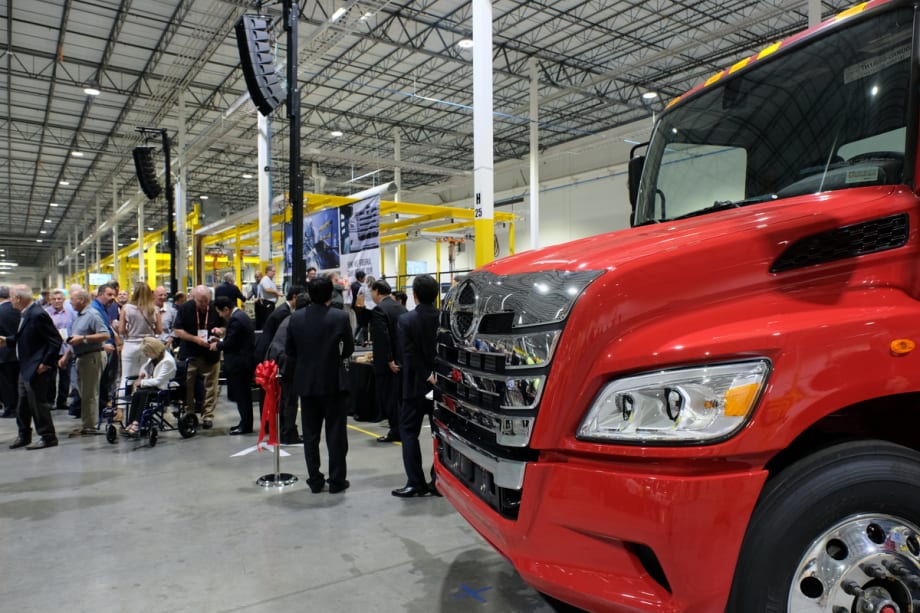
The Mineral Wells plant is currently producing 66 trucks per day on one shift. Hino says when the plant reaches full capacity, it will be capable of producing 30,000 trucks per year on two shifts.
Photos: Jim Park
3 min to read
Hino Motors has officially opened its new 1-million-square-foot manufacturing facility in Mineral Wells, West Virginia. The ceremony took place Wednesday, Aug. 22, capping a two-year effort that saw a former retail distribution center turned into a state-of-the-art truck production facility.
The first truck rolled off the new assembly line in June. Current production stands at 66 trucks per day on one shift. Hino expects production rates to grow to 15,000 units on one shift by 2020.
“Hino is committed to building its trucks and products in the market it operates in," said Hino Motors Ltd. President and CEO, Yoshio Shimo. "We have committed $100 million in capital investment into our new state-of-the-art manufacturing facility, generating 250 new jobs. Today, I am excited to announce an additional commitment of $40M to meet increased demand and product configurations, creating an additional 250 new jobs, totaling 800 team members."
The current workforce stands at 470 team members with plans to expand that to 550 by next year.
The facility will build all of Hino's Class 6, 7, and 8 conventional trucks, including the newly released class 7 and 8 XL Series.
Hino Motors began producing trucks on American soil in 2004 at parent company, Toyota's manufacturing facility in Long Beach, California. That facility closed in 2007 and production transferred to Williamstown, WV. Hino produced over 50,000 trucks at that facility. Today the Williamstown plant is vacant but remains a Hino property. All production has since shifted to Mineral Wells. No plans for the Williamstown facility were discussed during Wednesday's ceremony.
Hino Motors Manufacturing U.S.A. president, Takashi Ono, offered thanks to the town of Williamstown for being Hino's home for the past ten years, noting that all the Williamstown employees were transferred to Mineral Wells.
"This plant will serve as the manufacturing foundation and define the excellence of Hino Trucks in the United States," he said. "I'm proud, knowing that from New York to Dallas to Los Angeles, the DNA of Hino Trucks will shine with the passion, dedication and craftmanship of West Virginians."
"But I believe the greatest accomplishment for us may not be this new plant or the new trucks produced here, but that we managed to keep all of our team members. We could not have asked for a better outcome. You are our greatest asset. It is what you do every day that truly defines Hino."

Hino executives and invited dignitaries take part in a tradition Japanese tree planting ceremony
The event was attended by Gov. James Justice, state senators, U.S. Sens. Joe Manchin and Shelley Moore Capito, U.S. Rep. David McKinley, as well as several county and local officials.
“Hino has been a tremendous partner to the State of West Virginia since 2007,” said Justice. “With 800 West Virginians planned to be employed by Hino, they continue to be one of West Virginia’s biggest employers. We thank Hino for their continued investment in the great state of West Virginia.”
Prior to the official grand opening celebration, Hino executives and visiting dignitaries took part in the traditional Japanese tree planting ceremony, and later shared the Kagami-Wari ceremony to consummate Hino’s growth commitment to the U.S.
In addition to producing Hino’s current line up of conventional trucks, the Mineral Wells assembly plant will produce a new line of Class 7 and 8 trucks, the XL series, powered by Hino’s A09, 9-liter engine.
More Equipment

How Volvo Updated Its D13 for EPA 2027 [Watch]
Volvo’s updated D13 promises lower emissions without sacrificing performance or fuel economy. Take a closer look at what changed inside the engine in this HDT Spotlight video.
Read More →
Michelin Tire Improves Efficiency and Durability for Regional Fleets
The Michelin X Multi Energy D2 is a regional haul drive tire engineered to help fleets improve fuel efficiency, durability and traction in demanding stop-and-go operations.
Read More →
ZF Expands Commercial Vehicle Push in North America
ZF is expanding its North American commercial-vehicle presence with new transmission applications, electrification, trailer technology and autonomous-driving systems.
Read More →
Tesla Wants a Self-Driving Semi. Are Cameras Enough?
Could Tesla’s camera-only autonomous driving technology work on an 80,000-pound Semi? In this commentary, HDT's Deborah Lockridge takes a look at Tesla, Cybercab, and how autonomous trucks see the road.
Read More →
Kodiak: Driverless Long-Haul Truck Launch on Track for 2026
Kodiak AI says its driverless long-haul safety case is 93% complete and it remains on track to begin commercial operations by year-end 2026.
Read More →
What DOT’s Automated Vehicle Strategy Means for Trucking
The U.S. Department of Transportation issued a new automated-vehicle strategy that outlines plans for driverless-truck regulations, cross-state freight corridors, and federal safety standards.
Read More →
East Coast Port Launches $45M Electric Truck Push
The Port Authority of New York and New Jersey announced millions in incentives for zero-emission drayage trucks, yard tractors, and new charging hubs near the port.
Read More →
PlusAI Going Public to Fund Autonomous Truck Launch
A SPAC deal could provide PlusAI with up to $300 million as it works toward a 2027 commercial launch of factory-built autonomous trucks.
Read More →
NHTSA Moves to Rewrite Truck Fuel-Economy Rules
The National Highway Traffic Safety Administration says it lacks authority to regulate medium- and heavy-duty truck engines separately from complete vehicles, but the existing standards have not yet been eliminated.
Read More →
Detroit Opens Orders for EPA 2027 Engines
Detroit isn’t starting from scratch to meet EPA 2027 diesel emissions standards. Its Gen 6 DD13 and DD15 engines keep much of today’s platform while updating the fuel and aftertreatment systems.
Read More →