




Highway Bill Conferees Face Daunting Schedule
House and Senate conferees last week began work on the highway bill under considerable pressure of time and necessity. Counting today, the conferees have 19 working days left before the current extension expires June 30. Their staffs, who do much of the detail work in the conference process, probably will be working close to 24-7
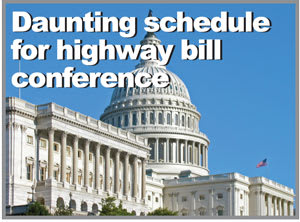
House and Senate conferees last week began work on the highway bill under considerable pressure of time and necessity.
Counting today, the conferees have 19 working days left before the current extension expires June 30. Their staffs, who do much of the detail work in the conference process, probably will be working close to 24-7.
A bet that they could finish negotiations by then would not be wise, according to many close watchers.
Transportation Secretary Ray LaHood has predicted that there will not be a bill, and American Trucking Associations President and CEO Bill Graves is nearly as pessimistic.
But Hill insiders say that if the conferees can find a way to compromise on tough issues such as funding and the Keystone XL Pipeline, there's a chance they can follow through with a bill sometime this year that at least begins the process of reforming the federal highway program.
"I think they are going to work as hard as they can between now and the deadline to get a bill done," said veteran transportation policy analyst Norma Krayem of the Washington, D.C., legal services firm, Patton Boggs. "If they can't get through (the issues) it won't be from lack of trying."
The conference process has many moving parts. Under traditional practice, conferees negotiate the details of the legislation that brought them together -- in this case the Senate's two-year, $109 billion bill, and the House's 90-day extension of the current program.
Trouble is, the House's extension does not contain the highway bill that was reported out by the Transportation and Infrastructure Committee. The full House was not able to pass that measure, which includes reforms that transportation experts say are needed to modernize the federal program -- many of which are similar to provisions in the Senate bill.
The Senate believes its bill should be the basis for the final bill, but is willing to incorporate House priorities in order to win House approval, said a senior Senate aide who could not speak on the record.
It will be difficult to get there, though, unless there is an agreement on a controversial provision of the House extension that would force the Obama administration to change its regulatory approach to the northern portion of the Keystone XL Pipeline.
That segment of the line, which would move oil from Canadian tar sands in Alberta to Steele City, Neb., is a political lightning rod pitting Republicans against Democrats over jobs, fuel prices, environmental concerns and the presidential election. It is not a purely partisan issue, however, since both labor interests and some Democratic legislators support the line.
The project, which must be approved by the State Department because the line crosses the U.S.-Canada border, has been stalled over concerns about the initial proposed route. It would have traversed Nebraska's environmentally sensitive Sandhills region.
Nebraska is in the process of approving a revised route that takes the line to the east of that region. TransCanada, the pipeline company, already has proposed this change to the State Department. The State Department has said it is open to the revision, and TransCanada says it anticipates approval in the first quarter of next year.
Whether or not that happens remains to be seen. A senior Republican aide in the House, who could not speak on the record, gave 50-50 odds on approval due to opposition from environmental interests who believe that the oil would diminish demand for electric cars.
Meanwhile, the House transportation extension bill has a provision that would take review authority away from the State Department and give it to the Federal Energy Regulatory Commission.
Whether or not there can be compromise on this point is anyone's guess at this point, but that's what it will take to clear the way for the highway bill.
"It's probably true that until Keystone gets resolved, the rest can't get resolved," said Mary Phillips, senior vice president for legislative affairs at ATA.
Compromise is a rare commodity on Capitol Hill these days, but it does happen.
Sen. Barbara Boxer, D-Calif., describes the House's pipeline provision is a "poison pill," but she also said, "We need to meet in the middle." Boxer chairs the Senate Environment and Public Works Committee, is one of the co-authors of the Senate bill and is one of the key negotiators on the bill.
She and her Republican counterpart, Sen. James Inhofe of Oklahoma, can claim a recent success based on compromise. The two are polar opposites on practically any political issue -- like Mars and Venus, as Boxer put it -- but they agree on infrastructure and fashioned a highway bill that passed the Senate with a strong bipartisan, 74 - 22 vote.
"If Inhofe and Boxer can agree, these conferees can agree," Boxer said in remarks last week at a meeting of the Coalition for America's Gateways and Trade Corridors.
Trucking interests favor completion of the pipeline but are focused on the main prize -- the highway bill. It is important for the industry that the conference negotiations include truck-related provisions that are in both the Senate-passed bill and the House T&I Committee's bill.
While portions of the bills overlap (both contain a drug and alcohol clearinghouse, for example), each contains provisions that don't show up in the other.
The Senate bill would mandate electronic onboard recorders, which ATA supports and the Owner-Operator Independent Drivers Association does not. The House bill lacks that provision. The House bill, on the other hand, would mandate a study of the 34-hour restart provision of the new hours of service rule, while the Senate bill does not.
The Senate bill also contains provisions that would help states focus resources on freight corridors, a first for the highway program.
Other major provisions of both bills are aimed at reforming the federal program by eliminating earmarks, speeding up the construction process and consolidating programs at the Department of Transportation.
If the conferees cannot finish work by the end of June, Congress will have to pass another extension, the tenth since the highway program officially expired in October 2009. That extension could be relatively short, if the conferees are close to agreement, or it could push the deadline out to the lame duck session following the election in November.
Related Stories:
4/27/2012 -- Highway Bill Conferees Face Tough Funding Issues but Share Some Common Ground on Policy
5/8/2012 Industry and Safety Groups Press for Recorder Mandate
4/25/2012 Transport Experts Say Public Must Push Congress to Act on Highways
More Drivers
When Language Stops the Truck: The Return of ELP Out-of-Service Orders
English language proficiency rules for commercial drivers aren’t new, but renewed out-of-service enforcement has raised the stakes. Here’s what carriers need to know before a driver reaches a roadside inspection.
Read More →
Samsara Launches Custom AI Agent Builder
Agent Studio lets fleets create AI tools for hours-of-service monitoring, reporting and driver support, including agents that communicate by phone.
Read More →
Trucker Path Expands Reserved Parking Network
Trucker Path has added close to 6,000 more truck parking spaces to its Trucker Path Reserved Parking Network with the addition of Safe Truck Parking.
Read More →
EEOC Sues Texas Trucking Company Over Driver Age Limits
The agency says Trancasa USA rejected applicants over 65 and applied tougher driving-record standards to those over 60.
Read More →
Nussbaum, Roehl Announce Second Driver Pay Increase This Year
This year has seen a swath of major truck driver pay increases as freight capacity has tightened.
Read More →
From One Generation to the Next: How Mentorship Builds Safer Truck Drivers
After three decades in trucking, Harold Perry shares what he's learned about driver safety, mentorship, and helping the next generation build confidence behind the wheel.
Read More →
Truck Drivers Need More Than Another Alert
Fleets have more visibility into truck health, safety events, and driver activity than ever. The next challenge is turning all that information into useful guidance for the person who has to decide what to do next.
Read More →
FMCSA Removes 110 Truck Driver Training Schools from Certified ELDT List
Federal regulators also are targeting more than 160 additional training providers and launching a nationwide audit of third-party CDL skills testers as part of a broader crackdown on trucking fraud.
Read More →
Hours of Service Pilot Programs: FMCSA Readies for 2027 Rollout
Two pilot programs could eventually reshape hours-of-service rules, giving truck drivers options to pause their 14-hour clock or use longer split sleeper rest periods.
Read More →
Medical Cards, English Proficiency Reshape Roadcheck Violations
Medical-card violations jumped to the top of the driver out-of-service list during CVSA’s 2026 International Roadcheck, while English-language proficiency violations appeared among the leading violations for the first time.
Read More →